Please note that if you are under 18, you won't be able to access this site.
Are you 18 years old or above?
Create
Upload
Import
Shorts
My Account
Mode
Login
Register
Your browser does not support HTML5 video.
jurisprudence
dogmas
Ethics
Poems and notice
supplications & soliloquy
The Holy Quran
Lectures
Movies and series
history
News & Politics
People & Blogs
Other
Up next
Autoplay
00:31
The etiquette of worship and dua by Imam Ali (a).
Navaye Behesht & Scholar Syeda Gul e Zehra
6 Views
·
24/04/20
Poems and notice
01:24:00
Shahadat Imam Hassan (as) | Imam Hasan (as) - Morals and Virtues | Sayed Ali Khalkhali | Safar 2023
Wessex Jamaat
1 Views
·
23/08/25
Lectures
01:24:24
Shahadat of Imam Hassan al-Askari (as) | The Miracle of Tai’y Al Ardh | Sayed Muhammad Rizvi
Wessex Jamaat
2 Views
·
23/09/25
Lectures
43:40
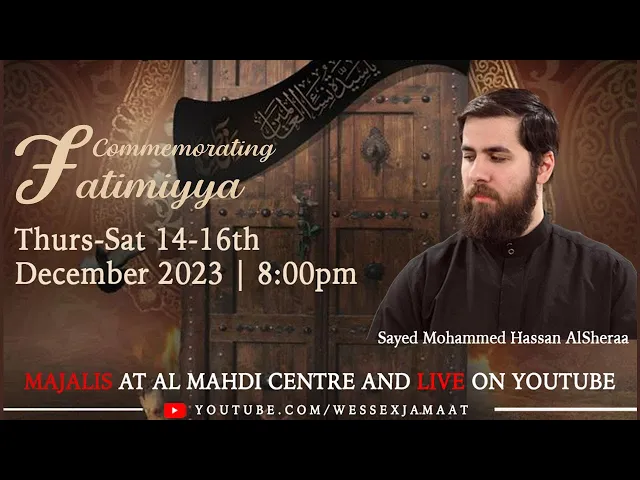
Fatimiyya Night 1 | Sayed Mohammed Hassan AlSheraa: Lady Fatima Of Portugal?
Wessex Jamaat
1 Views
·
23/12/15
Lectures
01:24:11
Fatimiyya Night 2 | Sayed Mohammed Hassan AlSheraa: The Forgotten Sisters of Sayeda Zahraa (as)
Wessex Jamaat
3 Views
·
23/12/16
Lectures
01:37:11
Fatimiyya | Sayed Mohammed Hassan AlSheraa: Lady Fatima's Unwavering Strength
Wessex Jamaat
2 Views
·
23/12/17
Lectures
01:10:04
Yaadgaare Zainab - Night 1 | Sayed Muhammad Rizvi
Wessex Jamaat
4 Views
·
24/08/24
Lectures
01:44:25
Yaadgaare Zainab - Night 2 | Sayed Muhammad Rizvi
Wessex Jamaat
4 Views
·
24/08/25
Lectures
02:31:40
Night 10 | Worship and the Thirst of Emotion | Shaykh Nuru Mohammed
Wessex Jamaat
3 Views
·
25/07/05
Lectures
01:37:26
Remembering the Legacy of Lady Fatimah (as) | Sayed Muhammad Baqir Qazwini
Wessex Jamaat
1 Views
·
25/11/04
Lectures
01:47:11
Why Do We Even Mourn? Part 1| Sayed Ali Moussawi | English Program | Night 1
The Ashura Project
3 Views
·
24/07/07
Lectures
01:34:53
Why Do We Even Mourn? Part 2| Sayed Ali Moussawi | English Program | Night 2
The Ashura Project
5 Views
·
24/07/08
Lectures
01:41:15
Shaitan: A Look At Our Greatest Enemy | Sayed Ali Moussawi | English Program | Night 3
The Ashura Project
1 Views
·
24/07/09
Lectures
01:09:45
Does Belief In Evolution Equal Atheism? | Sayed Ali Moussawi | English Program | Night 4
The Ashura Project
1 Views
·
24/07/10
Lectures
30:09
Why Do We Even Mourn? Part 1| Sayed Ali Moussawi | English Program | Night 1
The Ashura Project
3 Views
·
24/07/11
Lectures
36:01
Why Do We Even Mourn? Part 2| Sayed Ali Moussawi | English Program | Night 2
The Ashura Project
1 Views
·
24/07/11
Lectures
38:01
Shaitan: A Look At Our Greatest Enemy | Sayed Ali Moussawi | English Program | Night 3
The Ashura Project
4 Views
·
24/07/11
Lectures
32:01
Does Belief In Evolution Equal Atheism? | Sayed Ali Moussawi | English Program | Night 4
The Ashura Project
3 Views
·
24/07/15
Lectures
01:05:58
Is Remembrance of Ali (a) Worship? Sheikh Mohammed Al-Hilli | Ramadhan 2026
Sheikh Mohammed Al-Hilli
7 Views
·
26/03/11
Lectures
55:09
Prophet Saleh (a) | Surah Al-Qamar Ayeh 23-32 | Sheikh Mohammed Al-Hilli
Sheikh Mohammed Al-Hilli
2 Views
·
26/03/15
Lectures
Load more
How Different Creations Worship - Sayed Saleh Qazwini
0
0
0
Views
·
25/05/16
Share
Embed
MECCA Media
Subscribers
Subscribe
0
In
Lectures
Show more
Show Transcript
Transcript
[0:00]
Let me know when you're ready.
[0:05]
Alhamdulillah.
[0:33]
One of the core themes in the Quran and in the religion
[0:40]
of Islam is monotheism and the discussion on the oneness of Allah
[0:50]
subhanahu wa ta'ala.
[0:51]
But when you ask Muslims what is a lot of people they'll
[0:57]
come and they'll sayed is Allah is one that's what means however
[1:02]
scholars of calam scholars of theology when they discussed they talk about
[1:11]
can be divided into four different categories.
[1:15]
There are four different categories of one is called this means that
[1:31]
God's essence is one.
[1:31]
What does that mean?
[1:33]
That means that Allah subhanahu wa ta'ala cannot be divided into different
[1:39]
parts.
[1:40]
That means Allah subhana wa ta'ala is absolutely indivisible.
[1:45]
Right now for example, if you talk about yourself as a person,
[1:50]
can I be divided into parts?
[1:52]
Yes.
[1:54]
I'm made up of billions of cells, billions of parts.
[2:00]
I have my lungs and my kidney and my heart and my
[2:06]
head and my hands and my feet and all of these.
[2:07]
These are different parts.
[2:10]
When you say Allah subhanahu wa ta'ala, can you divide God into
[2:14]
parts or are there two different um segments or multiple segments of
[2:19]
Allah subhana wa tala?
[2:22]
No.
[2:22]
This is what we refer to as and this is where we
[2:29]
are at odds with for example the idea of the trinity when
[2:32]
it comes to Christianity.
[2:36]
Why?
[2:37]
Because they come and they say the father, the son and the
[2:39]
holy spirit they make up god.
[2:41]
What does that mean?
[2:43]
That means that god is divided into parts.
[2:46]
And the moment you divide god into parts then that means god
[2:50]
is not one anymore.
[2:53]
And is one first segment of ished there's no parts there's no
[3:00]
limbs.
[2:58]
There's no organs.
[3:02]
There's no partner no son no wife.
[3:05]
None of that.
[3:04]
That ised meaning the oneness of Allah subhanana wa ta'ala.
[3:09]
Now you go a level further in and the study of and
[3:17]
they say another type of is referred to as and this is
[3:24]
the divine attributes of God.
[3:25]
They are the essence of Allah subhana wa ta'ala.
[3:32]
So for example you say Allah is the God is the all
[3:39]
powerful powerful is the essence of Allah subhana wa tala it's inseparable
[3:49]
from God for example I was young then I grew older I
[3:52]
went to the gym and I became strong so then they come
[3:57]
and they say this person is this person is strong because I
[4:04]
gain gained that attribute after a while.
[4:05]
Allah subhanahu wa ta'ala does not gain any attributes or none of
[4:10]
the attributes are separate from Allah subhana wa ta'ala.
[4:12]
Allah God is the all knowledgeable.
[4:16]
For me when you are born you don't know anything and then
[4:21]
you grow you learn in knowledge you gain the knowledge.
[4:23]
Knowledge is not your essence.
[4:24]
But Allah subhana wa ta'ala knowledge is the essence of Allah subhana
[4:29]
wa tala.
[4:30]
That means God's knowledge does not become more.
[4:33]
God knows what happened yesterday.
[4:35]
He knows what happens today and he knows what happens in a
[4:38]
million years.
[4:38]
It the knowledge does not increase.
[4:41]
If the knowledge increases then that means God is going to gain
[4:45]
something and Allah subhanahu wa ta'ala knowledge is his essence power is
[4:52]
his essence is his essence these areat of Allah subhana wa t'ala
[4:57]
they are inseparable from the essence of God so this is one
[5:00]
type of so now we spoke about two types of parts and
[5:07]
organs the attributes utes they are one with Allah subhana t they're
[5:13]
not gained over time like my my attributes are gained over time
[5:17]
I gain knowledge I gain power the these are gained over time
[5:21]
another is referred to as the third category of is referred to
[5:30]
as the unity of the divine actions.
[5:37]
So what does this mean?
[5:40]
This means that Allah subhana wa ta'ala divine actions like the creator,
[5:46]
the builder, the sustainer, the provider, these are attributes of Allah subhanana
[5:53]
wa ta'ala that are the essence of God.
[5:57]
They are inseparable from God.
[5:58]
So this is also one of the ways to look at Allah
[6:02]
subhana wa ta'ala.
[6:04]
Power is not independent of God.
[6:06]
Power is the essence of Allah subhanana wa ta'ala.
[6:09]
God being the creator, that is the essence of God.
[6:10]
That's not something that Allah subhanana wa ta'ala acquires.
[6:15]
Like you and I, we acquire these different things.
[6:18]
And then the fourth which I want to focus on is what
[6:23]
scholars refer to as and that is the the unity and worship.
[6:31]
What does that mean?
[6:36]
That means that worship is exclusive to who?
[6:39]
To Allah subhana wa t'ala.
[6:43]
Can anyone else be woripped other than Allah subhanaa tala?
[6:46]
Now maybe people do worship but in reality the real worship goes
[6:51]
back only to Allah subhanahu wa ta'ala.
[6:55]
So acts of prayer such as prostration and sacrifice and supplication are
[7:01]
solely to Allah subhanahu wa ta'ala and not to anyone else.
[7:04]
Allah does not have any partners right now.
[7:07]
For example, you go to the Hindu faith.
[7:10]
They'll come and they'll tell you today I want to worship the
[7:16]
god of this you know Vishnu and today I want to worship
[7:17]
Ram and today I want to worship these different gods that they
[7:21]
have.
[7:21]
Can I worship one god one day and another god another day?
[7:28]
No.
[7:29]
There's only one Allah that is one and one lord that is
[7:32]
worthy of being worshiped and that is Allah subhanahu wa ta'ala.
[7:37]
And Allah says in the Quran everything in the in the heavens
[7:47]
and the earth will come on the day of judgment to Allah
[7:52]
subhanahu wa ta'ala as a now in this life some people they
[7:56]
choose not to live the life of they say no I have
[8:00]
power I have money I have wealth I'm not going to humble
[8:04]
myself to anyone but on the day of judgement ment every single
[8:08]
creation of Allah subhanahu wa ta'ala comes to God as a of
[8:17]
Allah subhanahu wa ta'ala and in Allah says verily the jin and
[8:25]
the humans have been created only to worship Allah subhanahu wa ta'ala
[8:31]
so now one question that some people have is Okay, we understand
[8:36]
people worship God, but do the birds for example, do the trees,
[8:43]
do the stars and the sun and the animals and the creation,
[8:46]
do they also worship Allah subhanana wa ta'ala?
[8:50]
The answer is yes.
[8:52]
Everything worships God.
[8:54]
Everything obeys Allah subhanahu wa ta'ala.
[8:58]
And Allah says the seven heavens they glorify Allah subhanahu wa ta'ala
[9:10]
and the earth and everything that is in the [Music] earth and
[9:26]
everything.
[9:25]
Every single cell, every single atom, every single being glorifies Allah subhanahu
[9:35]
wa ta'ala.
[9:37]
However, you do not you do not comprehend and you do not
[9:45]
realize and see their in a from he says he says everything
[9:58]
in the universe has a everything glorifies Allah subhanahu wa ta'ala.
[10:11]
But not every glorification is like the glorification of the other.
[10:20]
Meaning every single being glorifies Allah subhana wa ta'ala.
[10:26]
Every single creation worships Allah subhanahu wa ta'ala.
[10:28]
And this is in.
[10:31]
So sometimes when we delay our prayers, when we decide on not
[10:40]
fasting, when we decide on not doing that which is waj or
[10:43]
we decide on delaying it, we are actually standing out from all
[10:52]
other creation.
[10:52]
Let me think about that.
[10:55]
The next time I delay my prayer, that means that all the
[10:59]
creation, the sun and the stars, the billions of stars and the
[11:05]
moon and the cells and plants and the and everything and the
[11:09]
droplets of rain, everything is obedient to God except me.
[11:15]
Isn't that something that should give me some shame when I am
[11:19]
not quick to obey Allah subhanahu wa ta'ala?
[11:23]
This is something that we have to think about that when we
[11:25]
disobey Allah subhanahu wa ta'ala we are actually standing out from all
[11:31]
of the other creation.
[11:33]
All of the other creation they worship Allah subhanahu wa ta'ala and
[11:37]
they obey God and they follow God's direct commands and orders except
[11:46]
the human being sometimes has the audacity to disobey Allah subhanahu wa
[11:53]
ta'ala.
[11:50]
Now one question we said that all creation they worship.
[11:57]
So how does the other creation worship?
[12:01]
For example, how do the birds worship?
[12:04]
How do the animals and the planets and the sun and the
[12:08]
trees and all of that how do they worship Allah subhanahu wa
[12:14]
ta'ala?
[12:15]
One is that they do they glorify Allah subhanahu wa ta'ala.
[12:20]
They say subhan Allah, alhamdulillah, Allahbar, but they say it in a
[12:27]
way that we don't comprehend.
[12:28]
Now, someone might come and say, "This is something strange.
[12:35]
These are objects.
[12:34]
This is not a living being.
[12:36]
I don't know if any of you have seen the study, and
[12:40]
the study, I've seen it being spread around a lot of times.
[12:45]
people, they come and they take water, water, a cup of water,
[12:52]
and they're watching the water with a with a microscope and they
[12:57]
start saying good words.
[12:58]
They start saying positive words and the molecules within the water, they
[13:04]
move around in a way that looks like they're happy.
[13:08]
And then they come and they say some bad words.
[13:13]
This is you could probably look this up.
[13:16]
This the study that was done.
[13:18]
Yeah.
[13:18]
They they come and they they say something negative and they see
[13:22]
that these molecules they move around in a negative way.
[13:24]
What does that mean?
[13:27]
That means that everything comprehends in one way or another.
[13:29]
We don't see.
[13:31]
A lot of us we think that just because I didn't see
[13:33]
then that means it didn't exist.
[13:37]
We everything revolves around the human being when the human being is
[13:43]
a minute drop within this whole cosmic system and this whole creation.
[13:47]
So Allah subhana wa ta'ala says in the Quran, don't you see
[13:59]
that everything glorifi is God in the heavens and in the earth
[14:02]
and the birds, the birds?
[14:10]
Every being knows their own salah.
[14:13]
Every being knows their own form of worship.
[14:25]
That means everything in this creation worships Allah subhanahu wa ta'ala.
[14:31]
The mountains, do the mountains pray?
[14:34]
Yes, the mountains pray.
[14:37]
Allah says it in the Quran.
[14:43]
Allah says that when Doud used to recite the beautiful supplications and
[14:50]
as he recites the supplications the mountains would sing and they would
[14:57]
pray with Doudam and the birds they pray and there are narrations
[15:01]
for example there's a narration uh about the rooster it says that
[15:08]
the rooster when it wakes up in the morning and it is
[15:10]
cocooning they call it and it is cocooning uh that is actually
[15:18]
the that is glorification.
[15:19]
So don't when you hear the rooster now of course we live
[15:24]
in communities where we don't even hear roosters anymore unless you live
[15:27]
in a farm but when you hear the rooster and it woke
[15:29]
you up don't be too angry because he was doing his job
[15:34]
by praying and I was sleeping so I need to get up
[15:35]
and I need to pray.
[15:38]
So this is um one of the ways that the the the
[15:44]
creation of Allah subhanana wa ta'ala they all worship the the angels
[15:49]
the ones the best of God's worshippers are the angels they worship
[15:53]
Allah subhanana wa ta'ala 247 and Allah describes in safah which what
[16:03]
does safat means the angels lined up in a saf worshiping Allah
[16:08]
subhanahu wa ta'ala.
[16:09]
And in that there's a verse the angels they say we are
[16:19]
the ones who stand in a line in a single file line
[16:24]
obedient to Allah subhana wa ta'ala and we are the ones that
[16:29]
constantly glorify Allah subhana wa ta'ala.
[16:32]
So if I want to be like the angels, what do I
[16:36]
have to do?
[16:38]
I have to glorify Allah subhana tala.
[16:40]
If I want to be away then I will not be um
[16:46]
praying.
[16:44]
So now one question when people are praying which way we Muslims
[16:52]
where do we pray?
[16:55]
Which direction do we pray?
[16:57]
The thea is coming up and we're going to go and pray
[16:59]
for you all at the inshallah.
[17:02]
Where do the angels pray?
[17:05]
Which direction do the angels pray?
[17:10]
The angels they pray towards and Allah subhanahu wa ta'ala mentions in
[17:20]
the Quran in Allah subhana wa ta'ala mentions.
[17:28]
What does mamm mean?
[17:32]
Yes, it means it's crowded.
[17:36]
It's crowded with angels because the hadith says this is an from
[17:44]
Bakar.
[17:45]
It's a it's a a place of worship.
[17:48]
It is right above thea.
[17:51]
So if you're standing in the Kaa, you're doing around thea, there
[17:59]
are angels above you doing around the the arsh is one one
[18:07]
name that's the hub where where God's commands come out.
[18:12]
But the thing that the the place where the angels do around
[18:19]
that is al and that is directly above thea directly above thea
[18:23]
and that is why thea has its significance the place that it
[18:26]
is it has its significance because directly above it is the um
[18:33]
the so this is where the angels pray.
[18:36]
Now another question is okay the angels the animals and the insects
[18:44]
and the birds and everything when they pray they glorify Allah subhana
[18:49]
tala they do subhan allah alhamdulillah this is a form of prayer
[18:55]
what's another form of prayer what's another form of ibada that the
[18:59]
angels or that that the creation of Allah subhanahu wa ta'ala they
[19:06]
fulfill That is one of the forms of is by fulfilling the
[19:12]
task and the purpose that Allah subhana wa t'ala created them for.
[19:18]
So the son how does the son worship Allah subhana wa ta'ala?
[19:21]
The son worships God by doing and fulfilling that purpose which Allah
[19:26]
subhana wa tala created it for.
[19:30]
So Allah subhana wa ta'ala says in the Quran the sun and
[19:35]
the moon they have their rotating orbit.
[19:37]
They don't get out of their orbit.
[19:38]
If they get out of their orbit that means they're disobeying Allah
[19:41]
subhana wa t'ala.
[19:43]
So that is a type of worship or for example the mountains.
[19:49]
Allah says in the Quran, Allah subhana wa ta'ala places mountains and
[20:00]
rivers and pathways.
[20:03]
Each one fulfills its function for the sake of guidance of the
[20:07]
human being.
[20:09]
The wind has a function and that is to pollinate other to
[20:16]
pollinate other plants.
[20:15]
That is one of the functions of the wind and that is
[20:20]
the way that the wind obeys the commands of Allah subhana wa
[20:27]
t'ala and the water that comes every single drop of rain is
[20:34]
obeying Allah subhana t that's why some places Allah tells the rain
[20:39]
here and other places Allah tells them nope no rain so everything
[20:44]
obeys Allahh wa ta'ala and all of this creation from the sun
[20:53]
to the stars to the moon to the animals to the to
[20:59]
the horses and everything is created at the disposal of the human
[21:05]
being.
[21:06]
Allah created imagine this everything in this creation worships God and everything
[21:12]
in this creation has been created for me for the human being.
[21:18]
Allah says, "But in the end, the insan, what does the insan
[21:21]
do?" Some of them do kufur.
[21:25]
Isn't that a sad reality?
[21:27]
Everything in the creation, from the big to the tiny cells, everything
[21:35]
worships God.
[21:34]
And everything has been created at the disposal of the human being.
[21:42]
where the mules and the cattle and the horses and the donkeys
[21:45]
Allah says and the donkeys and the mules and the horses so
[21:51]
that you ride them and a form of adornment and then Allah
[21:58]
subhana ta says in another verse in the Quran and the cattle
[22:05]
Allah subhana ta created it for you take warmth from it from
[22:10]
the wool and to eat it and you benefit from it.
[22:14]
But then in the end everything that worships God is created at
[22:21]
for the disposal of the human being.
[22:24]
Yet the human being does not fulfill their function.
[22:26]
And what is my function?
[22:30]
We said one of the ways of worship is to fulfill your
[22:32]
function.
[22:33]
What is the function of the human being according to the Quran?
[22:42]
your function meaning Allah subhana wa ta'ala is telling me don't worry
[22:50]
about your risk don't worry about your money don't worry about your
[22:54]
food don't worry about these things I will provide all of these
[22:57]
for you have one job and your job is to be obedient
[23:04]
to Allah subhana wa ta'ala Allah says I don't want money from
[23:20]
you.
[23:18]
I am the one that gives you the but we do not
[23:22]
fulfill our purpose and our function even though all other creation they
[23:26]
do and then in the end we're worried about our income.
[23:31]
We're worried about am I going to have lunch today?
[23:34]
Am I going to have lunch tomorrow?
[23:35]
In five years am I going to eat?
[23:36]
Am I going to have this?
[23:38]
We worry about these silly things and we steer off of our
[23:47]
function and this is how we end up suffering.
[23:50]
So there's several types of worship.
[23:53]
One worship is glorifying Allah subhana wa tala and we have that
[23:57]
five times a day we pray.
[23:58]
That's something that we do.
[23:59]
Another type of worship is when I fulfill my function, my role.
[24:07]
Right now, for example, I'm a father.
[24:10]
If I fulfill my job as a father, that's a form of
[24:13]
ibada.
[24:14]
I'm a husband.
[24:16]
If I fulfill my role as a husband, being the caretaker and
[24:20]
the provider and the sustainer and the one who takes care of
[24:24]
the family and the breadwinner, that's a form of iba for me.
[24:27]
Allah will reward me for that.
[24:28]
I'm a teacher.
[24:30]
If I'm teaching, especially teaching my children, especially teaching them that which
[24:36]
is important, that is a form of a lot of us, we
[24:38]
think and worship is only bowing and prostrating.
[24:41]
No, that's not all that Allah subhana wa t'ala wants from me.
[24:44]
Allah wants me to fulfill my purpose, be an accomplished human being
[24:52]
that fulfills their role.
[24:53]
That is a form of i.
[24:54]
And another very important form of is to be contemplating and thinking
[25:07]
and this is see there are types of what makes the human
[25:10]
being greater than the other creation.
[25:11]
Why is the human being chosen over the animals for example?
[25:16]
Because the human being has the and one of the best forms
[25:22]
of is to use your to use your intellect.
[25:29]
Pondering sitting and pondering for one hour pondering about, you know, not
[25:34]
about Bitcoin and and and these things.
[25:37]
pondering about God and the creation and what my purpose is and
[25:44]
am I really fulfilling my purpose doing that which Allah subhana wa
[25:49]
ta'ala expects of me am I fulfilling my role as a father
[25:53]
as a husband as a mother as a wife am I really
[25:55]
is God pleased with me or is God not pleased with me
[25:59]
do I think about these things if I think about that then
[26:02]
that is a form of Allah will reward you for thinking about
[26:07]
these things.
[26:09]
So we ask Allah subhanahu wa ta'ala to make us from those
[26:14]
who are in who those who are constantly in the state of
[26:19]
worship and worship could be multiple forms.
[26:22]
Sitting with your parents is a form of in a hadith a
[26:28]
man came to and the prophet had called the Muslims to go
[26:37]
out for jihad.
[26:37]
So this young man he came to and he tells the prophet
[26:44]
I left my parents while their eyes were their tears were shedding.
[26:48]
I left them.
[26:50]
I said goodbye to them.
[26:50]
I came to to be with you all s even though jihad
[26:59]
and defending Islam and defending Allah is so important tells him go
[27:04]
back to your parents and make them smile the same way when
[27:07]
you when you left you made them cry because sitting with your
[27:15]
parents and being at their service for one le one night and
[27:19]
one day is better than jihad of one year in the way
[27:25]
of Allah.
[27:23]
So this is something this is the one of the ways that
[27:29]
Allah subhana ta will reward you.
[27:30]
A lot of us we think about we think about ibada meaning
[27:36]
I'm only praying and reading dua.
[27:37]
No that's not only the ibada that Allah wants from you.
[27:39]
Allah wants you to be someone who's functional, someone who's productive, someone
[27:44]
who's thinking, someone who's contemplating, someone who's giving back to their community,
[27:50]
someone who's providing, someone who's fulfilling their purpose and doing their job.
[27:55]
That is the best form of that Allah subhanahu wa ta'ala will
[27:58]
truly appreciate from us.
[27:59]
We ask Allah subhanahu wa ta'ala to make us from those who
[28:06]
are constantly in the state of ibada and you could do that
[28:12]
you could do that right now for example even when I'm eating
[28:15]
I could say my because you know when we talk about worship
[28:21]
the first thing we talk about is intentions what's the first step
[28:25]
of salah intention what's the first step of intention what's the first
[28:28]
step of intention So if I have my intention even when I'm
[28:33]
doing something normal I'm eating I have my that I want to
[28:40]
eat so that I can have the strength to obey Allah subhanahu
[28:46]
wa ta'ala.
[28:44]
Now this food not only am I enjoying a good succulent steak
[28:52]
but then I'm also getting thaw for it.
[28:57]
I'm getting reward for it because my Allah subhana t will reward
[29:02]
you based on your intentions.
[29:03]
My nia was to get closer to Allah subhanana wa ta'ala by
[29:06]
eating.
[29:07]
My nia is to get closer to Allah by going and hanging
[29:11]
out with friends.
[29:12]
I could either say I want to hang out with friends or
[29:14]
I could say I want to go and visit a mumin.
[29:17]
I want to go and spend some quality time with a mmin.
[29:21]
That's my nia.
[29:21]
Allah will give me a reward and this will be so everything
[29:26]
in your life from the moment you wake up till the moment
[29:29]
you sleep and even in your sleep if you have the and
[29:34]
the woo then everything in your life could be a form of
[29:37]
and we would be by doing that we would be greater than
[29:43]
the other creation of Allah subhana wa tala but if we don't
[29:44]
do that then we will be worse than even the animals and
[29:48]
the cattle we ask Allah subhanahu wa ta'ala to make us from
[29:53]
those who are in a constant state of worship.
[29:57]
Alhamdulillah.
[30:04]
Allah.
0 Comments
sort
Sort By
Top Comments
Latest comments
Publish
Up next
Autoplay
00:31
The etiquette of worship and dua by Imam Ali (a).
Navaye Behesht & Scholar Syeda Gul e Zehra
6 Views
·
24/04/20
Poems and notice
01:24:00
Shahadat Imam Hassan (as) | Imam Hasan (as) - Morals and Virtues | Sayed Ali Khalkhali | Safar 2023
Wessex Jamaat
1 Views
·
23/08/25
Lectures
01:24:24
Shahadat of Imam Hassan al-Askari (as) | The Miracle of Tai’y Al Ardh | Sayed Muhammad Rizvi
Wessex Jamaat
2 Views
·
23/09/25
Lectures
43:40
Fatimiyya Night 1 | Sayed Mohammed Hassan AlSheraa: Lady Fatima Of Portugal?
Wessex Jamaat
1 Views
·
23/12/15
Lectures
01:24:11
Fatimiyya Night 2 | Sayed Mohammed Hassan AlSheraa: The Forgotten Sisters of Sayeda Zahraa (as)
Wessex Jamaat
3 Views
·
23/12/16
Lectures
01:37:11
Fatimiyya | Sayed Mohammed Hassan AlSheraa: Lady Fatima's Unwavering Strength
Wessex Jamaat
2 Views
·
23/12/17
Lectures
01:10:04
Yaadgaare Zainab - Night 1 | Sayed Muhammad Rizvi
Wessex Jamaat
4 Views
·
24/08/24
Lectures
01:44:25
Yaadgaare Zainab - Night 2 | Sayed Muhammad Rizvi
Wessex Jamaat
4 Views
·
24/08/25
Lectures
02:31:40
Night 10 | Worship and the Thirst of Emotion | Shaykh Nuru Mohammed
Wessex Jamaat
3 Views
·
25/07/05
Lectures
01:37:26
Remembering the Legacy of Lady Fatimah (as) | Sayed Muhammad Baqir Qazwini
Wessex Jamaat
1 Views
·
25/11/04
Lectures
01:47:11
Why Do We Even Mourn? Part 1| Sayed Ali Moussawi | English Program | Night 1
The Ashura Project
3 Views
·
24/07/07
Lectures
01:34:53
Why Do We Even Mourn? Part 2| Sayed Ali Moussawi | English Program | Night 2
The Ashura Project
5 Views
·
24/07/08
Lectures
01:41:15
Shaitan: A Look At Our Greatest Enemy | Sayed Ali Moussawi | English Program | Night 3
The Ashura Project
1 Views
·
24/07/09
Lectures
01:09:45
Does Belief In Evolution Equal Atheism? | Sayed Ali Moussawi | English Program | Night 4
The Ashura Project
1 Views
·
24/07/10
Lectures
30:09
Why Do We Even Mourn? Part 1| Sayed Ali Moussawi | English Program | Night 1
The Ashura Project
3 Views
·
24/07/11
Lectures
36:01
Why Do We Even Mourn? Part 2| Sayed Ali Moussawi | English Program | Night 2
The Ashura Project
1 Views
·
24/07/11
Lectures
38:01
Shaitan: A Look At Our Greatest Enemy | Sayed Ali Moussawi | English Program | Night 3
The Ashura Project
4 Views
·
24/07/11
Lectures
32:01
Does Belief In Evolution Equal Atheism? | Sayed Ali Moussawi | English Program | Night 4
The Ashura Project
3 Views
·
24/07/15
Lectures
01:05:58
Is Remembrance of Ali (a) Worship? Sheikh Mohammed Al-Hilli | Ramadhan 2026
Sheikh Mohammed Al-Hilli
7 Views
·
26/03/11
Lectures
55:09
Prophet Saleh (a) | Surah Al-Qamar Ayeh 23-32 | Sheikh Mohammed Al-Hilli
Sheikh Mohammed Al-Hilli
2 Views
·
26/03/15
Lectures
Share
Embed
Home
Latest videos
Trending
Top videos
Popular Channels
Shorts
Explore more
Help
Choose a payment method
Language
English
Arabic
Dutch
Pay By Wallet
Log In
Username
Password
Forgot your password?
Login with
New here?
Register
Sign Up!
Username
E-mail address
Password
Confirm Password
Male
Female
By creating your account, you agree to our
Terms of use
&
Privacy Policy
Already have an account?
Log In