التالي
11 المشاهدات · 20/04/30
13 المشاهدات · 26/03/09
11 المشاهدات · 26/03/11
8 المشاهدات · 26/03/11
10 المشاهدات · 24/10/06
11 المشاهدات · 07/01/29
10 المشاهدات · 22/05/25
6 المشاهدات · 24/01/31
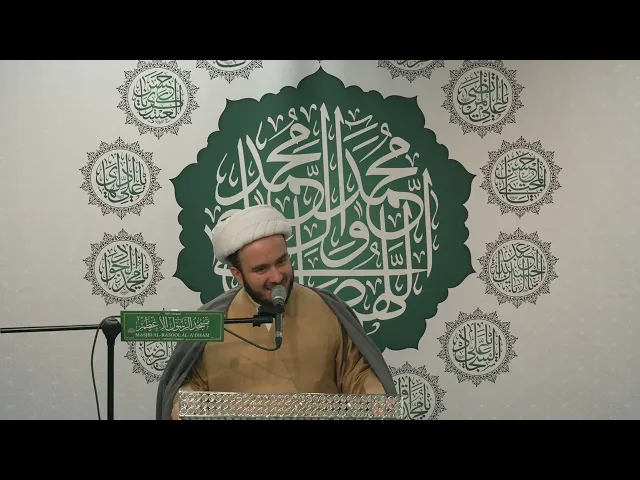
Biography of the Prophet- Migration - Verse 194 of Aali Imran- Hamam Nassereddine
0
0
14 المشاهدات·
24/07/29
في
محاضرات
This is a lesson from a series of lessons conducted by Hamam Nassereddine @ Mahad Rasul in Imam Hussain Foundation. The lessons focus on main events that took place throughout the life of the holy Messenger of God, Mohammed. (peace be upon him and his family).
أظهر المزيد
Transcript
[0:14]foreign in our last lesson we were still dissecting verses from surat
[0:59]ali we touched upon verse 193 and we mentioned the difference between
[1:13]we mentioned that sins divide into two categories major sins and minor
[1:23]sins and we mentioned that ultimately every sin in itself is major
[1:30]every sin in itself is major why because a person when sinning
[1:35]disobeys allah subhanahu wa but when we compare one sin to another
[1:43]one of the sins one of the two sins will become minor
[1:47]and the other will become major and we gave the example of
[1:52]swearing at a believer cutting his arm off and killing him all
[1:59]of them are major even swearing at the believer or insulting him
[2:03]that is a major sin in the eyes of allah but when
[2:08]compared to cutting his arm off that becomes minor because cutting his
[2:13]arm off is much greater whereas cutting the believer's arm off his
[2:20]body as major as it may be it's a minor sin when
[2:26]compared to killing the believer killing the believer killing the innocent soul
[2:31]is one of the seven deadly sins i told you that even
[2:36]amongst the kebab there are quebec right even amongst the major sins
[2:40]we have seven top deadly major sins one of those seven is
[2:48]what killing the innocent soul we also mentioned the importance of repenting
[2:55]before it is too late and the importance of making up for
[3:01]our sins and making sure that we end our lives in a
[3:06]good manner as in making sure that when we die we are
[3:11]uh pious we're righteous and we've repented from the past sins we
[3:18]read a beautiful hadith going back to rasulallah where the prophet mentioned
[3:23]that if a person if a person ends his life in a
[3:28]good manner as in if he does well during the last part
[3:32]of his life if he pleases allah during the last part of
[3:38]his life what will happen allah azzawajal will forgive his past sins
[3:43]allah will forgive his past sins so it's very important to make
[3:50]sure that we end our lives in a good manner thus you
[3:53]find imam sajad saying in one of his supplications what a short
[4:06]yet deep segment make sure that my life um is concluded or
[4:17]comes to an end as i am a believer who is pleasing
[4:25]you when that time comes ya allah make sure that i am
[4:28]a believer that i am doing something good that i am pleasing
[4:32]you etc finally we mentioned a scary yet important story about unfortunately
[4:42]he had become an apostate on the brink of death right before
[4:47]his death and we said that it was his envy which led
[4:52]him to that result unfortunately it was his envy the envy he
[4:58]had towards his colleague who had become a merjah it said the
[5:03]marjah was none other than saying almost as knowledgeable which tells us
[5:14]a lot about envy envy is scary it's a scary deadly sin
[5:21]or the least we can say it's a scary deadly trait which
[5:25]might lead a person to commit horrifying deeds hence when a person
[5:32]feels envious when he feels that he's envious towards someone else let
[5:36]him rush into cleansing himself from the trait and the least we
[5:43]can say is let him rush towards changing that envy from negative
[5:48]envy to positive envy what we call an arabic the negative envy
[5:53]is called hassan and the positive envy is called sometimes both of
[5:58]them are used in the same meaning but in general the positive
[6:04]envy is called and the negative one is called what's the difference
[6:09]between the two although our topic tonight is not envy the difference
[6:15]is when your envy is towards someone you wish that they lose
[6:21]a particular blessing so when i see someone for example who's very
[6:27]pious and i say i i wish he wasn't that pious that's
[6:31]envy or when i see someone who has for example a new
[6:35]car and i say i wish he didn't have that new car
[6:36]or i wish he didn't have a happy life that's envy on
[6:43]the other hand riptor positive envy is to wish that you possess
[6:51]the same blessing that the other person possesses without wishing that he
[6:56]loses the blessing so when i see for example my brother in
[7:00]faith was with a nice car i say allah ah give me
[7:05]a nice card just like you gave him a nice car when
[7:08]i see that my brother in faith for example is happy in
[7:13]his life i'll say allah bestow happiness upon me just as you
[7:17]bestowed happiness upon him or when i see someone who's very pious
[7:20]and for some reason i'm not that pious i say allah just
[7:23]as you made him pious make me pious just as you made
[7:28]him for example a leader of piety make me a leader of
[7:31]piety that's positive envy it's a it's one of the traits of
[7:36]a believer it's one of the traits of a believer today inshallah
[7:42]we want to shed light on verse 194 but before we do
[7:50]so um before we do so we want to read a few
[7:54]ah hadith a few traditions from that are connected with verse 193
[8:01]of surat al-imran let's re-read the verse just in case we forgot
[8:07]it allah subhanahu wa'ta'ala says what in verse 193 of he says
[8:35]surely we have heard a preacher calling to the faith saying believe
[8:39]in your lord so we did believe our lord forgive us therefore
[8:45]our faults and cover our evil deeds and make us die with
[8:51]the righteous last week and the week before we explained the meaning
[8:56]of and how it does not contradict the infallibility of the commander
[9:03]of the faithful nor the infallibility of the lady of light fatima
[9:25]the author of that book cites the book for those of you
[9:32]who don't know is a book of tafsir that contains the narrations
[9:36]of it i think i've told you this before and i'll say
[9:39]it again when we come to the books of tafsir the books
[9:43]that explain the holy quran some books explain the quran through traditions
[9:50]only meaning through the narrations of the prophet or the prophet and
[9:56]for example when we come to sunni muslims they have uh tafsir
[10:03]books like a dural manthur for sheikha sayuti who was a prominent
[10:08]sunni scholar that contain a hadith narrations of the prophet and his
[10:15]companions and sometimes the narrations of in regards to the quranic verses
[10:24]so basically he explains the quran using what the prophet is nearly
[10:30]at the half said or what the companions have said or sometimes
[10:34]what the imams like imam al-baqara have said on the other hand
[10:40]when we come to the other side the when we come to
[10:43]the shia muslims we also have books of tafsir that only contain
[10:49]a hadith one of them is another is tafsir al-burhan a third
[10:53]is tafsir nur and we have others as well so in tafsir
[10:58]ayashi we have the following tradition which i sent to you through
[11:03]the chat section the tradition goes back to ahmad bin abdul rahman
[11:07]bin qatir he says that imam salam commented on the verse rabbana
[11:20]when they say our lord we heard a caller calling to the
[11:26]faith telling people believe in the truth telling the the people believe
[11:32]in your lord so we believed what did the imam say he
[11:39]said by now i think that's clear right we've said multiple times
[11:59]these verses are speaking about imam ali and but imam sadiq al-islam
[12:04]is revealing a new secret that many of us might not have
[12:08]heard of he says that islam heard a call coming to him
[12:14]from the sky and the call said what am i soon believe
[12:21]in the messenger so he believed in the messenger s possibly i
[12:25]say possibly this call was heard when uh first came down upon
[12:36]rasulullah and the prophet was told to start propagating the message of
[12:40]islam now we've said before but some of you were not present
[12:44]in those classes that when rasulullah began propagating the message uh firstly
[12:50]he started propagating the message in a secretive manner so for three
[12:55]years he was calling people to islam in secret in secret after
[13:02]three years when he was 43 years old salallahu to make a
[13:11]public declaration and inform the people inform quraysh and the arabs that
[13:16]he was the messenger of god so i say possibly this hadith
[13:22]is speaking about uh you know the first moments uh when when
[13:28]jibril islam descended on the prophet and told him to start propagating
[13:33]the message of islam here one might say why would imam ali
[13:38]alaihissalam hear that call from the sky well obviously because of his
[13:45]pure soul he's so pure so sincere so attached to allah subhanahu
[13:51]wa'ta'ala he deserves to hear a call from the sky addressing him
[13:56]specifically not to say of course that if he didn't hear that
[14:00]call he wouldn't have believed on the contrary always believed in rasulallah
[14:07]in fact he believed in him from the day he was born
[14:12]so when we say that imam ali was the first muslim man
[14:16]the first male to become muslim what we really mean is that
[14:22]he was the first male to announce his islam but the reality
[14:27]is imam is the embodiment of islam from he was a believer
[14:37]in his cousin and his brother in faith and his master rasulallah
[14:50]this is one hadith it's a very beautiful hadith another hadith we
[14:54]want to share today before we start with verse 194 of surat
[15:00]al-imran is also a hadith going back to imam assad this one
[15:12]is also interesting the author cites the book is a is one
[15:21]of the four books of hadith which our marajah greatly depend on
[15:28]in order to extract islamic verdicts in order to islam extract islamic
[15:36]verdicts it was written by sheikh tulsi or one of his main
[15:47]goals behind writing was to mention jurisprudential narrations that go back to
[15:54]islam that were uttered by it and to reconcile these narrations because
[16:01]sometimes what happens is you'll find a hadith by an imam saying
[16:06]that for example this is wajib and then another hadith saying that
[16:11]this is not wagit for example or you'll find that the imam
[16:15]alayhi salaam commands his companion to do a particular deed and then
[16:19]another imam or the same imam uh tells his companion that if
[16:24]he wants to die to do that deed he can and if
[16:27]he wants he can refrain from doing it in that book he
[16:34]made a beautiful attempt and he actually achieved his goal in what
[16:38]in kind of explaining why there was an apparent contradiction between these
[16:44]hadith and he showed how we could remove the apparent contradiction the
[16:57]tradition going back he says there are uh multiple recommended prayers so
[17:16]after one of those recommended prayers there's a dua there's a supplication
[17:22]that is after you pray the two recommended prayers sorry the two
[17:40]recommended um make sure to to say these words that are part
[17:49]of your supplication to recite some of the verses that we've uh
[18:06]learned right the some of the verses in surat ali hamran starting
[18:13]with the verse saying mentioned what we should say we're not going
[18:25]to mention the full narration so the imam teaches us to say
[18:36]the following words our lord we heard the call we've heard the
[19:04]call and we have believed in the caller and the preacher who
[19:10]is the preacher the messenger of allah is so here we the
[19:25]imam islam explains that call and he says that he teaches us
[19:30]to say allah we heard the call and we have believed in
[19:34]the caller when he called out and he commanded his nation to
[19:42]believe in the authority and guardianship of the gorging that you appointed
[19:48]meaning ali abner now you might be asking why are you mentioning
[19:59]this tradition i'm mentioning it so we may understand that the verse
[20:06]doesn't only pertain to the event of migration it doesn't only pertain
[20:15]to what imam ali and the salaam said when they migrated there
[20:19]are other meanings that uh that were instilled in this verse by
[20:25]allah subhanahu wa the verse here is also referring to what the
[20:31]verse is also referring to the incident of and so now whenever
[20:41]you read these verses verses of ali you'll make a connection with
[20:46]a migration and a connection with any questions till now i'm guessing
[21:11]not you have a question yes sister xana go ahead okay and
[22:02]grant us what thou has promised us by thy messengers and disgrace
[22:09]us not on the day of resurrection surely thou dost not fail
[22:15]to perform the prompts as usual we have a few points to
[22:25]mention firstly the verse says our lord and grant us what thou
[22:31]has promised us by thy messengers what is the meaning of here
[22:38]according to some interpretations there is an omitted word there is what
[22:44]we call a mudaf word that's mudaf if you've learned arabic grammar
[22:51]you'll know what i'm talking about there's a word that's moldov and
[22:55]the modaf so what's that omitted word it could be and it
[23:03]could also be li san or al-sina what's the difference if the
[23:08]word is tastic which means belief then the verse is saying the
[23:12]following our lord grant us what you promised us for believing in
[23:20]your messengers so they're saying yeah allah we believe in your messengers
[23:25]and you told us through the messengers those who believe will be
[23:32]granted heaven they will be granted waves and waves of blessings etc
[23:38]so give us whatever you promised us through your messengers that's one
[23:41]meaning give us what you promised us because of our belief the
[23:49]second interpretation which is based on the word lisan or al-sina is
[23:56]means what it means means tongues so the meaning would be ya
[24:03]allah grant us what you promised us through the words of your
[24:13]messengers the meaning is somewhat similar to the first interpretation but it's
[24:17]a bit different it's more general if you think about it why
[24:21]because the messengers are muslim especially the last messenger muhammad sallallahu alaihi
[24:28]informed us that allah multiple promises allah's promises pertain to this world
[24:39]and the hereafter one of his main promises was that if you
[24:42]believe and perform good deeds you'll be in heaven on a day
[24:45]of judgment and you'll be saved from hell fire but that's not
[24:49]the only promise he promised other things like for example he promised
[24:54]in the quran that if you pay sadaqah if you pay charity
[25:00]allah azzawajal will return the amount of money that you paid and
[25:05]in fact he will multiply it for you so not only will
[25:10]you not lose what you paid rather you will gain more thus
[25:15]the the the tradition says what it says bring down your sustenance
[25:23]through charity hence we say if someone for example is having trouble
[25:29]with acquiring sustenance if you know he's working hard but subhanallah he's
[25:34]not making a good amount of money let him do business with
[25:38]allah subhanahu wa by paying sadaqa will give you back what you
[25:47]paid sooner or later and will multiply it for you so if
[25:52]you pay a dollar the least allah will do based on the
[25:55]traditions of course and based on the quran the least allah will
[25:59]do is give you back 10 dollars in fact sometimes he multiplies
[26:04]it by 700 that's up to him so the minimum is 10
[26:08]and the the maximum is 700.
[26:12]in fact if allah wants to give you more he can because
[26:15]ultimately he is the old generous and he can do whatever he
[26:19]wants that's one promise another promise was if you are pious allah
[26:28]will provide you with a way out whosoever fears allah allah will
[26:35]provide him with an outlet sometimes due to the islamic laws you're
[26:45]unable to pull yourself out of a particular problem you face a
[26:50]particular problem and you know how to exit the problem but there's
[26:54]a problem there's a problem in exiting the problem what is it
[26:58]you're going to disobey allah so you know how to save yourself
[27:03]from your predicament but in order to do that you're going you're
[27:08]going to have to cross your limits you're going to have to
[27:15]um you know do something haram so here what do you do
[27:18]allah tells you if you find that all avenues are blocked and
[27:24]you remain pious i'll open a door for you i'll open a
[27:28]door for in fact i might open many doors several doors for
[27:33]you that's a second promise a third promise um is a promise
[27:45]regarding dua right supplication the duhonii call upon me and i shall
[27:51]answer you allah says so long story short allah made multiple promises
[27:55]some that pertain to this world and some that pertain to the
[28:00]hereafter so when they say our lord grant us what you promised
[28:12]us uh by thy messengers if we if if we um believe
[28:18]that the word that's omitted is the meaning would be what meaning
[28:26]would be allah grant us what you promised us through the words
[28:29]of your messengers and it would be referring to all the promises
[28:35]of god that he descended upon us through the messengers then they
[28:44]say allah do not disgrace us do not humiliate us on the
[28:53]day of judgment again they mention humiliation subhan allah which emphasizes the
[29:02]fact which emphasizes the fact that they're very scared of this spiritual
[29:06]punishment and that they believe this punishment is worse than physical punishment
[29:11]hence you see that they keep on mentioning it yet they haven't
[29:19]mentioned uh fire the punishment of getting burnt uh the punishment of
[29:25]getting bitten by snakes or getting you know um attacked by scorpions
[29:31]etc the question is how might someone be humiliated on the day
[29:41]of judgment how there is a punishment that is very disturbing and
[29:46]that is the punishment of being exposed you think about it it's
[29:54]a very scary punishment allah subhanahu wa'ta'ala on a day of judgment
[30:01]can expose us in front of all humans in front of every
[30:05]human being he has created by displaying our sins to them and
[30:10]that will mean that you'll be exposed in front of allah number
[30:15]one who already knows about you and me uh the angels number
[30:20]two the close servants of god number three and fact every random
[30:25]harry joe and peter out there everyone will see your sins that
[30:30]in itself is very disturbing and scary especially if a person was
[30:35]viewed to be a respectful man or a lady in this world
[30:39]if that person is exposed on the day of judgement you could
[30:43]imagine that the amount of disgrace and the amount of shame he'll
[30:48]feel so when they say that word alludes to this punishment and
[30:57]similar types of punishments thus you see that when you read the
[31:01]traditions of allah that yes there will be people who will be
[31:09]exposed on the day of judgement but then again allah will conceal
[31:14]the believer the believer who was righteous although he you know sinned
[31:20]sometimes here and there due to his weaknesses allah will conceal him
[31:24]and when he questions him allah azzawajal we have a beautiful tradition
[31:29]by imam al-baqarah where he says that allah azzawajal will question the
[31:37]believer in secret so the people present won't hear what allah is
[31:43]telling that believer or what the believer is telling allah secondly allah
[31:49]azzawajal will will ask him about his sins the sins of that
[31:54]believer and the believer will confess because ultimately if you don't confess
[31:59]if you don't say allah i sin what else are you gonna
[32:03]do you can't fool allah right however surprisingly there are people who
[32:10]will try to fool god on david on the day of judgment
[32:12]and who will say allah no we didn't do x y and
[32:18]z so allah will silence them he will seal their mouths and
[32:21]will allow their hands to speak and their legs to testify for
[32:28]the sins that they had committed so the believer takes the easy
[32:33]way out he says ya allah yes i sin here i sin
[32:36]there i committed x y and z what does allah do is
[32:44]at that point commands that the sins of that believer turn to
[32:49]good deeds and then he displays his record in front of the
[32:56]people so when he does that the people become surprised and they
[32:59]say doesn't this person have at least one sin didn't this person
[33:03]sin at least once in his life because they see that the
[33:09]record concerning the bad deeds is empty and the record contain concerning
[33:13]the good deeds is filled with good deeds this will be uh
[33:17]a manifestation of what we call or actually what the quran calls
[33:22]here an easy questioning or an easy reckoning that is the manifestation
[33:35]of the easy reckoning on that day bear in mind of course
[33:40]that this is not the fate of every single believer this is
[33:44]the fate of a believer who was righteous but you know he
[33:50]sinned here and there due to sometimes his desire or his anger
[33:55]but he would fix his mistakes let us not forget and i
[34:00]always like to remind myself and you of this narration there are
[34:05]believers who ultimately enter hellfire but these are what the worst of
[34:10]believers some of them as imam ali sa's remain in jahannam for
[34:17]300 000 years before the intercession of adelbert actually pulls them out
[34:24]of jahannam the reason i keep on repeating this specific tradition is
[34:28]so that we can always be hopeful and fearful we don't want
[34:33]to have too much hope where we say you know what we're
[34:37]going to heaven for sure even if we commit the biggest sins
[34:41]and then again we don't want we don't want to have too
[34:43]much fear to the point where we say you know what whatever
[34:45]we do we're going to be doomed let's stay balanced stay hopeful
[34:52]and fearful fifty percent open fifty percent fear then the verse says
[35:08]surely thou dost not fail to perform the promise reminds us that
[35:19]ultimately when he makes a promise he upholds it do you know
[35:28]why because sometimes we might imagine that allah azzawajal does break his
[35:33]promise you might imagine that allah does break his promise why because
[35:38]we see that whatever we want isn't happening instantaneously it's taking time
[35:46]so we might imagine that allah broke his promise i'll give you
[35:54]a clear example when we do duha when we supplicate usually we
[36:02]we assume that allah will answer our supplication instantaneously so if i
[36:10]tell him ya allah i want so and so today i should
[36:15]see the answer by tonight right if i don't see it by
[36:20]tonight nor by a week nor by a year i might get
[36:23]to a point where i say allah broke his promise so when
[36:27]he says or in another verse does not break the promise he
[36:36]wants to confirm this reality telling us my slaves even though sometimes
[36:42]you might think that i break my promise i want you to
[36:46]know that i don't for example with dua with dua the problem
[36:55]lies in us we imagine that if we do a supplication it
[37:02]has to be answered instantaneously when in reality it doesn't you see
[37:09]allah didn't tell you if you do i will fulfill your request
[37:12]instantaneously what did he say he said i'll answer you and indeed
[37:19]he's truthful if you do a duha if you supplicate allah answers
[37:25]you from day one yes from day one but when does he
[37:27]fulfill your need that's the question so we need to understand and
[37:33]this is based on what said if you want you can refer
[37:38]to usual the section regarding over there you'll find traditions about this
[37:42]issue told us there's a difference between what allah subhanahu wa ta'ala
[37:45]between allah's between allah's answer and between allah fulfilling your need so
[37:52]when you do dua if you fulfill the conditions of supplication allah
[37:55]answers you on the spot the question is when does he fulfill
[38:02]the need he might fulfill it on the spot he might fulfill
[38:06]it in a year in fact he might fulfill it in 20
[38:13]years or 70 years or on the day of judgment ultimately he
[38:16]knows when is the right time to fulfill that specific need if
[38:22]we remember this point and we also remember that sometimes we ask
[38:28]something which is not good for us you know i ask allah
[38:36]to grant me a lot of money a lot of money he
[38:41]doesn't he doesn't he grants me an amount of money but an
[38:44]amount that you know allows me to live a good life not
[38:48]a luxurious one and i tell myself why i've done dua a
[38:55]hundred times i've done every deed out there i've recited in the
[39:01]message i've went to ziyarah i've beseeched him for some reason allah
[39:10]is not expanding my sustenance when it comes to money why because
[39:17]allah for example allah knows this person can't withstand uh he cannot
[39:25]withstand or he cannot control a lot of money if he gives
[39:31]him a good amount of money an amount that he needs to
[39:36]live he'll stay in control of the money but if he gives
[39:39]them more then he'll become like karun and the money will become
[39:43]in control of him so he'll lose his faith or he'll lose
[39:47]his piety because of his wealth so long story short sometimes allah
[39:54]doesn't answer us although he said because we're asking for the wrong
[40:03]thing and he knows this is this is not good for us
[40:07]but even then even then it doesn't mean that your dua went
[40:10]in vain it doesn't mean that you know you've um you haven't
[40:16]acquired anything from duha on the contrary when you supplicate you are
[40:23]acquiring a lot because number one you're strengthening your relationship with allah
[40:29]that's one number two you're worshiping him it's a type of worship
[40:32]number three you're acquiring reward without doubt and number four you're relieving
[40:39]yourself from stress one of its instantaneous effects is relief from stress
[40:47]or relief from anxiety and depression right whenever you feel sad whenever
[40:53]you feel overwhelmed with anxiety recite and complain to allah then tell
[40:58]me how you'll feel so you are acquiring um a lot of
[41:06]rewards and godly prizes in fact because you're asking allah for something
[41:13]and he isn't giving it to you because he knows it's bad
[41:19]for you be certain that sooner or later he will give you
[41:23]something better than what you asked for he will give you something
[41:29]better than what you asked again this is all based on quran
[41:34]and he's reminding us of this reality because sometimes unfortunately we might
[41:50]get to that point where we believe you know allah broke his
[41:56]promise and who knows maybe people will get to that point before
[42:01]the reappearance of saman may allah hasten his reappearance why am i
[42:06]saying this because we have multiple traditions telling us before imam and
[42:10]mahdi rises the majority of those who claim to believe in him
[42:20]will abandon their beliefs the majority one will say why maybe because
[42:28]they'll see that too much is happening there's just too much havoc
[42:32]too much problems too much oppression so they'll get to the point
[42:38]where they'll say you know what if there was an imam if
[42:40]there was a mahdi on earth he would have reappeared so when
[42:45]we see all this havoc all this oppression all this uh shedding
[42:52]of blood etc and the imam is not rising that means he's
[42:56]not present possibly this is what they'll think subhanallah once they abandon
[43:02]their faith in the imam again it's the majority not everyone once
[43:06]the majority abandons their faith in the imam what happens sahib is
[43:11]a man appears so allah delays the reappearance as a test for
[43:19]the people so that everyone's true color shows the true color of
[43:23]the hypocrite shows and the true color of the believer shows similar
[43:28]to how he tested the uh the people before us with their
[43:33]own forms of salvation not to forget also that allah knows best
[43:43]when is the right time for the imam alayhi salaam trumps bye
[43:53]if this is clear then we also have a few a hadith
[43:59]to share concerning this holy verse the first one or actually the
[44:08]first uh two or three involve supplication you'll realize that in these
[44:15]verses verses 1 90 to 195 of uh our lord how many
[44:26]times do they say our lord five times here we have a
[44:35]beautiful hadith which the tradition goes back to rasulullah and the prophet
[44:54]have said prophet says if someone has a need and he needs
[45:10]allah to fulfill it obviously we need allah to fulfill all of
[45:15]our needs so whenever someone has a need he says if he
[45:21]says five times our lord allah will fulfill his knee please keep
[45:29]the explanation that we mentioned a few minutes ago in your mind
[45:32]that when the hadith says he'll be granted his need his need
[45:39]will be fulfilled it doesn't mean it's going to be fulfilled on
[45:44]the spot that's a possibility and it's also possible it will be
[45:52]fulfilled later on then the prophet said well he said the proof
[46:00]that um supports these words is in the book of allah what's
[46:06]the proof he says he says that the proof is found in
[46:18]these verses then he recites the verses that we're studying starting with
[46:25]the verse saying rabbana mahalakhta had saying that these verses contain the
[46:38]word our lord and it's mentioned five times in verse 195 allah
[46:49]says what at the start of the verse thus their lord answered
[46:57]their call thus their lord answered their call so the prophet is
[47:05]what is deriving particular meaning from these verses telling us that since
[47:14]since they mentioned that five times and allah said fast thus their
[47:19]lord answered their call this means if you and i say rabbana
[47:24]five times allah will answer our call now tell me and be
[47:31]honest with yourself um would you have derived that meaning from from
[47:35]these verses if you read them we wouldn't yes we did pay
[47:40]attention that they mentioned rabbana several times but we didn't make that
[47:47]connection rasulullah is notifying us telling us listen there is a connection
[47:50]between mentioning five times in between ijaba between allah and syria if
[47:58]that shows you anything it shows you that the quran is filled
[48:03]with secrets but we need always to reveal those secrets for us
[48:14]since we're mentioning here's another tradition also found in going back to
[48:31]rasulallah he says it says that whoever raises his hands or his
[48:40]arms towards allah now doesn't have a specific place where he's found
[48:46]he's the creator of time and space so what is what what
[48:51]is meant here when the prophet says whosoever raises his hands or
[48:56]arms towards allah what is meant is that you raise your hands
[49:00]or arms towards the sky whosoever raises his hands or arms towards
[49:06]the sky and says as he's humbling himself for allah and as
[49:13]he's asking allah for his bounties oh lord three times allah will
[49:22]fill his hands with mercy we have a second tradition which tells
[49:26]us that whenever you lift your hands to the sky towards the
[49:31]sky allah make sure to place some sort of mercy or blessing
[49:38]in your hand so when you put it down wipe your face
[49:41]and your chest with the hand with your hand because allah has
[49:47]given you something instantaneously have one last tradition also in wasa elishiya
[50:09]the prophet is nearly to have set if the slave calls his
[50:21]lord saying oh lord allah response if he says it twice or
[50:41]thrice um if he says it twice twice or thrice allah will
[50:47]say i am at your service my slave ask me and i
[50:50]shall give you another meaning we can derive from the last part
[51:05]of the hadith is that whosoever says it twice in fact he
[51:09]says it thrice allah will tell him i am at your service
[51:15]my slave ask me and i shall give you okay i think
[51:35]we're out of time for today we'll stop here inshallah next week
[51:39]we'll start with verse 195 and we'll see uh what we can
[51:47]derive from the holy verse foreign
0 تعليقات
sort ترتيب حسب
- أعلى تعليقات
- أحدث تعليقات
التالي
11 المشاهدات · 20/04/30
13 المشاهدات · 26/03/09
11 المشاهدات · 26/03/11
8 المشاهدات · 26/03/11
10 المشاهدات · 24/10/06
11 المشاهدات · 07/01/29
10 المشاهدات · 22/05/25
6 المشاهدات · 24/01/31