
التالي
3 المشاهدات · 23/07/22
2 المشاهدات · 23/07/25

3 المشاهدات · 23/07/28
2 المشاهدات · 23/12/15
3 المشاهدات · 23/12/17
1 المشاهدات · 24/07/08
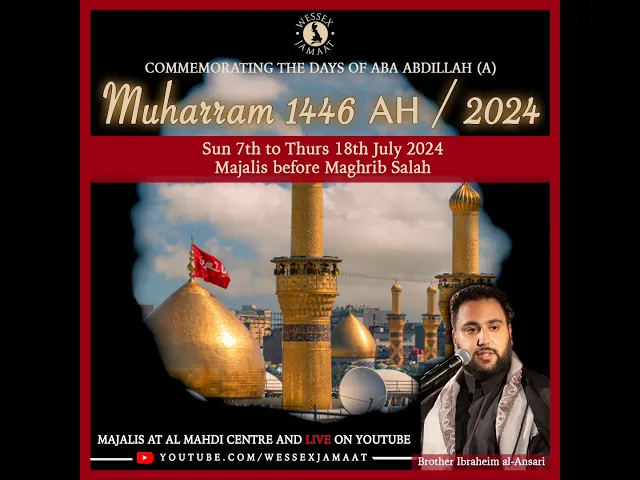
1 المشاهدات · 24/07/09
Ramadan Night 4 - Q&A - Sayed Ahmed Qazwini - Sayed Fadel Al Sayed
0
0
0 المشاهدات·
26/02/22
في
محاضرات
Ramadan Night 4 - Q&A - Sayed Ahmed Qazwini - Sayed Fadel Al Sayed
أظهر المزيد
Transcript
[0:11]What else did you want?
[0:12]>> Uh, there was a second part to your question.
[0:18]>> Yeah.
[0:26]The bayon bean.
[0:31]>> [clears throat] >> Yeah.
[0:33]Regarding this surah, I would have to go back to the so
[0:39]it's not um I have not reviewed the in a long time,
[0:41]but what comes to mind is it could be hean is how
[0:46]to speech >> speak speaking.
[0:48]So he's the one that taught the you know the human being
[0:53]how to speak.
[0:53]is Allah referring to a specific you know word specific sentence that
[0:58]can only be known if we go back to the hadith of
[1:02]and I don't recall any hadith here so it could be just
[1:07]general he taught him how to speak >> Allah is the teacher
[1:10]of the human being he taught him how to speak there's a
[1:12]there's something I'd like to add to your first question first of
[1:17]all you said that there's a sequence and this sequence proves that
[1:21]Allah you know He taught first and then he created the human
[1:25]being.
[1:26]First of all, I would argue against that.
[1:28]Not that I'm saying this is wrong.
[1:31]I'm just saying this is speculation.
[1:32]Just because Allah put it in this sequence does not necessarily mean
[1:37]this is how it happened.
[1:41]No.
[1:42]Maybe because Allah is starting with um you know the most important
[1:44]and then he's going down.
[1:45]So you're looking at it chronologically.
[1:46]Maybe Allah is not looking at it chronologically.
[1:50]Maybe Allah subhana wa ta'ala is looking at it from what you
[1:55]know what's what's most important for example.
[1:57]Um second of all we can say maybe Allah taught the angels
[2:00]because we believe the Quran Allah created these meanings of the Quran
[2:04]way before he created the universe.
[2:06]I mean way before he created human beings and he taught it
[2:12]to an angel.
[2:10]Um there's hadith from the B about that.
[2:15]So it could be that he taught the angels uh the Quran
[2:21]and then this is possible or maybe it could be he taught
[2:23]Allah because we know the soul of Allah was created much before
[2:29]the souls and even the bodies of all the other believers.
[2:31]You know there's a hadith of attributed toasool >> true >> I
[2:41]was a prophet and pro and even before Adam was was created
[2:45]his soul was created.
[2:48]So there's multiple explanations but at the end of the day I
[2:54]mean going back to the hadiths of regarding this I think it
[2:56]would be the safest.
[3:01]Yeah.
[3:00]Fine.
[3:07]I'm so sorry, Afwan.
[3:09]Uh, we have a car blocking.
[3:10]If we can move it, please.
[3:10]It's license plate ESH1 1883.
[3:14]If someone can please move it immediately.
[3:17]It's blocking a lot of cars.
[3:19]So, Ford Explorer.
[3:28]>> Um, so I have a question.
[3:31]I always get two different responses to this, so I just wanted
[3:33]some clarity.
[3:34]Um, but regarding >> I get two different responses as well.
[3:37][laughter] >> Regarding uh traveling and praying assid when you're visiting to
[3:43]your childhood home, but you're don't live there anymore.
[3:45]So I live out of state.
[3:48]I've been living here now for 5 years.
[3:50]But when I visit my parents, I still consider that my home.
[3:53]So am I supposed to be praying that asid or can I
[3:57]pray it normal like regular salah?
[3:58]Well, according to say where do you follow first?
[4:01][laughter] >> Yeah, that makes it more easier.
[4:05]So you actually you actually consider your your still the the place
[4:08]where you were born and bred.
[4:09]Is that what you're talking about?
[4:10]>> Just where I Okay.
[4:13]But when you you had the intention you had the intention to
[4:18]go back there, do you still consider it your home?
[4:20]>> Yeah.
[4:21]But I don't consider moving back living there again.
[4:23]>> You don't consider moving back living there?
[4:25]>> No.
[4:26]still consider >> yeah okay so well I know according to sayani
[4:32]correct me if I'm wrong she could if you still got the
[4:37]consideration that you consider that your home then you can still you
[4:40]pray I'm unless I'm >> that's right >> because some people some
[4:48]people they actually they made the intention they don't want nothing to
[4:52]do with that's a that what you can say that place of
[4:55]residents that where they grew up.
[4:58]Like for instance, like my daughter, she comes now to my house
[5:01]when she was born in Red Woolong, but she has no intention
[5:03]to come back and live.
[5:05]>> Your daughter, huh?
[5:06]>> Your daughter?
[5:07]>> Yeah.
[5:09]Um, so she's she's actually made the commit that she doesn't want
[5:14]the to have that as her original place of residence.
[5:17]So she she prays kaser when she comes to my house.
[5:22]But you consider it your home.
[5:23]So as soon as you consider your home and the attachment, then
[5:27]you you pray to mom.
[5:29]Say no.
[5:27]>> That's true.
[5:29]Yes.
[5:30]It's it's really about what you consider that place.
[5:33]Do you feel like you're at home?
[5:36]It's still my home or the connection is gone.
[5:38]So it's I mean it's there isn't very a very clear answer.
[5:43]It's just varies from person to person.
[5:51]But their opinion is different.
[5:54]So is it?
[5:55]>> Yeah, it's a it's a case by case.
[6:00]Each person is different.
[6:00]Maybe for me, I no longer consider this place my home.
[6:04]I I cut my ties with it.
[6:06]When I come, I'm I'm kind of like a visitor.
[6:08]But one of my siblings, no, they still have ties with it.
[6:11]Usually, this is this, like I said, this isn't a general law.
[6:17]Usually most people if they were born in a place and their
[6:19]parents live there and they have a house there usually that place
[6:22]remains as a home for you know the rest of their life.
[6:28]This is most people because they keep going back there and they
[6:31]feel like they're at home.
[6:33]You know this is how I explain it to some people.
[6:34]Do you feel like you're a traveler there or this is home
[6:39]for me?
[6:40]Like if there is um a pandemic, you know, everyone ran ran
[6:44]to their wherever they felt was home.
[6:46]Is that some place you would go to?
[6:49]So there's some indications that may be able to help you.
[6:54]Is this a a place that I see as home or no?
[6:58]This is just like any other city.
[6:59]So that's what it really comes down to.
[7:02]So, it's a feeling, but it's more than just a feeling.
[7:06]A feeling where there's actually some reality behind it because I'm actually
[7:10]um at home there.
[7:12]I mean, I don't feel like I'm a traveler.
[7:15]I don't mind.
[7:17]Um now, if if if you definitely say, "I'll never ever move
[7:21]there again." That might make it a little more difficult to pray
[7:24]to mom.
[7:30]They told me I don't >> Yeah, this is what the say
[7:57]he mentioned you know about his They call this when you leave
[8:03]your home, it's as if you've given up that place.
[8:04]So, did you forfeit this place being my home or no?
[8:09]You still feel like this is my home.
[8:12]That's what it comes down to.
[8:14]Like I said, it will differ from person to person.
[8:18]Um, >> so when you left, do you used to live there
[8:26]or no?
[8:27]Oh, you never live there?
[8:28]>> No, my parents still live there.
[8:30]>> Your parents used to live there or they live there now?
[8:33]>> I live there 40 years.
[8:34]>> So you used to live there with your parents.
[8:37]So it was your home at one point.
[8:39]When you left when you left, did you leave for good?
[8:45]I'm not going back.
[8:45]Or no, I I got married or well I got a job.
[8:49]I still have those ties or those my intention is maybe I'm
[8:53]going to come back.
[8:54]>> I have to live there.
[8:58]Yeah.
[8:58]Then I think in your situation you'd pray.
[9:01]>> You'd pray.
[9:03]Yeah.
[9:03]>> For the brother's side, do we have any questions?
[9:07]>> No.
[9:12]>> That was a little lie.
[9:14]I have two.
[9:16]First of all, say Ahmed, thank you for always teaching us.
[9:17]Um, you know, we we can never repay you.
[9:20]And say, thank you so much for coming from Australia.
[9:23]Um, we're blessed to have you here.
[9:25]So, thank you so much.
[9:26]I have a question for each of you.
[9:27]Um my first question is let's say you're making uh a mistake
[9:31]during salah and by mistake I mean for example you pray an
[9:37]extra raqa or for example you um yeah we'll go with that
[9:41]example you pray an extra for example you know obviously you realize
[9:47]it during the the actual raa what what do you do and
[9:49]I guess the second question for say ahmed will be let's say
[9:55]uh obviously in the sha We believe that you can pray salah
[10:00]together like if you timing wise let's say hypothetically you pray obviously
[10:08]you always want to pray it as early as possible but let's
[10:12]say you pray during time you know have you missed the prayer
[10:16]>> sure first of all with praying extra can you bring it
[10:26]closer >> so with praying extra art it's it doesn't first of
[10:30]all it doesn't uh make this salah void um but because you've
[10:35]added some depend also where where did you where did it was
[10:38]it in the first raka second raka like you know there's there's
[10:43]there's different rules like whether I have to pray sometimes of adding
[10:46]something or have to I didn't add something where I got to
[10:50]pray but usually when I add something usually when I add something
[10:57]like you said an extra offense like it was a uh salat
[11:05]which >> yeah okay then yeah okay with with with that so
[11:10]if if for for some reason um you got up on the
[11:17]fourth you got up on the fourth you haven't started anything you
[11:19]you sit back down you sit back down and then finish off
[11:22]your prayers and then what we do we do If you if
[11:27]you know you know know how they do that.
[11:29]So that's that's the probably the point >> as long as before
[11:32]>> as long as before.
[11:36]Yeah.
[11:35]For if what sometime if you added it then you just you
[11:43]know you you still do the same thing afterwards.
[11:46]Isn't that right?
[11:47]Say yeah after Yeah.
[11:48]So you do the same thing afterwards because you've gone past the
[11:52]recourse stage.
[11:52]But that's a very important point.
[11:54]Exactly.
[11:55]Before you can sit back down, fix up your problem.
[12:00]You know, you added something which is most most of the times
[12:03]with adding something is no problem.
[12:04]It's not a problem.
[12:07]It it can be if if you're doing an extra sag like
[12:09]in the in the sujud and all that stuff, but you know,
[12:14]but that's the there's like an an a fix for basically every
[12:19]time, but it's basically whether I have to pray It's depending on
[12:28]the situation.
[12:29]There's no playing around with it.
[12:33]But if you really if you really honestly if you your your
[12:36]concentration lapse in that um salah is all over the place and
[12:43]you you really got to fix up your mindset.
[12:46]>> I sense that I trying to remember your question.
[12:51]I I can't.
[12:54]Sorry.
[12:58][clears throat] >> Yes.
[13:00]Okay.
[13:00]Okay.
[13:01]So, if you pray mad during ahat time, well, what do you
[13:07]mean by time?
[13:10]>> Okay.
[13:12]Where are you where are you getting the ashhat time from?
[13:18]>> Okay.
[13:19]The reason why I ask this is because and times how we
[13:26]the how we interpret and define the times is different than how
[13:34]non.
[13:32]So if you see in the other mass non Sunni mass when
[13:38]they're praying time this is not what we consider as time we
[13:41]also believe there's a time for and there's a time for but
[13:47]you don't have to wait you can pray and together earlier you
[13:51]can pray and earlier and you can wait and pray it during
[13:57]its time but the time of and is not what you see
[14:02]the sunni mass do it there's a different calculation to it.
[14:05]So depending on the we're talking about the Shia calculation time according
[14:12]to the B is whenever the sky turns pitch black and you
[14:17]can see the stars because you notice after sunset there still will
[14:23]be some redness you know some colors of of of the day
[14:26]there will be some light.
[14:30]It takes on average probably up to an hour sometimes maybe 40
[14:33]minutes after sunset until it's pitch black the sky that's when time
[14:38]starts and in the hadiths of the they call this >> when
[14:44]you can see the stars that's time now I think if you
[14:49]see the sun mass that's not when they pray sometimes I see
[14:51]them praying at like 11 p.m.
[14:57]that's way too late.
[14:56]Um sometimes it's like 2 hours after.
[15:00]So the correct definition of time can you pray then?
[15:07]Yes.
[15:10]Because and they extend all the way till midnight.
[15:15]This is according to you know most you have until the midnight
[15:21]the midnight I mean the Islamic midnight not 12 a.m.
[15:23]which is you take sunset and you take fudger or there's another
[15:29]opinion you take sunset and you take sunrise and you look like
[15:31]right in the in the middle it's usually between 12:30 and and
[15:37]1:00 a.m.
[15:35]So you have until um until midnight.
[15:41]You can you can intentionally delay until 11 11:30.
[15:45]So there's nothing wrong with with praying at time say it's better
[15:53]to pray it earlier as soon as you hear the adan pray
[15:57]and then pray together both of them.
[16:02]Afon, I have one anonymous question from the sister's side.
[16:05]She said, "Salam say I have a question I've been thinking about.
[16:08]I've noticed the number seven and odd numbers appear often in Islam.
[16:13]Is there a sign a specific significance or wisdom behind that?" >>
[16:17]Say numbers.
[16:17]>> Numbers.
[16:20]Yeah.
[16:20]>> I did a I did a lecture a long time ago
[16:22]about numbers, but um I did on the number 40.
[16:26]But but there is there is there has to be some type
[16:31]of significance with seven you know we have the seven saw and
[16:34]then we also you know also the circulation around the ka seven
[16:38]times the safa seven times so it had to be some type
[16:44]of significance of course um in our you know this holy number
[16:48]uh but from my understanding cuz I looked I looked into the
[16:54]40 hadith and it met a lot of meaning of what happened
[16:56]to do with 40 and there was a lot actually a lot
[17:01]of uh connection between even western uh theological thinking of what 40
[17:06]does to a person in terms of the ahad and that but
[17:10]seven my understanding I can the plain like I really don't know
[17:13]honestly to to say that but I know that it has some
[17:18]type of uh significance because it's many of our deeds uh so
[17:21]even some of the the narrations we do we we actually read
[17:26]it seven times like or say it seven times.
[17:27]So, um say if you want to add.
[17:30]>> Yeah, I mean honestly this is going to be just speculation.
[17:34]What's special about seven?
[17:37]I have no idea, right?
[17:38]What's special about six or as this new generation, they love six
[17:42]seven both together, right?
[17:44]>> Um I don't know.
[17:46]The reason why I don't know is because we haven't been told.
[17:52]So this is all like people's analysis on you know the number
[17:56]three the number this I personally don't think this is something we
[17:59]have to worry too much about because the imams didn't really care
[18:02]about this the imams told us learn your learn the imam of
[18:07]your time learn how to pray don't worry about these things so
[18:10]even if I'm sure there is a significance because god doesn't randomly
[18:14]do anything you know like they say it to >> um the
[18:22]sevens.
[18:21]>> Uh what else?
[18:23]>> I mean there isn't too many, right?
[18:26]>> No, not not as many.
[18:28]>> Yeah, I mean there probably there's other numbers where you can
[18:34]find much more examples of it.
[18:35]But seven, I I'm trying to think, you know, what else is
[18:38]seven?
[18:39]I don't see that many times it's repeated such that I can
[18:42]extract like a rule from it.
[18:44]I mean, at the end of the day, it's a number.
[18:46]If God would have said five, we would have said, "Oh, something
[18:48]with five." If we would have said eight.
[18:51]These are all numbers.
[18:51]There's probably wisdom or we have to say there is wisdom behind
[18:55]everything.
[18:56]But it wasn't disclosed to us.
[19:00]And something that wasn't disclosed to us, I don't think we should
[19:03]try too hard to try to figure it out.
[19:06]>> I have one question up here.
[19:08]>> Yes.
[19:09]Say um I have a question for you about what happens when
[19:14]you like when you don't pray but you read the Quran and
[19:17]you like you fast and you give charity out.
[19:22]>> What happens if you pray you don't pray but you do
[19:27]the other deeds?
[19:27]>> Yeah.
[19:28]So [clears throat] with your permission say so there is a hadith
[19:35]from the prophet where he says is the pillar of your faith
[19:42]if your salah counts everything else will be looked at will be
[19:49]considered but if your salah doesn't count because you don't pray or
[19:53]you pray it wrong nothing else then Allah subhanaa won't even look
[20:00]at your other deeds.
[20:00]Now what does this mean?
[20:01]There are different opinions between scholars.
[20:04]Some take it as you know the literal at meaning at its
[20:11]face value.
[20:09]If you don't pray, you're not going to be rewarded by Allah
[20:15]for the other good deeds that you do.
[20:17]One of the condition of your other good deeds, all of them
[20:20]to be counted is you have to pray.
[20:23]It's either pray and get everything else counted or nothing counts.
[20:28]Now, that doesn't mean if someone doesn't pray then they say then
[20:33]I shouldn't fast.
[20:35]No, because we're only talking about a means reward because when you
[20:39]do a waj there's two things that you will achieve.
[20:45]Number one, you'll get reward.
[20:47]Number two, Allah won't hold you accountable for not doing it.
[20:52]So Allah will still count that you did it.
[20:54]That means he's not going to punish you.
[20:58]Why didn't you fast?
[20:57]But there's no reward.
[21:00][snorts] So it's not right to say if I don't pray then
[21:04]why should I go to Hajj?
[21:04]Then why should I uh fast?
[21:08]Then why why should I give zakat?
[21:10]No.
[21:10]Because if if you don't do those now you're just sinning more
[21:14]and more and more.
[21:16]If you don't pray that's one sin.
[21:19]Don't increase it to more sins.
[21:20]But without your salah, you won't receive a reward.
[21:25]It's just you're not sinning, but you're not being rewarded.
[21:28]Some other they give it a more um I would say a
[21:36]an easier interpretation where they say if you don't pray, there's no
[21:43]guarantee there's no guarantee that your other will count.
[21:45]The only way to guarantee that Allah will count your other is
[21:50]if you pray as well.
[21:50]So on the day of judgment maybe Allah won't count any of
[21:53]your deeds because you never prayed.
[21:57]So if you want to guarantee then pray.
[21:59]It's a way in which Allah subhana t is kind of pressuring
[22:05]you to pray because it's very important.
[22:09]>> Thank you says um we have an anonymous question from the
[22:14]brother's side.
[22:15]The question is what should the what should be the role of
[22:17]our woman in society?
[22:19]How should they be spending their time in adulthood towards fulfilling the
[22:21]religious duty >> place?
[22:24]What was it?
[22:24]>> The role of woman >> said before we got up here
[22:29]I said to say I said I'll do the easy ends you
[22:32]do the hard ones.
[22:34][laughter] that that's for me stuck from the word me as well
[22:40]and but our I believe that the women especially these days have
[22:47]had a much much greater role in the in society in terms
[22:52]of because of the you know as they say the hijab factor
[22:56]out there um and the symbolization but uh what actually were discussing
[23:06]the other today uh about the the beloved example of the the
[23:12]wife of and so we we symbolize that when God says so
[23:18]first of all he's given an example to all everyone wasn't just
[23:22]males and female like just the females but everyone and how we
[23:26]saw it we saw that imagine that that this lady was in
[23:32]a a time and era where her husband was.
[23:34]So basically in a in a in an era or an era
[23:38]that that was very toxic but she chose after everything after what
[23:45]she could she was basically the queen of the world she chose
[23:48]the whole uphold the principles of ma and following Allah subhanahu wa
[23:53]ta'ala.
[23:53]Now when I look at it today and so it's a we're
[23:56]in a toxic environment you know it's very similar especially for a
[24:02]a sister and the attention is on you and the attention probably
[24:04]is more on you because of the you know the way you
[24:07]stand out.
[24:08]Guess you know the males we got our beards and that but
[24:13]the the female especially we're in the proper hijab your symbolization of
[24:19]but you have that symbol to to to stand out more.
[24:25]So when when doing that the attention on you is going to
[24:32]be much more so that way the role of the lady in
[24:33]today's society besides that of what we've learned from Ahmed B of
[24:40]what Fatim Zah or Lady Zam has taught us we find that
[24:43]to to have this knowledge of religion is of utmost the same
[24:49]as the males have the the you know to strive and be
[24:52]as they say be this great example.
[24:57]The sisters have to do the same thing.
[25:01]The sisters have to do the same factor in terms of the
[25:02]way they portray themselves out.
[25:06]Being out in the open, whether you're at work, whether at university,
[25:10]but being modest and holding and still having and upholding the principles
[25:15]of what B taught us, it's very important.
[25:18]And the mother for me like I said she zaman has this
[25:24]think he said this beautiful thing he goes behind every great man
[25:29]is a great lady everyone whenever you look at something the holy
[25:35]prophet had zah hussein had z like but I'm saying like women
[25:42]have always been there in our factors as a partnership in in
[25:49]upholding the principles Yes, men have other duties as well that have
[25:53]been prescribed on them in terms of offering the you know the
[25:56]security and maintenance and other stuff for the family.
[26:01]But I still think that the essence that the lady has to
[26:03]have the uphold principles because she's going to be also the person
[26:09]that's going to spending more time with the child and if her
[26:12]aid is strong and her knowledge is strong of the religion then
[26:16]she's going to be the the basically the seed that that is
[26:21]planted within that child.
[26:23]uh honestly the the pressure that that I' I've really look upon
[26:29]our sizes.
[26:30]I look I look upon them in great honor and respect because
[26:33]I can I can sometimes as they say in in the public
[26:39]be not noticeable but with with the with you are going to
[26:43]be noticeable but how noticeable how noticeable it's up to you it's
[26:46]up to you how your closeness it is to and the principles
[26:50]of what what they stood for then this is this is what
[26:53]becomes the the the leading factor that can show people that the
[27:00]true um honor honorability of women because you know in the west
[27:04]they have this thing that we they see us as our women
[27:08]as oppressed but then we show them hold on a sec have
[27:09]you actually read your Quran like the story that I gave you
[27:15]now about god's given about that you know mariamad like like we
[27:19]show all of these things Islam gave us of the nissa way
[27:24]before westerners did go and look when when American women were were
[27:28]were voting or the ladies back in um in England or in
[27:31]Australia, you know, inheritance, rights, like all this was given to the
[27:37]women because we because Allah showed the the greatness for God's sake,
[27:43]man.
[27:41]Mecca was the Mecca that we turn to every single day.
[27:47]the the the foundation of it was a a slave that used
[27:53]to be for given to Ibraim cast in a desert a lady
[27:55]basically who who who was there with a foundation that we now
[28:01]face every single day she's the only lady that's buried according to
[28:05]our narrations in the holya so we we find that even when
[28:12]I'm moving in the the footsteps of Safa and Marwa I'm moving
[28:14]in the footsteps of a lady.
[28:18]It's a science of God.
[28:21]My God, it's this lady gave me.
[28:23]It's ladies, ladies, ladies.
[28:24]So, they've always been part of it.
[28:26]But it's on to the sisters themselves how I become this representation
[28:33]and in the society is depending on your level of tawa on
[28:37]your level of your of to Allah.
[28:46]alaykum.
[28:49]>> Um, so yesterday's lecture you talked about complaining and venting and
[28:54]you said that during the end when you complain to a non-believer,
[28:57]it's as if you're complaining about Allah.
[29:00]But what if your like friend is using your own beliefs?
[29:02]Does it still make it complaining?
[29:03]If you're saying like, "Oh, remember your God.
[29:07]He's big.
[29:08]He's mighty.
[29:07]You know, he holds all the power." So what if the non-believer
[29:12]uses your beliefs >> yeah towards you she's like >> so this
[29:16]was a hadith that I quoted from and I see and I
[29:21]saw it repeated from more than one I this is exactly what
[29:32]the hadith said whoever complains to a believer it's like you have
[29:37]complained to Allah There's another and whoever complains to a non-believer then
[29:52]it's as if you have complained about Allah and you've objected and
[29:57]you haven't submitted to the will of Allah subhanahu wa ta'ala.
[30:01]So I mean if if we if we follow this hadith strictly
[30:08]then no you ha has to be a believer.
[30:11]It's it's it's not enough if it's a non-believer that's pretending to
[30:15]be a believer or that's acting to that's acting as um you
[30:20]know as a believer.
[30:24]So you know that's one of the ma main conditions that it
[30:27]has to be a believer.
[30:28]Um I it it can be argued.
[30:32]So I don't know what theat would say about this is you
[30:34]know if if a believer you're sure that a non-believer is going
[30:40]to help you and provide that spiritual support exactly like the believer
[30:46]could that pass I mean it's an argument to be made but
[30:49]definitely that's part of the gray area that I would stay away
[30:56]from.
[30:53]So stick to a believer when it comes to complaining and venting.
[30:59]Now remember if if you're thinking like therapy, this isn't really complaining
[31:03]and and and venting.
[31:06]Therapy is more trying to diagnose, you know, certain issues in your
[31:09]life.
[31:10]So I wouldn't necessarily call that complaining and venting.
[31:15]Um, and even with therapy, I mean, if you can find a
[31:19]Muslim therapist, I would always recommend that over a non-Muslim therapist.
[31:28]>> Say, I had two very short questions inshallah.
[31:31]I'm sure you guys know about duh and if you recite it
[31:35]40 days in a row, inshallah it be alongside and his army
[31:37]when the time comes.
[31:39]Uh for me personally, there's been multiple times I went like 20
[31:43]days in a row, almost 30, and I still fall short, you
[31:47]know, a couple times.
[31:47]How can I, you know, get closer to achieving that goal?
[31:51]And also, when you are doing, do you have to recite it
[31:54]yourself or could you listen to it at the time of >>
[32:01]Well, subhan Allah.
[32:03]When you when you said you got to what 20 days and
[32:06]>> 30 days?
[32:07]>> 30 days.
[32:09]Yeah.
[32:11]We have a narration.
[32:13]I can only go back on the narration.
[32:16]You know that when whoever does a for 40 days, then God
[32:18]puts the the N of the a in your heart that you
[32:23]can never leave that deed ever again.
[32:24]But I don't know you and says just like you don't know
[32:30]me.
[32:30]like I've got my faults and we know none of us uh
[32:32]muscle men.
[32:34]I would always if if you're getting to nearly 20 30 days
[32:40]that's that's pretty good.
[32:39]That's pretty good.
[32:41]And if I can sum up the rel Islamic religion, it's called
[32:46]consistency, steadfastness.
[32:48]But there is something there is something definitely stopping you you know
[32:53]to continue those extra 10 days because you know we've had narrations
[32:58]where people want to see imam and they do the ham for
[33:04]39 days on the fourth day something happens and they don't get
[33:08]the to do it.
[33:11]I would personally look at yourself look at yourself on and see
[33:16]what what did I do because we we we we have narrations
[33:21]that say the only reason that you're you're stopped method you know
[33:27]when tells the you know is asked I haven't got to do
[33:32]salah the imam tells him that look at you there is something
[33:35]in your deeds that's stopping you from from continue and getting the
[33:40]privilege of doing it could be something very small.
[33:43]How do you know for instance that you know that time you
[33:45]didn't get up for I'm saying for instance that you didn't get
[33:50]up and you took it for granted h I didn't get up
[33:52]when you get the feet how do you know that wasn't the
[33:56]the the the thing that pushed you over there so you didn't
[33:59]get the feet to to continue or we have some narrations that
[34:07]says that if you eat a morsel of haram food that your
[34:10]dua and your salah is not accepted for 40 days that some
[34:14]you know I I was careless.
[34:15]I was careless.
[34:17]I went and ate at a place.
[34:19]I didn't do my study.
[34:21]I was just told there was hal I saw a certificate like
[34:23]most people say and I just ate.
[34:26]And you're doing dua.
[34:28]Remember you're doing a dua.
[34:30]You're you're besieging Allahh in this beautiful manner where what the hadith
[34:36]says it's a weapon of the believer.
[34:38]So I would personally and this is the month now the month
[34:42]where you you reflect and you look back and you do the
[34:44]mahass of the you know says check I went up to 30
[34:54]days I was doing so good go back and have a look
[34:59]maybe just maybe something very small that I've done even sometimes we
[35:02]have the narration if you look at your parents in that but
[35:06]you know that that kind of disrespectful That could have been it.
[35:08]That just that look could have stopped you from having the of
[35:14]reading for 40 days.
[35:15]There was there is something believe me there is something there is
[35:19]something within us.
[35:21]We always if we do that dissecting and we look and you
[35:27]know the the kind of like deep insight and seeing and cover
[35:29]and and find we will find it.
[35:31]We'll definitely find it.
[35:33]I ask Allahh for your sake and for the sake of the
[35:35]believers I believe you can do it 100% you can do it
[35:41]just take each day by day you told me you got the
[35:45]30 days I am sure that just with and this is the
[35:46]month of mak of of now of forgiveness use this as an
[35:53]advantage now to hopefully push you to the point where you get
[35:56]to the 40 days and say thank God that now I'm going
[35:59]to make this part of my everyday ritual >> [clears throat] >>
[36:06]If wants to add anything, >> I think that was a a
[36:11]very good answer.
[36:11]It could be something um you know this is part of dua.
[36:16]You know, every time I try to change, I try to repent,
[36:25]I try to do something good, something comes between me and that
[36:28]good.
[36:30]Then he starts mentioning certain possibilities.
[36:34]Say maybe because you saw me I waste too much time.
[36:41]>> Maybe because you saw me that I'm not I don't have
[36:44]that shame in front of Allah subhanahu wa ta'ala.
[36:48]Maybe it's because of this.
[36:49]Maybe it's because of that.
[36:53]So it could be my fault.
[36:53]And you know what I would add is let's say you tried
[36:59]your hardest.
[36:57]you got to 30 35 yes you didn't achieve technically what I
[37:03]im said 40 consecutive but I believe at the end of the
[37:09]day Allah subhanahu wa ta'ala he's very generous can Allahawawel give me
[37:16]that extra push and just count it for me if you have
[37:22]that much hope in Allah and you ask him I I don't
[37:27]think that he will disappoint you.
[37:29]So just try your best.
[37:29]Try your best.
[37:31]I mean, you failed the first time, try a second time.
[37:33]You know, like say father said, it's it's kind of like consistency.
[37:39]So don't just do it 40 days and leave it forever.
[37:40]When the tell you to do something for 40 days, what they
[37:46]mean is make it a habit in your life.
[37:48]Make it a habit because when you if you can do something
[37:50]for 40 days, you can do it for forever.
[37:54]So if you couldn't the first time, try it a second time.
[37:59]So even if you've done the 40 times, you know, read it
[38:03]at least like once a week.
[38:04]As long as you're putting up a good effort and it's consistent,
[38:07]inshallah, Allah won't disappoint you.
[38:10]>> Just back on that question said it's very important about the
[38:16]40 days as well and and he basically if you can sum
[38:21]up the Islamic religion is consistency.
[38:23]You got to keep you got to keep doing something.
[38:25]Like you know the the westerners have the what they call the
[38:27]2190 rule.
[38:28]They say it takes 3 weeks to implement a habit but then
[38:33]it takes 90 like 90 days was like 3 months.
[38:37]So it becomes part of you.
[38:38]We're saying no Islamically 40 days with sincerity it can be become
[38:43]part of you.
[38:45]But it's it's it's something that we you got to do this
[38:47]habit.
[38:48]It's it's basically changing the habits in inside of you.
[38:53]You're a habitable person.
[38:53]We our whole life you watch yourself the way you sit in
[38:58]the car, the way you know you drive, the way you you
[38:59]got certain places in the house you want to sit.
[39:03]That's that's the human that's how we are humanly.
[39:06]So when you you get this out of this complacent mindset and
[39:09]say no I want to move closer to God almighty and then
[39:14]you know they have the with the habits they have three things
[39:19]they have it's like uh they call the three Rs if and
[39:21]for those people that know about him it's like remember routine and
[39:27]then um I think it's um replace so this this is something
[39:35]oh reward sorry reward board you know and these are the three
[39:38]the three things that you know I'm I'm reminding myself okay the
[39:42]benefits of dah okay then the routine of me is what you
[39:47]said to make it regularly and then the reward of it comes
[39:50]after after the three remember these three Rs in every that you
[39:57]do and you find sometimes you see a person how he thinks
[40:00]with those three Rs when the adan goes off the adan and
[40:05]is the reminder.
[40:07]The routine is to what?
[40:10]To get up and do woo.
[40:10]The reward is to pray on time.
[40:12]While someone who's watching, you know, right at the end, there's like
[40:18]five minutes to go of that great basketball or or football match,
[40:22]you know, the event goes off.
[40:25]There's no movement.
[40:27]The routine is I want to see what the game end.
[40:30]Then in the end, his team loses.
[40:31]He goes for Salah and he's angry.
[40:34]That's his reward.
[40:36]He doesn't even concentrate on the on the prayers anymore.
[40:39]But like some say it said do it consistently and I guarantee
[40:45]guarantee with the mercy of Allah you will you will get to
[40:47]there and even better.
[40:55]My question is in regards to as someone who works in healthcare
[41:00]uh and experiencing the and experiences the passing of patients what dua
[41:04]would I be able to read on behalf of that patient whether
[41:07]they are Muslim or not.
[41:10]>> So during the during the state of if you see someone
[41:15]who is slowly dying they're you know living their last moments and
[41:23]their last hours of their life.
[41:26]Now theam they've taught us a couple of duas and but they've
[41:30]kind of focused on doing this for a believer.
[41:34]Now is there a problem to to to recite these for a
[41:38]non-believer?
[41:39]I don't think so.
[41:39]I don't I don't I don't I don't see a reason why
[41:43]it would be haram.
[41:46]But the focus is on a believer because it eases um that
[41:48]transition to the next life.
[41:52]So will it have the same effect for a non-believer?
[41:53]I don't know.
[41:56]So for example, one of the most recommended duas if you see
[42:01]someone who is in the state of they're slowly passing away is
[42:04]what they call dua and dua in the hadiths of is not
[42:15]what we call dua what we call dua is right that's not
[42:20]what the used to call dua when the used to call say
[42:26]dua If you see this in a hadith, it's a specific dua.
[42:29]It's a it's a collection of of Allah.
[42:38]Subhan Allah.
[42:45]Alhamdulillah.
[42:47]This has been proven to be very helpful according to the another
[42:52]thing is reciting seven times and if you can 70 times in
[42:59]one hadith he shows how powerful and effective this is.
[43:03]He says if you recited the fat 70 times on someone who's
[43:07]dying and you notice that Allah brought him back to life don't
[43:12]be surprised.
[43:10]The Imam is exaggerating and he's trying to show you how powerful
[43:18]the potence of of this dua of reciting fat 70 times that
[43:21]it can bring someone who's dead back to life.
[43:25]But Allah will not allow that because there are some things that
[43:28]Allah will just never allow.
[43:31]But if there's any room for this person's life to be extended,
[43:35]that means if Allah hasn't made it for sure that that he
[43:39]has to leave, then Allah subhana t might extend his life or
[43:44]Allah may ease that transition to the next life.
[43:49]So reciting fat dua, I don't do you remember anything else.
[43:56]Uh these are for the mmin.
[44:00]But of course >> for a m and by mumin we mean
[44:03]like at least a Muslim >> but if it's an atheist I
[44:07]don't really know if that's going to help them honestly.
[44:08]I mean you can try if you have extra time >> get
[44:13]him get him to revert at the last moment maybe that will
[44:16]give him that chance to enter heaven.
[44:18]>> Yeah.
[44:22]Thank you, SA.
[44:24]Inshallah, this will be the last question and it's being said anonymously
[44:27]from the sister side.
[44:29]Um, she said, "I stopped praying when I was in middle school
[44:32]to high school, sophomore year, so I didn't take off my hijab,
[44:35]but I didn't pray, ate haram, didn't fast, but when I came
[44:40]back to my dean, I was told since it was so much,
[44:42]I didn't have to make it up." But I repented, cried to
[44:44]Allah, and I'm just confused on if I should pray all the
[44:46]salah I missed and the fast that I missed.
[44:50]So [clears throat] she missed salah for a couple of years and
[44:55]fasting.
[44:56]Now she wants to make it up.
[44:57]Correct.
[44:58]Am I understanding cor correctly?
[44:59]Does she have to make it up or not?
[45:00]>> Does she have to make them up?
[45:01]>> Yes, of course.
[45:03]You always have to make up the prayers that you missed and
[45:09]the fasting that you missed.
[45:10]There's no way.
[45:10]There's no exception for anyone where they miss salah for a couple
[45:17]of years and then they they don't have to make it up.
[45:19]Yes.
[45:19]If I'm a convert, I was a non-Muslim and then I convert
[45:24]to Islam, do I have to make up all those years when
[45:26]I was a non-Muslim?
[45:28]Let's say I'm at age 60.
[45:29]No, because there's explicit hadits about that.
[45:33]>> But if I'm a Muslim and I don't pray for whatever
[45:37]reason, I'm not a practicing Muslim.
[45:39]My parents never told me I have to make up every salah
[45:44]and every year of fasting of the month of Ramadan.
[45:49]No, with no exceptions.
[45:49]I mean the the only exception the only exception we find in
[45:53]religion to someone being exempted from prayer specifically is for sisters and
[45:59]their cycle.
[46:01]That's the only exception for men.
[46:04]There's absolutely no exception to the extent that our say if you
[46:10]can't pray because you're disabled sit down and pray.
[46:12]You can't even sit down you're sleeping on your bed pray.
[46:17]And subhan Allah, I think this is also kind of like an
[46:19]an exaggeration that shows you how important salah is, but it could
[46:23]be, you know, it could be something that someone could actually do
[46:27]one day.
[46:28]Even if someone is drowning, the hadith says, but he's slowly drowning
[46:33]and he notices it's salah time and he happens to have the
[46:36]IM says pray.
[46:38]But how do you pray if you're drowning?
[46:40]The Imm says just lift your eyes up and say, "Ya Allah,
[46:47]count this as salah for me." So even in the most difficult
[46:49]times of your life, don't neglect salah.
[46:52]Why?
[46:53]Because salah is supposed to help you when you're in need.
[46:55]Salah is the cure.
[46:59]Salah is for someone who's desperate.
[47:01]For someone who is in need, this is when you invoke Allah
[47:05]subhana ta's help.
[47:06]So when you are dying, this is when you are most in
[47:10]need of salah versus when you're healthy, young, and there's nothing wrong
[47:16]with you.
[47:13]That's why the Quran says means what?
[47:21]>> Seek that means seek help through salah and patience.
[47:26]And some hadiths they say patience here is referring to fasting.
[47:30]So yes, you always have to make up your fasting and your
[47:35]salah that you missed.
[47:36]>> Unless I were in a coma for two years.
[47:38]>> None.
[47:38]>> Unless I were in a coma for two years.
[47:40]>> Coma.
[47:42]Yes.
[47:42]If someone is in a coma, the scholars state that uh you
[47:48]don't have to uh make up the salaz if you were in
[47:52]a coma.
[47:51]Inshallah, no one has to deal with this.
[47:53]uh you know it's not worth to you know just for you
[47:59]to be exempted from salah for you to ask Allah to to
[48:03]put you in a coma.
[48:04]So that's really the only exception.
[48:12]>> If you don't know you guess to the best of your
[48:16]knowledge.
[48:16]Guess to the best of your knowledge.
[48:20]Whatever you can come up with when you sit down and think
[48:23]what's the minimum is it one year you know one way say
[48:28]start with the least number that you know you missed so for
[48:30]example one year are you sure you missed one year if it's
[48:35]yes go to two years are you sure you missed two years
[48:38]if it's yes whenever you're not sure whenever you reach a threshold
[48:45]where less than this I know I missed more than this I'm
[48:46]not sure stop at that even if it's 10 days 20 days
[48:53]what's the minimum that you can you know that I missed make
[48:56]that amount up that's the minimum and you don't have to make
[49:01]up the rest that you have doubt in so only what you
[49:05]know you missed you have to make it up thank you so
[49:07]much s for this Q&A today inshallah we're going to be having
[49:10]more Q&A throughout the month I really appreciate everybody's attendance tonight if
[49:13]you guys are hungry we we have someh outside Muhammad
0 تعليقات
sort ترتيب حسب
- أعلى تعليقات
- أحدث تعليقات
التالي
3 المشاهدات · 23/07/22
2 المشاهدات · 23/07/25
3 المشاهدات · 23/07/28
2 المشاهدات · 23/12/15
3 المشاهدات · 23/12/17
1 المشاهدات · 24/07/08
1 المشاهدات · 24/07/09