



Volgende
7 Bekeken · 12/05/27
Lessons on the Koran - Suratul Baqara - V.35 part 3- Hamam Nassereddine
0
0
33 Bekeken·
24/07/29
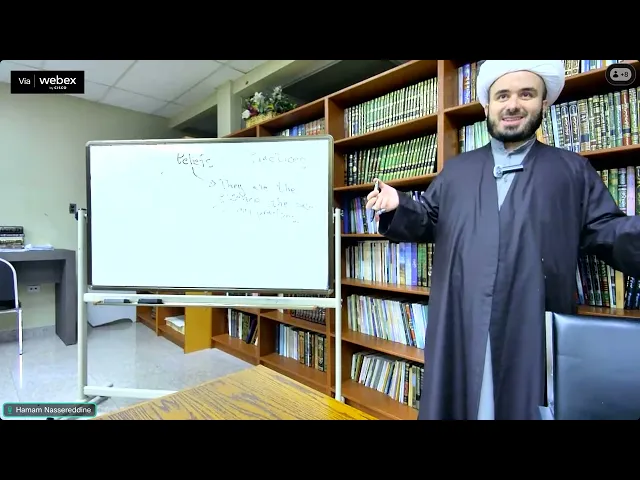
This is part of a series of lectures given by Hamam Nassereddine that shed light on the holy Koran and explain its verses. These lectures were given at Mahad Imam Ridha in Imam Hussain Foundation.
Laat meer zien
Transcript
[0:14]foreign in our last lesson we covered multiple important points one of
[0:58]them was what should we do when we encounter a passage such
[1:02]as a quranic verse or a narration which seems to be contradicting
[1:11]common sense which seems to be contradicting logic are we supposed to
[1:16]put our intellect behind our backs our backs or the passage behind
[1:23]our backs we said none of the above what we're supposed to
[1:28]do is number one accept the call of the intellect and try
[1:33]to understand what allah is saying in the quran or what allah
[1:40]have said through their traditions because sometimes what happens is we assume
[1:47]that there is a contradiction that the passage holds a contradiction with
[1:54]common sense or logic but the reality is the reality is there
[1:59]is no contradiction all we need to do is actually understand allah
[2:03]properly and understand so long story short we said allah when he
[2:14]speaks in the quran he never contradicts common sense he never contradicts
[2:18]logic so if there is a verse which seems to be presenting
[2:24]a passage um or some sort of statement which contradicts logic we
[2:33]need to look deeper into that verse to understand exactly what allah
[2:39]is saying so for example when i read verses in the quran
[2:45]that seem to be attributing physical properties physical traits to allah obviously
[2:54]doesn't want to tell me that he's physical or material how could
[2:58]he want that when he himself said telling us that there is
[3:04]nothing in this universe nor in existence that resembles him if there
[3:10]is nothing that resembles him that means he is not material he
[3:14]is not physical which means the verses that seem to be attributing
[3:20]physical properties to allah aren't really doing so we might misunderstand those
[3:25]verses but if we look deeply into them and we connect them
[3:31]with other verses in the quran verses which we'll touch upon today
[3:36]in sha allah and we connect these verses with the words of
[3:40]who are the speaking quran will be able to understand what allah
[3:48]actually meant the same applies to what the same applies to the
[3:53]narrations of when there's a narration that is linked to one of
[4:04]the infallibles if that narration seems to be presenting a message which
[4:09]contradicts logic i shouldn't rush in refuting the narration rather i should
[4:17]take my time and look deeply into it connect it to other
[4:20]narrations connected to narrations hopefully i'll be able to understand what meant
[4:30]when they said that word if they actually said it that was
[4:37]one point we mentioned a second point we mentioned was was actually
[4:45]divided into multiple points and that point revolved around adam's so-called disobedience
[4:54]and the command that allah subhanahu wa ta'ala presented to adam when
[4:59]he told him not to approach the tree we said that it's
[5:05]not a maulawi command it was not a malawi man and according
[5:10]to sharif meaning was recommended for adam not to approach the tree
[5:22]and he disobeyed that command hence there was absolutely no sin just
[5:26]as i might disobey the recommended command of allah pertaining to salat
[5:32]alay if i don't pray salah to lame i am not a
[5:38]sinner i haven't sinned although i've disobeyed allah's command according to allam
[5:44]what did we say believes that the command was it wasn't a
[5:51]shady command so what we did last week is we presented multiple
[6:00]proofs supporting the um the opinion of alamo and or sharif in
[6:09]better terms we presented multiple proofs that indicated that the command was
[6:17]not maori one of those proofs was what if you remember it
[6:22]was the verses of surat taha we said allah subhanahu wa'ta'ala mentions
[6:29]the story of adam his story in the gordon and how he
[6:31]approached the tree in three parts of the quran so if you
[6:40]want to actually have a good understanding of what happened you must
[6:45]connect these verses because the verses of the quran are intertwined they're
[6:50]connected so we went to surat there what did we see we
[6:54]saw that allah subhanahu wa'ta'ala told adam to beware from the devil
[7:00]to be cautious and to be aware and he told him that
[7:05]the devil wants to pull him out of that garden why does
[7:10]allah tell him in surah to beware from the devil tells him
[7:14]because if you if if the devil pulls you out of the
[7:19]garden what will happen he says fatashka you will go through fatigue
[7:23]then allah comes forth and describes he describes the gordon of adam
[7:31]telling him that in that garden he does not undergo hunger thirst
[7:39]nakedness or the heat of the sun what does that mean it
[7:48]means he was living in a luxurious garden so here we give
[7:51]an analogy if you remember saying that when adam approach the tree
[7:59]he ultimately accelerated the process of exiting his garden why did we
[8:04]say he accelerated the process of exiting the garden because ultimately he
[8:10]was going to come down he was created for earth and we
[8:15]presented multiple proofs up until now supporting this idea one of them
[8:20]is allah's word in surat al-baqarah so adam alaihissalam was supposed to
[8:26]come down to this world he was supposed to come down to
[8:32]earth which meant that his stay in the garden was a temporary
[8:39]state even if he didn't approach the tree sooner or later allah
[8:43]was going to bring him down so he did what he accelerated
[8:47]the process now adam had what he had two options adoption of
[8:53]remaining in that gordon up until the time elapses or accelerating the
[8:58]process and coming down by coming down adam alaysalam was like a
[9:04]person this is the analogy it was like a person who was
[9:10]told to sit in a five-star hotel for two months or three
[9:15]months before he starts doing business with his co-worker so this person
[9:20]has a co-worker and the co-worker tells him that you know what
[9:24]we're going to start business but for now i want you to
[9:29]rest take your time enjoy your time in the five-star hotel for
[9:32]two or three months and inshallah after those months end after the
[9:39]time elapses will uh start the work that person knows that ultimately
[9:45]he's going to work so what does he do he enters the
[9:49]hotel enjoys himself for a day and then he leaves the hotel
[9:55]he enjoys his stay for a day and he leaves the hotel
[9:59]why because he wants to start working this was the second point
[10:04]that we mentioned last week we also read a tradition by imam
[10:12]where ali posed questions to imam pertaining to verses in the quran
[10:24]which might be understood to be attributing sins to the prophets and
[10:30]he asked him about adam so-called disobedience or sin so we read
[10:35]the part uh that mentioned imam rita's answer concerning adam and we
[10:44]read that imam salam confirmed that adam did not sin that adam
[10:51]did not sin when he said that his disobedience took place where
[10:56]in the garden it didn't take place on earth and we said
[11:02]based on the words of imam based on the wording of the
[11:07]hadith we understand that the imam is saying when he was in
[11:10]the garden he was not mukellah what does that mean it means
[11:18]he was not uh responsible of um carrying out or implementing a
[11:24]maori command there was a command directed at him but it was
[11:30]not mawlana when did the tech leaf begin when was adam actually
[11:39]responsible of carrying out the commands of allah when he came to
[11:43]earth and that also proves our claim which is now today we
[11:55]want to continue with verse 34 or 35 of surah al-baqarah and
[12:03]we still have two points to mention two important points number one
[12:07]what was that tree what was the tree actually verse 35 we
[12:14]want to know what was the tree um that allah pointed to
[12:20]when he told them not to approach the tree and what is
[12:26]the meaning of because allah says what says so the question is
[12:44]what was that tree was it an apple tree orange tree what
[12:52]kind of fruit did it bear and the the the real question
[13:00]is what would what what actually called adam alaihissalam allowed him to
[13:10]you know enjoy his time in his garden and he allowed him
[13:15]to go towards any tree in the garden correct there was one
[13:23]tree that allah told him not to approach and what's interesting is
[13:27]allah points to that tree he uses what we call an arabic
[13:35]islamic now for those of you who have learned arabic grammar you
[13:43]know that hadi the word is used to point to something that's
[13:49]close it's used to point to something close for example i have
[13:54]a water bottle right beside me okay i can say for example
[13:59]because it's close i want you to keep this point in mind
[14:03]because do not approach this tree this tree which is close but
[14:14]after adam alaihissalam approaches the tree for some reason he becomes four
[14:21]allah azzawajal later on we're going to see tells him what he
[14:28]says um i'm mentioning the meaning of the verse it's not the
[14:38]exact wording it says is a word indicating that the tree is
[14:45]what it's for it's also a sim is also so you use
[14:53]it to point to something but the difference between hadi and is
[14:59]that hadi is used for something close and tilka is used for
[15:04]something for so for some reason the tree becomes form why inshallah
[15:07]we'll see just keep that point in mind so the real question
[15:14]is what actually hold adam towards the tree well we need to
[15:21]understand adam adam salam is the proof of god adam adam's main
[15:27]concern is what adam's main concern isn't his belly isn't to fulfill
[15:34]his desire his main concern is getting closer to allah remember this
[15:41]is the person allah told the angels to prostrate for and this
[15:48]is the person who was taught the names so we're talking about
[16:00]a holy figure holy figures are interested in what they're interested in
[16:05]getting closer to god now when we come to traditions we have
[16:14]multiple traditions telling us that the tree allah mentioned when he said
[16:24]for example was connected to holy spirits to holy creations so what
[16:32]we're saying is there was a physical truth and it did have
[16:36]some sort of fruit or some sort of crop on it but
[16:43]that tree was connected also to spiritual beings it was connected to
[16:49]holy figures what holy figures it was connected to the holiest figures
[16:54]the most important people muhammad muhammad this is based on what said
[17:03]we have multiple traditions on this record one of them is the
[17:08]one we're going to read and explain today in sha allah so
[17:12]what we're saying is the following what caused adam alaihissalam to actually
[17:20]come forth and approach the tree was that he wanted to reach
[17:27]a high position he saw that the tree was connected knowing that
[17:44]uh and albeit have that status he wanted to join them in
[17:51]their status adam remember is interested in getting closer to allah so
[17:56]he wanted to join them he wanted to didn't have what it
[18:10]takes to be at the position of he was so out of
[18:18]mercy towards adam out of compassion he tells him don't approach the
[18:24]tree as in don't give yourself a headache you can't reach that
[18:30]position let us read the tradition of imam already on this reward
[18:35]and will move forward so the main point i want you to
[18:39]keep in mind right now is the tree was physical but it
[18:44]was also connected to holy spirits in fact the holiest spirits number
[18:52]two is a prophet of god a proof of god who's interested
[18:57]in getting closer to allah subhanahu wa number three when he saw
[19:05]the supreme status of he wanted to reach their status that's what
[19:11]actually draw him drew him towards the tree but allah knew from
[19:15]the beginning wasn't able to get to that position so out of
[19:20]his mercy he told him don't approach the tree let us read
[19:28]the tradition of himala i'll copy and paste it for you inshaallah
[19:49]you can find it in tafsir mizan foreign so the tradition says
[20:15]that allah tell me about the tree inform me about the tree
[20:45]from which adam and eve ate what was that tree why does
[20:49]he want to know he says it doesn't that people have differed
[20:55]in regards to that tree some say for example that it held
[21:01]this fruit and others say held that fruit etc he says he
[21:12]tells them some people narrate that the tree was a wheat tree
[21:17]so it was a tree in the garden of adam salam which
[21:21]bore wheat hassan says others narrate that this tree was the tree
[21:37]of envy so if it's the tree of envy and adam and
[21:42]eve approached it what does that mean it means that was the
[21:48]question of the imam said what he said he said all of
[21:58]those opinions are occurred how the imam continued or actually asked he
[22:06]said he's asking the imam how could all of these um all
[22:16]of these opinions be correct when they're not the same opinion they're
[22:22]multiple opinions and they seem to be contradicting so the imam said
[22:28]what or possibly it is alayhis are different than the trees over
[23:01]here the trees in that garden would bear multiple types of fruits
[23:06]for example or multiple types of crops so one tree would bear
[23:10]wheat and would also bear at the same time grapes so he
[23:19]tells him whatever he said it's not those trees are not like
[23:24]the trees in this world hence when the imam tells them that
[23:29]all of these opinions are true telling him that it was a
[23:37]tree bearing wheat and it was also the tree of envy he's
[23:41]telling abu salt that there is no contradiction between these opinions because
[23:50]the tree in the garden of adam alaihis could have multiple functions
[23:58]each tree had multiple functions and multiple benefits any questions till now
[24:08]each tree could have multiple functions and benefits do we have any
[24:12]questions before i continue with the hadith so he says after allah
[24:50]honored adam by making the angels prostrate for for him by basically
[24:55]commanding the angels to prostrate for adam and after he honored him
[25:05]by uh placing him in his garden adam alaihi salam asked a
[25:12]question he said that allah subhanahu wa ta'ala create a bashar that
[25:18]is better than me the word bashar is a word referring to
[25:26]the human being why was the human being called bashar because his
[25:31]bashara his skin appears realize there are certain animals that are covered
[25:38]with what covered with fur or covered with hair like gorillas monkeys
[25:45]etc the human being does have hair but his skin a good
[25:50]portion of his skin a significant amount of his skin chokes for
[25:55]that reason he was called bashar so when he says bashar he's
[26:02]talking about human beings like him he asks allah created a bashar
[26:07]better than me he knew what was going through his mind and
[26:25]allah knew that there were people who were superior to adam he
[26:31]wanted to show him those people so he called him and told
[26:38]him raise your head raise your head o adam and look at
[26:47]the base of the throne before i continue i want you to
[26:53]know that this throne that we speak about um is a creation
[27:01]of god there is a creation of god called in harsh that
[27:04]allah has created and it's a massive creation it's a great and
[27:11]massive creation yes allah isn't sitting over it because allah is not
[27:15]physical rather he has full control over the throne just as he
[27:20]has full control over every segment in the universe but keep in
[27:24]mind that based on the traditions of there is something called the
[27:34]throne so allah he looked at the base of the throne and
[27:49]he saw the following writing on the base there is no god
[27:54]other than allah muhammad rasool allah muhammad is allah's messenger fatima is
[28:15]the mistress of the women of the worlds and hassan hussain are
[28:24]the masters of the youth of paradise fakala adam i told him
[28:46]oh adam these people are part of your progeny you will be
[28:50]their grandfather however they're better than you and actually they're better than
[29:02]all of my creations so they are what at the top of
[29:07]the pyramid the greatest creations not only the greatest greatest human beings
[29:11]they're the greatest creations of god had it not been for them
[29:23]he thousand i wouldn't have created you nor would i have created
[29:29]heaven nor would i have created hellfire and had it not been
[29:34]for them i would not have created the sky nor the earth
[29:38]does this remind you of anything yes it does or it should
[29:46]at least it reminds you of a passage in hadith which says
[29:49]that the whole universe was created for who for allah created the
[29:56]creations he created the universe he created us and the jinns all
[30:04]for the sake of who for the sake of his beloved adam
[30:22]don't look at them in an envious way or else i will
[30:34]i will pull you away i will push you away from wherever
[30:40]you are residing the place where adam alaihissalam was residing that gordon
[30:48]was a place where adam alaihi salam was spiritually close to allah
[30:56]subhanahu wa so allah tells him that if you look at in
[31:02]an envious manner you will become spiritually distant from me i will
[31:09]distance you in a spiritual manner of course because allah is not
[31:13]physical i will distance you from here the imam says what it
[31:22]says now i'm going to um translate what the imam is saying
[31:36]and he said i'm going to give you a literal translation and
[31:39]then once we're done with that i'll explain the tradition in sha
[31:44]allah so he says adam alaihissalam after that incident stared at in
[31:52]an envious manner that's the literal translation and he wished to possess
[31:59]their position he wished that he was that his position was their
[32:05]position or in better terms he wished that he was at the
[32:09]position so what happened fatha alaihissalam and led him to eating from
[32:32]the tree the tree allah subhana told him not to approach what
[32:41]is meant by the shaitaan gaining dominion over adam isn't that he
[32:45]actually controlled him physically no what has meant is that he called
[32:52]him towards what eating the tree as the quran says and he
[32:58]told him to come and eat the tree and for some reason
[33:03]adam salam listened and actually approached the tree then he says so
[33:22]adam also stared at fatima in an envious manner and that led
[33:28]her to eating from the tree just as adam ate from the
[33:33]tree adam allah out of their garden and brought them down to
[33:54]earth now an important question comes to mind what is meant by
[34:03]adam and eve looking at we need to understand this product well
[34:22]you see look at the tradition carefully don't rush look at it
[34:30]carefully what does it say it says if you've studied arabic grammar
[34:44]you'll know that the word wow in arabic has multiple functions sometimes
[34:51]the word wow when you say for example sometimes it means and
[35:00]but it doesn't only mean and for example when i say i'm
[35:08]saying muhammad and ali came but sometimes the wow isn't actually used
[35:14]in that sense sometimes it's what we call wow it's a wow
[35:23]which describes the state of a person when something happens let me
[35:29]give an example verse 55 of surah 5 verse 55 of surah
[35:45]your guardians allah says are only three allah and his messenger and
[35:55]those who believe who are those who believe he tells you those
[36:06]who believe are the ones who uphold prayer and pay charity because
[36:20]he is the one who was praying and was in the state
[36:26]of when a and the only person who helped him on that
[36:34]day was by giving him what by giving him his ring as
[36:38]he was in the state of gukur he made a signal to
[36:42]the beggar telling him to come and take the ring so he
[36:46]came and he took it from the hand of the imam according
[36:49]to a second tradition the imam gave him a shirt he gave
[36:53]him a shirt long story short he is the one who paid
[36:58]alms who paid charity while he was in the state of now
[37:03]this wow when allah says how would you translate it would you
[37:11]say and they're bowing down no that would be a wrong translation
[37:14]this is aliyah it's telling you what was the state of amir
[37:19]al-mu'min salam when he gave the the ring or when he paid
[37:25]alms so you would say those who believe those who uphold prayer
[37:29]and pay alms as there in the state of so sometimes the
[37:37]wow doesn't mean and sometimes it's i hope that's clear if that's
[37:44]clear then we'll move on to a third type of wow there's
[37:48]a third type of wow called wow what's here it's basically a
[38:00]wow which will explain what was meant before it so you'll use
[38:04]two words one that comes before the wow and one that comes
[38:07]after it the word that comes after the wow explains the one
[38:12]before it if that's clear now we'll go to the tradition of
[38:18]imam he was at their position so here the imam explained that
[38:47]envy of adam what was that envy it was the positive type
[38:55]of energy for those of you who were present yesterday in our
[38:59]sida class if any if any of you were actually present you
[39:03]heard that there are two types of envy positive type and a
[39:10]negative type the positive type of envy is what we call and
[39:18]it's also called hasset sometimes in arabic you can call it hasset
[39:21]for example well actually before i give the example let me explain
[39:25]the concept and then i'll give the example what's when you see
[39:33]that someone has a particular blessing and you wish to have the
[39:42]same blessing without wishing that he loses it that's it's a good
[39:46]tree for example i see that my brother in faith masha'allah praise
[39:52]salah every night and i don't pray salt and then every night
[39:56]so i say ya allah grant me the godly aid i need
[40:04]to pray salat and let every night just as he's praying salat
[40:07]and that every night this is what this is raptor i don't
[40:11]want him to stop praying salat i want him to continue but
[40:15]i also want that for myself so this is positive envy whereas
[40:21]negative envy which is called hasan and also called ripta sometimes is
[40:28]what type of envy it is basically a state in which you
[40:35]intend or you wish that the person who has a blessing loses
[40:41]that blessing let me use the same example when i see my
[40:45]brother in faith praying salatullah every night i wish that he did
[40:51]not praise a lot of me i wish that you know he
[40:57]wasn't that guided he wasn't that spiritual that religious this is hasa
[41:01]this is the negative type of envy it's the type of envy
[41:07]which khabib was afflicted with rabin saw that habib islam was superior
[41:13]to him and was destined to be adam's successor he wanted to
[41:19]be the successor of adam so what did he do he was
[41:22]envious towards happy he didn't want habil to have that position if
[41:31]that's clear now we will go back to the imam's tradition when
[41:39]adam alaihi salam looked at in an envious manner what does what
[41:45]did that mean it mean it all he wanted was that he
[42:12]becomes the partner of animal that he reaches their position but that
[42:16]was too much for adam this is the one thing which led
[42:23]him to what to approaching the tree so he can actually get
[42:27]to that position but subhanallah when he approached the tree he realized
[42:31]that he failed in reaching their position even then allah did what
[42:38]allah gave him a prize inshallah we're going to get to that
[42:41]prize later on allah gave him a prize when allah gives adam
[42:48]a prize after adam you know disobeys the command of god that
[42:53]in itself shows you that adam did not sin so i'll repeat
[43:01]because i know these words might be a bit bizarre at the
[43:07]moment maybe this is the first time you're hearing this um there
[43:11]are two types of hassab negative envy and positive envy both are
[43:17]called hassan sometimes and both are called although usually we call the
[43:23]positive envy and the negative envy hase looked at albeit in an
[43:31]envious manner meaning he wanted their blessing but he didn't want them
[43:38]to lose the blessing he didn't want them to lose a blessing
[43:41]but he actually looked at them in an envious manner meaning he
[43:47]wanted them to lose their position in the eyes of allah subhanahu
[43:52]wa adam would have become cursed allah would have cursed him and
[43:54]he would have definitely lost his chance of of of being a
[44:00]prophet of god but that's not adam salaam in order to add
[44:11]clarity to this point remember how we use envy in english for
[44:15]example when you see methylene you know your friend having a good
[44:23]time happy in a good state etc and sometimes you tell your
[44:26]friend i envy you what do you mean by that word you
[44:29]actually mean that i wish you lost your blessing no you mean
[44:33]that i wish i was in your shoes as in i wish
[44:39]i had what you had we have a beautiful hadith by imam
[44:45]and imam which says that every shaheed every martyr on the day
[44:55]of judgement will wish to have the the position of abu fateh
[45:02]does that mean that they're going to actually you know wish that
[45:08]abbas wasn't so great that abbas wasn't so high in the eyes
[45:11]of allah no rather it means that they're going to wish that
[45:16]they had that position as well that they were the partners of
[45:19]the abbas in that position so that is the meaning of adam
[45:28]and eve looking at allah and passed away last year uh he
[45:50]was the author of encyclopedia regarding the prophet's biography and he called
[46:03]it the uh correct biography of rasulallah i believe it's about no
[46:11]less than 30 or 40 volumes a great historian and a great
[46:30]uh he revealed a lot of important pieces of knowledge he wrote
[46:33]a book called adam full book on this issue on the issue
[46:38]of adam alayhi salaam the tree the gordon iblees etc so in
[46:44]that book he comments on this tradition and he says when allah
[46:49]tells adam and eve not to look at a hidden bank in
[46:53]an envious manner here allah is referring to the negative ending to
[46:59]hassan but when adam actually looks at them in an envious manner
[47:06]over there adam alaihi salam does what so it's referring to the
[47:24]positive envy do we have any questions before we continue more questions
[47:49]but we have a few minutes left so let's tackle one more
[47:56]point before we conclude insha'allah by now it should be clear that
[48:03]the tree in that garden was a physical tree but it was
[48:07]what attached to the holiest spirits the spirits one question remains concerning
[48:19]verse 35 do not approach this tree last you shall become from
[48:34]the unjust now the question is what is meant by being unjust
[48:37]and how could a prophet of god be unjust how could a
[48:43]prophet of god be unjust this is a verse or the least
[48:52]i can say is this part that i mean part of the
[49:03]holy quran and in order to understand you need to bring back
[49:13]the verse to what to the verses to the verses inshallah on
[49:18]saturday um we have a magnus and the topic will be muhammad
[49:29]and with verses i would highly recommend you to listen or to
[49:34]watch the major list because i'm going to explain thoroughly the the
[49:40]the meaning of and verses but for now i want you to
[49:48]understand this point verses are those verses that are decisive that are
[50:00]uh direct when we say direct what do we mean we mean
[50:05]that when you read the verse you understand the meaning of the
[50:13]verse by reading it for example when allah says or he says
[50:22]know that there is no god other than allah where he says
[50:29]do not approach adultery do not approach foreign verses when you read
[50:34]them if you actually understand arabic you'll understand um the message behind
[50:42]these verses whereas verses are white verses are those that give you
[50:56]multiple meanings when you read them and those meanings contradict one another
[51:02]read a verse and multiple meanings come to mind when you read
[51:07]that verse now those meanings are contradicting which means we can't say
[51:13]allah subhanahu wa'ta'ala meant all of those meanings no no some of
[51:16]the meanings are definitely wrong now we want to know which meaning
[51:19]that allah intend on conveying in order to determine the right meaning
[51:35]you have to take the mute back to it back to the
[51:42]by taking it back to the mat you'll be able to understand
[51:46]which meaning is that which meaning is the right one i think
[51:49]i gave an example last time but i'll repeat myself just just
[51:52]in case to clarify this point and we'll conclude that the class
[51:55]inshaallah allah tells you that on a day of judgment there will
[52:04]be believers who will look at their lord and says those faces
[52:17]shall be looking at their lord that is the literal translation of
[52:21]the verse like when i read in arabic what do i understand
[52:29]multiple meanings come to mind the first one is people will literally
[52:35]look at allah and they'll see him physically just as they see
[52:45]their you know tvs their backpacks their laptops etc that's the first
[52:52]meeting the second meaning is no people will be looking at the
[52:57]mercy of their gold ah the reward of their little so the
[53:01]word mercy or reward is actually part of the verse but it's
[53:08]omitting what we call in arabic was if allah says which meaning
[53:18]is the right one because these are different meanings they're contradicting the
[53:24]second one implies that allah will not be seen with the physical
[53:28]eye the first one implies that he will be seen with the
[53:30]physical eye so which one is the right one here we go
[53:37]and on top of that we go back a verse indicating that
[53:56]allah that nothing resembles allah nothing in existence resembles we understand that
[54:02]the first meaning is wrong the first meaning was not intended by
[54:10]allah which meaning the one saying that people will literally look at
[54:15]their lord on the day of judgment so we're left with with
[54:23]which meaning with the second saying that people will look at the
[54:29]reward or the mercy of their lord and that meaning itself was
[54:38]what i presented which makes complete sense by the way why because
[54:56]ultimately everything in existence is a what is a sign of god
[55:01]when you look at anything in existence even yourself you can see
[55:08]uh the presence of allah azzawajal because we're a creation thus you
[55:11]need what a creator and you can see a manifestation of allah's
[55:17]attributes every creation that holds a lot of secrets thus its creator
[55:24]must be knowledgeable right you can see allah's power allah's knowledge allah's
[55:28]mercy allah's kindness allah's generosity allah's wisdom through his creations although you're
[55:33]not physically looking at the essence of god so when you look
[55:41]at your tawa your rewards in heaven spiritually speaking not physically spiritually
[55:47]speaking you'll be looking at allah subhanahu wa you'll be seeing a
[55:50]manifestation of his attributes as elijah so long story short with with
[56:01]verses we have to take them back to verses and we have
[56:06]to take them back to understand those verses why are we saying
[56:14]this because allah he told adam and eve if you approach the
[56:19]tree you will be from the unjust that's the literal translation so
[56:24]now the question is what is the meaning of the unjust we
[56:28]said it's foreign
0 Comments
sort Sorteer op
- Top Reacties
- Laatste Reacties
Volgende
7 Bekeken · 12/05/27