التالي
8 المشاهدات · 21/12/07
11 المشاهدات · 24/11/14
10 المشاهدات · 22/05/25
6 المشاهدات · 24/01/31
9 المشاهدات · 24/02/01
2 المشاهدات · 24/02/27
7 المشاهدات · 24/04/24
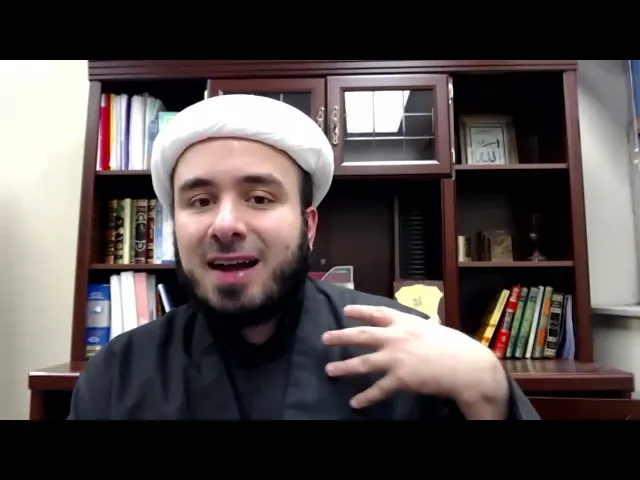
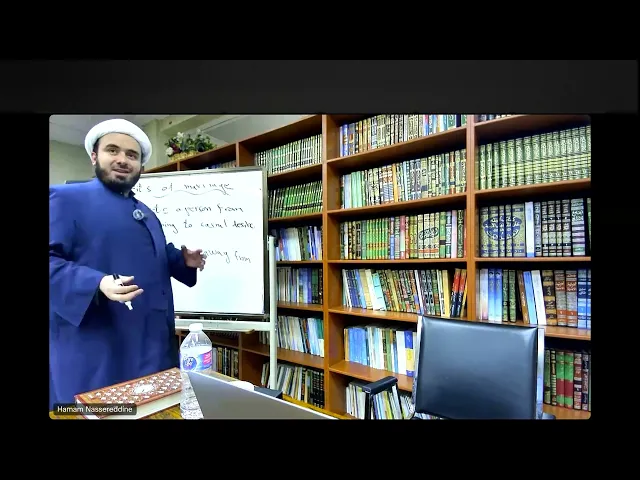
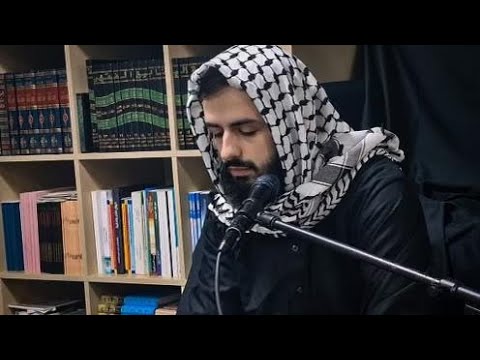
BH- Lesson 22- What made lady Fatima (pbuh) rejoice? - Hamam Nassereddine
0
0
9 المشاهدات·
24/12/17
في
محاضرات
These are lessons in which we shed light on Koranic verses and narrations from Ahlul Bait (peace be upon them) that teach us the steps one should take to build an Islamic family.
أظهر المزيد
Transcript
[0:06]ald in our last lesson regarding how to build an Islamic household
[0:47]we were speaking about we mentioned certain Traditions that spoke about The
[0:54]Good Wife and the last point we were looking at which was
[0:58]one of the vital points one should try to implement when he
[1:05]wants to build a Muslim or an Islamic household uh the last
[1:09]point we mentioned was that the two spouses should agree that if
[1:15]they go through disagreements or if they go through problems and for
[1:21]some reason they're unable to solve the problems unable to get rid
[1:26]of the disagreement then they should appoint a judge who will judge
[1:31]fairly between them and that judge is the infallible judge meaning in
[1:46]other terms it is essential for them to look at what the
[1:53]Quran says and what say regarding the problem that they ran into
[2:00]and then both of them should submit to what the Quran or
[2:06]what say it's as simple as that if they know what the
[2:13]Quran or what said then they'll remind each other they'll remind themselves
[2:19]of what said if they don't know or then or they're unsure
[2:26]then they can simply refer to the people of knowledge if they
[2:30]refer to someone who is an expert in that field and for
[2:33]some reason suppose he doesn't know or at that specific moment he
[2:39]forgot what the Quran or what said regarding that specific issue then
[2:45]they'll refer to someone else and they'll keep on doing that until
[2:49]they get to what they'll get to a result once they understand
[2:55]what the Quran what say on that regard both of them should
[3:03]submit to what say I'll be honest however one problem that we
[3:06]do face in societies is that one of the two spouses or
[3:13]both of them will not submit to what the say we we
[3:20]as sh um naturally will submit to what the Quran or what
[3:26]say from a belief perspective right as in believe that what they
[3:32]say is right what when when they say something is wrong will
[3:36]believe that this is wrong when they say something is false we'll
[3:39]believe it's false when they say something is true we'll believe it's
[3:44]true correct that's from a belief perspective but on a practical level
[3:49]sometimes you'll find the sh may Allah uh guide them all and
[3:58]guide us you'll find the sh sometimes um not implementing certain things
[4:06]that he believes in so he believes that this is right because
[4:09]said it's right but he or she will not implement it will
[4:15]not practice it or she believes that this is wrong because said
[4:21]it's wrong but again she will not abstain from that specific thing
[4:26]so working on our submission on our practical submission is beyond necessary
[4:34]um especially when we're talking about spousal issues and spous problems have
[4:44]given us advice if men and women alike if husbands and wives
[4:50]apply the advice of their spousal life will be a comfortable life
[4:54]their spousal life will be a life of of comfort a life
[5:01]of peace but the problem is what sometimes we do not Implement
[5:07]what our said what our IMS said that's the problem we said
[5:23]we learned this from who okay you're telling us that we should
[5:27]appoint an infallible judge who will judge between the two spouses in
[5:31]case they run into a problem or a particular disagreement and they're
[5:35]unable to get rid of the problem or the disagreement who teaches
[5:40]us to refer to that infallible judge none other than the two
[5:47]infallible spouses the two lightsi and I think I shared this tradition
[5:54]with you but we'll share it again I just sent it right
[5:56]now on the chat section from it we derive this very important
[6:01]point the tradition says as you can find in cites the book
[6:15]that IM said that his father said he said meaning Ali and
[6:28]they came to the prophet and they appointed him as the judge
[6:33]between them both in regards to what in regards to to service
[6:40]or Services what is excuse me what is Fatima's Duty in regards
[6:46]to uh the services that she has to present to Ali and
[6:51]what is Ali's Duty in regards to the Serv Services he should
[6:58]present to fatim we said this once but we'll say it again
[7:02]they had no spousal problems had absolutely no spousal problems but here
[7:13]they're teaching us that any two believing spouses should always refer to
[7:18]what Allah says subhana wa tala to what Allah says to what
[7:23]the infallible say um and they should impl L what they say
[7:30]especially especially if the two spouses disagree on a particular Point Ali
[7:38]and Fatima did not disagree on anything and even then they went
[7:46]toas Allah and they they asked to judge between them which means
[7:51]that if there is a problem if a problem does occur or
[7:55]there is a disagreement a disagreement does occur between the two spouses
[7:59]then obviously they should refer to the infallible judge so he told
[8:11]Fatima that it is it is upon her it is her responsibility
[8:16]to uh work inside the house whatever lies inside the house is
[8:23]part of her responsibility or responsibilities meaning she's responsible of upholding the
[8:34]house chores taking care of the house chores and he told Ali
[8:43]that he was responsible of taking care of the issues or the
[8:49]Affairs that lie outside of the house meaning he's responsible of what
[8:53]bringing let's say wood into the house bringing water bringing food bringing
[8:59]sustenance Etc bear in mind Ali and Fatima here represent Muslim husbands
[9:10]and Muslim wives Ali represents the Muslim husband and Fatima represents the
[9:18]Muslim wife right so the narration tells us here that based on
[9:23]the Islamic system the lady is responsible of upholding the house chores
[9:29]she's responsible of let's say clean the house fixing the bed um
[9:37]cooking food uh cleaning the dishes Etc and the husband is responsible
[9:41]of what of working outside the house and bringing money and other
[9:47]form forms of sustenance that the family needs into the house this
[9:52]is based on what based on the Islamic system yes I believe
[10:02]work as yeah the the prophet here wants to to say s
[10:15]Al that the it is on the lady to to uphold the
[10:23]house Choice make sense and it's on the man to to work
[10:28]and bring bring sustenance to the family now whether the man has
[10:31]to leave the house or not does not make a difference naturally
[10:35]or usually he has to leave the house right he has to
[10:39]leave the house to uh to to to bring sustenance but if
[10:44]we suppose that someone can work from home the the same would
[10:48]apply although I've realized that even when it comes to these jobs
[10:51]that are uh performed from from home uh the job itself sometimes
[10:57]requires the the worker to leave the house for example there's an
[11:04]urgent meeting and the boss wants you in the office right [Music]
[11:36]what does that mean this statement has multiple interpretations that mentions one
[11:45]is the following the the the lady of lightam is saying only
[11:52]Allah knows the amount of joy that penetrated through my heart when
[11:57]the prophet Sall alai wasam when the prophet told me that I'm
[12:04]not required of leaving the house and as a result he concealed
[12:08]me from the sight of men ultimately when a lady Works what's
[12:17]going to happen in many cases if not in most cases she's
[12:23]going to have to mix with nonaham men that's a given in
[12:28]our world today even in Muslim countries if a lady works then
[12:34]in many cases or most cases she has to what she has
[12:40]to see nonah men they have to see her yes she'll be
[12:42]wearing hijab if she's religious she'll be wearing hijab but she still
[12:50]sees non they still see her she interacts with them they interact
[12:54]with her so we know that teaches us to separate both genders
[13:13]as much as possible yes there are cases where both genders have
[13:18]to be in the same room where both genders have to interact
[13:21]there are cases like that yes so in such cases obviously the
[13:27]lady must observe full hijab we're talking about the physical hijab and
[13:32]the lady and the man both of them should observe the internal
[13:37]hijab the spiritual hijab so none of them for example look at
[13:41]each other in an unlawful manner none of them touches the other
[13:44]so on so forth that's what that's part of the internal hijab
[13:49]beautiful but in general is zah the Lady of Light the lady
[13:56]of Chastity and shyness teaches us Muslims and teaches the world that
[14:00]the more segregation we have amongst genders amongst both genders the better
[14:05]it is for society she's the one who said it is best
[14:11]or better for a woman not to be seen by a man
[14:15]nor to see a man now some you know some people might
[14:17]be outraged when they when they hear this Hadith you know how
[14:22]can you say such a thing well first of all it's it's
[14:26]not me it's and I'm the smallest servant for if she says
[14:32]something I will accept it without doubt she's one of the created
[14:35]lights of Allah subhana waala we have to accept what she says
[14:40]secondly zah is not saying it's a must she didn't say it's
[14:46]wag she said it is best it is best for a woman
[14:52]not to be seen by a man nor to see a man
[14:55]so here we understand from fa that the Les mix we have
[15:02]between both genders the more segregation we have the better it will
[15:06]be for society hence you find in general in general that when
[15:12]we come to Islamic centers or Islamic mosques uh mus uh to
[15:16]to uh massage it Sor uh you find that women will be
[15:21]in one room and men will be in a different room and
[15:25]if they're both in the same room in many cases there will
[15:28]be a partition or curtain between the men and the women or
[15:34]the woman will be sitting in the back and the men will
[15:36]be sitting in the front such that the men will not be
[15:39]able to see the women of course it would be better to
[15:42]have a curtain that separates them both but in general you find
[15:48]that in mosques and in Islamic centers there is an atmosphere of
[15:51]segregation this has been taken from what some people might think this
[15:55]is culture right this is simple cult simply culture no yes perhaps
[16:03]um perhaps certain cultures do emphasize on segregation but this is a
[16:09]religious concept it's a it's a FY concept Zam taught us that
[16:17]it is better to have what to have segregation it is better
[16:21]to separate both genders as much as possible when she said she
[16:31]said it is better for a woman not to be seen by
[16:37]a man and not to be seen uh sorry it is better
[16:39]for a woman not to see a man and not to be
[16:43]seen by a man what's interesting is the the word of which
[17:12]I explained earlier explains to us or demonstrates for us displays for
[17:20]us one of the dis disadvantages of women working in public one
[17:29]of the disadvantages of having a lady working in public is that
[17:34]she's going to have to mix and interact with what with nonah
[17:38]one might tell me but there are cases where this is necessary
[17:42]I say put those cases aside I'm not talking about cases of
[17:49]necessity I'm talking about cases in general so I'm talking in a
[17:55]general manner if there's a case of necessity that that uh that
[18:01]uh tells us it is necessary for the lady to be working
[18:06]in a specific place in a specific setting that's different that's different
[18:12]are you talking about necessity of I'm talking about uh no well
[18:26]what do you mean by necessity of profession for example uh a
[18:31]doctor okay right a woman would need a female doctor foress yeah
[18:35]that is what I mean by profession okay and by the need
[18:40]for the moment I mean like somebody who needs she she needs
[18:44]to to work for a certain reason yeah I'm talking about both
[18:47]yeah both both cases so when when what I mean to say
[18:52]is that when there's a case of necessity and the lady has
[18:55]to to work then well we can't say anything about that right
[19:00]she has to work she has to work uh would there still
[19:07]be a disadvantage um stemming from her interacting with non Maham men
[19:14]yes but that would be a need I I guess or it
[19:16]would be necessary for her to go through that because she needs
[19:21]to work in that specific setting in that case she would obviously
[19:25]be required of observing hijab and not crossing any uh religious boundaries
[19:30]right she and the men would be required of of of doing
[19:38]so but when we say that it is better for women to
[19:40]you know be in their houses and to uphold the house chores
[19:46]that's better for them than working outside the house we're talking in
[19:51]a general sense and we're uh what do you call it uh
[19:57]we're uh excluding the cases of of necessity even when we look
[20:01]at those cases of necessity for example there's a lady she's a
[20:05]widow and she has no one to support her she has orphans
[20:10]and she needs to work outside of her house to sustain herself
[20:14]and her children even in that case if she's able to work
[20:21]in a setting where there's more segregation or a setting where there's
[20:26]complete concealment for her that would be better for her but if
[20:28]she can't work in such a setting she has to be in
[20:33]the setting where you know she interacts with nonah to a certain
[20:36]extent then we tell her you're allowed to do that God help
[20:40]you of course may Allah T protect you may Allah help you
[20:45]you're allowed to do that but make sure that you preserve You
[20:49]observe the Islamic hijab and you do not cross any religious boundaries
[20:54]um so yeah that's uh that's the comment I wanted to uh
[21:00]to make ahed go ahead regarding uh the the comment of woman
[21:12]in the workplace I recently went to the doctor to get treated
[21:18]for strep and it was uh treated by a female nurse and
[21:20]doctor is that permissible or or impermissible so you you you can
[21:29]be treated by a female doctor or a female nurse but it
[21:32]depends but but there are as we said religious boundaries that cannot
[21:38]be crossed so it depends on the type of treatment that you
[21:42]that you are receiving in some cases it is unlawful to be
[21:46]treated by the female doctor or nurse and in some cases it
[21:51]is lawful it depends on what's Happening I'll give you an example
[21:55]I'll give you two examples an example pertaining to the to uh
[21:59]to um the lawful case and an example pertaining to the unlawful
[22:09]case for example I go to a doctor okay and what I
[22:12]I have a specific you know condition that requires that the doctor
[22:19]touches me in a way such that there's skin to skin contact
[22:25]okay and I can go to a female doctor or I can
[22:29]go to a maale doctor and they're both at the same level
[22:35]of expertise they have the same experience in this case if I
[22:40]go to the female doctor and she touches me I'd be doing
[22:44]something Haram it's unlawful because I can go to to the mail
[22:48]the mail doctor is available okay and it's Haram for the male
[22:53]to to touch me but it's Haram for the female to touch
[22:55]me I'm not in a case of necessity well calleda in Arabic
[23:02]a case of necessity that necessitates that I go to the the
[23:06]female doctor and get treated by her such that there's skinto skin
[23:14]contact contact so in this case if I go to the female
[23:16]doctor it would be unlawful make sense as for the lawful example
[23:22]uh if I go to a female doctor and I tell her
[23:29]about my condition but she doesn't she doesn't touch me she tells
[23:32]me what I have to do she tells me you know let's
[23:35]say what what what I have to do or what I have
[23:39]to consume what medication I have to take for example to treat
[23:41]my condition but she doesn't touch me and she doesn't uh look
[23:47]at any body parts of mine that uh she's not allowed to
[23:53]see or that I'm not allowed to uncover in front of her
[23:56]in this case it would be what it would be lawful because
[24:01]me going to the female doctor is not leading me or her
[24:07]to any Haram de make sense there are other examples that that
[24:11]can be given but I I uh wanted to give these two
[24:16]examples to clarify the point we mentioned which is in some cases
[24:21]if you get treated by a female doctor or nurse uh getting
[24:28]that treatment might be unlawful and in some cases it might be
[24:31]lawful it all depends on what happens and also it depends on
[24:39]your case are you in a case of necessity or not as
[24:43]in is it necessary for you to be treated by the female
[24:51]doctor or nurse or not so the um the uncovers one of
[25:09]the major disadvantages that uh ladies acquire when they when they work
[25:15]in public when they work outside of their their homes and this
[25:19]disadvantage should not be taken lightly I'm mentioning this because the reality
[25:25]is this disadvantage might create a good amount of spousal problems believe
[25:34]it or not some people might you know neglect these words they
[25:39]might even belittle what I'm saying but this is a reality there
[25:42]are spousal problems that are created within the house or within the
[25:46]household because women mix to an excessive degree with nonaham men so
[26:00]when we get rid of that and we apply the Islamic system
[26:04]what's going to happen there is a good amount of spousal problems
[26:10]that will be removed I'm not saying all spousal problems come from
[26:15]that no no no and I'm not blaming women for the spousal
[26:17]problems that exist amongst households no no sometimes the spousal houss take
[26:24]place because the man is at fault that's a given sometimes they
[26:29]take place because the woman is at fault sometimes no one is
[26:35]at fault but they're unable to understand one another nonetheless what we
[26:42]should keep in mind is when we have an excessive amount of
[26:50]mixing between men and women J uh between men and women who
[26:54]are non mahs problems are bound to happen if not spousal problems
[27:01]other kinds of problems will take place Allah subhana does not teach
[27:05]us a particular concept or particular deed for no reason he knows
[27:11]best as the Quran says Allah knows yet you do not know
[27:18]so it's quite interesting that zah mentions this point when uh when
[27:24]the prophet says that she is uh she is responsible upholding the
[27:30]house chores and is responsible of bringing sustenance and um Provisions to
[27:37]to the house all right well mention other points inshallah uh and
[27:49]we'll continue with uh these topics next week alive
0 تعليقات
sort ترتيب حسب
- أعلى تعليقات
- أحدث تعليقات
التالي
8 المشاهدات · 21/12/07
11 المشاهدات · 24/11/14
10 المشاهدات · 22/05/25
6 المشاهدات · 24/01/31
9 المشاهدات · 24/02/01
2 المشاهدات · 24/02/27
7 المشاهدات · 24/04/24