







Up next
7 Views · 21/12/07
9 Views · 24/11/14

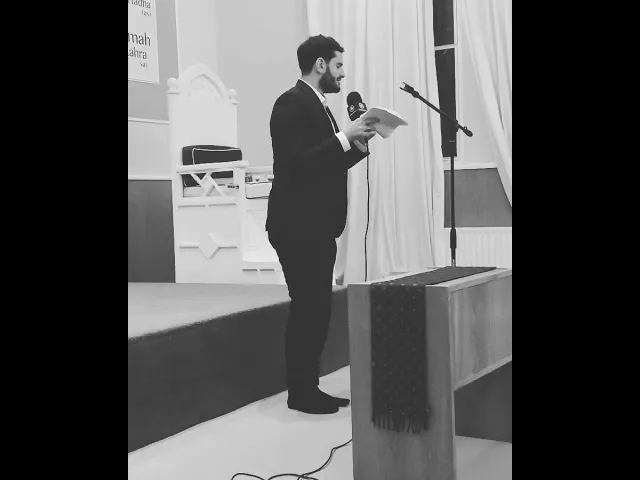
To Surrender and Submit - Sayed Mehdi Qazwini (Night 2 Muharram 2019)
0
0
9 Views·
24/03/23
In
Lectures
To Surrender and Submit - Sayed Mehdi Qazwini (Night 2 Muharram 2019) at the Ahlul Bayt Center of Toledo
Show more
Transcript
[0:00]to LA he wa barakato audhu billahi Samia Ali min ash-shaytani r-rajim
[0:09]bismillahi r-rahman r-rahim al-hamdu lillahi rabbil alameen wa sallahu wa salam o
[0:16]allah al anbiya wa l-mursalin Habib Allah al al-amin below cozumel Mustafa
[0:22]Muhammad Ali BtoB navaja renal massaman al muntaha being sallahu wa salam
[0:35]alayka ya rasul allah sallallahu assalam alayka ya a bar abdullah yamato
[0:43]la hill wha wah-bah-bah Nejat Illuma gallatin kanakam ced vana for suppose
[0:52]an edema audhu billahi min ash-shaytani r-rajim bismillahi r-rahmanir-rahim balaam an Islamic
[1:03]watcher who lillahi wa huwa morrison fella who a drove our Enderby
[1:11]well our hope on alayhim wala home yesenin sadaqa allahu allahu allah
[1:17]allahu allah muhammad wa ala muhammad one of the perennial and existential
[1:30]challenges that has faced humanity throughout the ages is the question of
[1:38]theodicy and that is the question of why evil exists in this
[1:49]world and more particularly why do bad things happen to good people
[1:54]if you think about bad things happening to bad people we justify
[1:59]sometimes in our mind you see someone who's annoying and they trip
[2:04]over something and you say well he deserved it or she deserved
[2:10]it but why do bad things happen to good people people who
[2:14]are innocent pure who have not hurt anyone and this is a
[2:17]question that in order for religion to stay relevant throughout the ages
[2:30]must be asked so when you look at the three major Abrahamic
[2:35]faiths Islam Christianity and Judaism within Christianity there were a number of
[2:42]philosophers and theologians who tackled this question such as st.
[2:51]Augustine and st.
[2:50]Thomas Aquinas in Jewish theology it was mainly Maimonides and of course
[2:59]in the Islamic tradition there were many scholars who tackled this question
[3:05]and the common thread in that question the common theme that appears
[3:09]in the answer to that question of why evil exists all scholars
[3:13]and theologians and philosophers agree that human beings have free will human
[3:23]beings are not robots and it's interesting because the question of God's
[3:29]quote-unquote behavior becomes a question of human being behavior and these questions
[3:38]normally come up when something really happens such as a natural disaster
[3:47]or genocide people begin to ask the question how if God is
[3:53]omnipotent meaning that he has power over everything and if he is
[3:58]Omni benevolent meaning that he is all good and all benevolent how
[4:02]is it that something like this can happen in the history of
[4:10]the shri school of thought one of the earliest scholars to answer
[4:16]this question was a Sheikh Hasan OOP particularly in response to the
[4:22]question of how allah subhana wa ta'ala would allow something like the
[4:28]tragedy of Oshawott to happen think about it this is not a
[4:32]random group of people I mean even if it was a random
[4:37]group of people it would still be a tragedy we watch movies
[4:40]today produced by Hollywood or a TV series that are completely fictional
[4:44]that have nothing to do with the truth but you're able to
[4:51]emotionally connect with the characters on stage so if you see a
[4:55]loss of life you're able to weep because it tells you of
[5:00]human nature even if you're not personally connected to this person so
[5:06]it wasn't a random group of people but rather it was the
[5:09]family of rasulullah sallallahu alayhi wasallam the purest household so the early
[5:16]communities they struggled with this question of how could something so great
[5:21]happen to people that were so pure and so among the early
[5:28]scholars to answer this question was a chef of sudoku who passed
[5:31]away in the year 381 after Hitler and he wrote a book
[5:35]he'd wrote a number of books but in one of his books
[5:37]it's a codicil amamiya in which he describes the Creed and the
[5:44]theology of the annual debate school of thought in his response he
[5:49]delineates between God's will and God's desire everything in this world happens
[5:58]because God wills it to happen it is out of his will
[6:00]his mushiya in the Arabic language when we say masha'Allah literally the
[6:06]phrase masha'Allah means what God wills because everything which is magnificent normally
[6:14]if you see something magnificent you say masha'Allah in a way you're
[6:19]saying this is what this is out of the will of God
[6:23]as as great as it is you're reminded of the collip of
[6:28]the creator that created it meaning that God who willed it is
[6:33]greater than this thing that you are in awe about so he
[6:38]says there there were two things there's the there's the will of
[6:42]God and everything happens for the will of God good bad ugly
[6:45]nice not nice everything out of the will of God however God
[6:52]does not desire desire is something else God does not desire for
[6:56]everything to take place in this fashion and God speaks about his
[7:01]desire in the Quran the things that he desires to see and
[7:07]the things that he does not desire to see for instance what
[7:10]does God desire he says for instance in allaha yuhibbu tawa beam
[7:16]well you have bull mustafa harine god desires and he loves when
[7:24]he sees people who are repentant and people who purify themselves and
[7:30]allah subhana wa ta'ala also says in the quran and ilaha lie
[7:35]ahead there are instances things that God does not like to see
[7:41]it happens out of his will in allaha yuhibbu Kalam Italian for
[7:47]for instance people who are deceitful and people who walk around with
[7:51]pride God does not desire for that to happen he does not
[7:55]like it when that happens but it's out of his will because
[8:01]this human being is not a robot this this human being also
[8:05]has free will so the answer that a shekel Sidhu provides is
[8:10]that even though it was something that was so abhorrent something that
[8:14]was so tragic it was not something that God desired for it
[8:19]to happen but it happened through his will and so an even
[8:26]deeper question behind that is that how low does humanity have to
[8:31]get to how low of a level does humanity have to get
[8:36]to for something like this to happen for them to be on
[8:38]the other side or for people to stay quiet because what was
[8:45]equally as tragic as the people who fought against imam hussain were
[8:49]the people who stayed quiet the people who went to bed that
[8:55]night they heard about the news and they went to bed and
[8:58]they had restful sleep so in actuality it was something that happened
[9:03]that had long-term effects and it had short-term effects the short-term effects
[9:09]if you read history we would find that there were a number
[9:15]of people who within the next 10 to 20 years after what
[9:17]happened to Imam Hassan and his family they rose up and the
[9:25]benoît Maya although they ruled their entire period of rule was about
[9:29]80 years so although they ruled for a few decades after the
[9:32]massacre of Karbala it was not peaceful for them ever never was
[9:37]it peaceful for them there was there was a series of rebellions
[9:40]and revolutions one of the first of those rebellions was that that
[9:46]was known as table to table being the penitence and these were
[9:50]a number of people who had initially invited Imam Husain to be
[9:54]with them to be their leader in Kufa but then they sold
[9:59]him out when he agreed and they turned away and they let
[10:04]him down and after they heard about his death it shook their
[10:08]conscience so they created an uprising and it was not a successful
[10:12]uprising that was short term long term is that the massacre that
[10:18]happened became a focal point where the entire religion of Islam became
[10:27]preserved so that you and I can practice the faith and understand
[10:30]the faith in the way that it was sent down to the
[10:35]sort of lhasa allah honey who i do send them one of
[10:36]the writers historians he says you know when at one of the
[10:44]predicaments is that we don't know we don't truly understand the magnitude
[10:48]of what imam hussain did precisely because his revolution was successful we
[10:53]would be able to see if you if he did not rise
[10:58]up we would be able to see how different the situation was
[11:01]and what he was saying was that islam was on the verge
[11:07]of becoming an arab monarchy it was on the verge of becoming
[11:10]an arab monarchy and we have present-day Arab monarchies so we know
[11:17]how terrible the situation could have been so take the model of
[11:22]the Arab monarchies that we have today that would have been the
[11:24]entire Islam if you know what I mean and you can read
[11:31]between the lines so the question then goes back to what is
[11:33]submission and what is surrender ins because it all happens out of
[11:38]the will of allah subhana wa ta'ala the quran tells us the
[11:43]following Balam an Islamic Jihad Li hua hua Morrison verily the one
[11:50]who submits his face to Allah and he is marcin and he
[11:56]is benevolent fella who agile were and that'll be what I hope
[11:58]finale him what a home the afternoon so what does it mean
[12:00]to submit your face to God well first of all according to
[12:06]some commentators they say that here in this specific verse to submit
[12:10]a Salaam to submit means to be sincere to be sincere in
[12:17]your affairs the way that you carry yourself and the face is
[12:20]the holiest part of the body it's the most honored part of
[12:26]the body part of that is the forehead where we placed on
[12:29]the ground in prostration to Allah subhana wa tada when you receive
[12:34]someone a loved one a relative and you greet them you kiss
[12:37]them on their face on their cheek on their forehead it's the
[12:44]most honored place and we're mandated to take care of our face
[12:47]because our face represents our physical appearance it's the first line of
[12:52]our appearance and that's why laws of hygiene you know there's an
[13:01]insistence in in that area the laws of Hygiene taking care of
[13:04]yourself taking care of your face and being presentable before you leave
[13:08]the home what does it mean to submit in essence submission is
[13:17]the opposition of rebellion and we're told that the first person or
[13:22]the first being to rebel against the will of Allah subhana wa
[13:26]ta'ala was whom i beliefs when the angels in the jinn were
[13:34]ordered to submit to to prostrate to Adam and all of them
[13:37]prostrated except for Iblees and his reasoning was that he saw himself
[13:42]as superior and that's why he did not submit but rebellion the
[13:51]act of rebellion in and of itself is not something evil it's
[13:58]not deplorable we must first understand principles and define our values by
[14:06]principles to understand whether rebellion is good rebellion or whether it's bad
[14:15]rebellion not all rebellion is bad why because imam hussain ali salam
[14:20]he rebelled was it not an act of rebellion it was an
[14:24]act of rebellion but because imam hussain ali salam had the proper
[14:27]values which were derived from principles his rebellion was a good rebellion
[14:33]his revolution was a good revolution it was virtuous it was benevolent
[14:38]so in order to understand the nature of the act of rebellion
[14:41]we must first understand and follow principles not follow people the people
[14:47]who were confused at that time they didn't know what side to
[14:52]take the reason they were confused is because they didn't stand on
[14:54]principle they did not follow principle they followed people amirul mumineen Hani
[15:01]Salaam during one of his battles before the battle of German specifically
[15:07]he is he is confronted by one of the Companions and most
[15:11]of you know the story one of the companions he looks to
[15:15]him and he sees full on and full on on the other
[15:17]side of the battlefield people that were companions of the Prophet and
[15:25]he turns to me and he and he confronts him about this
[15:27]fact he says how is it that we're about to go into
[15:30]war when I recognize this person and that person and they were
[15:33]with the Prophet and so on and so forth and in a
[15:37]very short version Imam Ali Ali Salaam clarifies the confusion and he
[15:41]tells him he says you look confused here in the calomel Busan
[15:45]Alex you look very confused here and then he tells him he
[15:48]tells an elephant Hawk that are with Allah why I feel bad
[15:53]on a tavola when you understand the principle of goodness and virtue
[15:58]then you all know who is good and who is virtuous and
[16:06]when you understand evil as a value then you will be able
[16:08]to recognize who is evil and what is evil meaning that don't
[16:11]follow a person just because of a name or just because of
[16:16]a lineage or just because of a family test their behavior and
[16:19]does their behavior is it in alignment with the values that they
[16:22]claim to have is it based on the principles which they claim
[16:32]to support in one narration Imam Ali Ali Salam he he tells
[16:37]his companions not to fall victim to false prestige one narration says
[16:42]that one day Amira meanwhile he was Emir he was on his
[16:47]horse he was riding his horse and he saw a number of
[16:53]people following him a number of followers so he turned to them
[16:55]he said do you have any business with me is this why
[16:59]you're following me they said no we do just wanna you know
[17:03]we want to follow you you're a leader we want to bask
[17:09]in your glory he told them turn back he says if you
[17:12]have no business from you turn back because your actor following me
[17:15]now is harmful for you because it's disgrace for you to follow
[17:23]someone for no reason and it's also harmful for the person who
[17:25]is riding as well because it gives the person who is riding
[17:29]a false sense of prestige that people are following me because I'm
[17:33]somehow special he said if you don't have any real business with
[17:37]me turn away go back the reason I this submission I think
[17:43]because as as a community humanity psychologically there is especially in a
[17:49]world of radical individualism and I'll talk about this in one of
[17:56]the nights were promoted in today's day and age that the world
[17:59]is about you we live in the age of the influencer that
[18:06]anybody can really rise to the top and so this idea of
[18:09]having to submit or it's a surrender which this concept is built
[18:14]into the name of our faith the religion of Islam is surrender
[18:19]ins it irks people and it rubs people off the wrong way
[18:24]and one reason specifically if if you look at contemporary society is
[18:32]because of the fact that a lot of people have been let
[18:37]down by certain political institutions by certain religious institutions so when you
[18:45]talk about submission and when you talk about coming under submission that
[18:51]Earth's people and it rubs them off the wrong way but submission
[18:55]is part of who we are as long as it is two
[19:00]principles and not people we follow people as long as we follow
[19:03]principles there's a writer by the name of Alan Lloyd McGuinness and
[19:09]he wrote a really important book some of you are probably familiar
[19:12]with this book bringing out the best in people and he said
[19:16]that whenever you're dealing with a group of people always always consider
[19:21]that there might be temporary insanity what is insanity insanity is when
[19:28]someone loses their mind always consider that whoever you're dealing with they
[19:34]might go insane temporarily because sometimes we tend to idolize people and
[19:40]we follow up their feet and you know they're they become the
[19:47]Alpha and the Omega for us and our entire life revolves around
[19:50]people but then that person we don't realize is not infallible what
[19:54]if that person loses their mind one day and unfortunately when we
[19:59]follow that tends to happen a lot especially with with celebrities in
[20:04]this day and age where people idolize them for what they stand
[20:12]for and then all of a sudden the celebrity or the person
[20:16]that's being followed the idol does something wrong and they fall from
[20:20]grace or they commit suicide and millions of people millions of followers
[20:26]are affected because they idolize this person because they saw them as
[20:34]perfect so submission is not submission to people submission is submission to
[20:37]principles we submit to people as long as they follow principles this
[20:43]is point number one point number two is that submission is not
[20:49]the absence of opinion but rather the absence of rebellion and as
[20:55]Muslims we are not asked for uniformity we are asked for unity
[21:04]you know being able to create harmony between people is truly an
[21:10]art and not a science there's a lot of books on leadership
[21:16]management's how to get things done but in reality if you think
[21:22]about it if you've ever been in a leadership position even within
[21:26]your own home try to get two people to harmonize and synchronize
[21:31]and work together on a project and you would know exactly how
[21:35]tough this is if you've worked in Masjid leadership then you know
[21:42]exactly what I'm talking about having people work together in harmony and
[21:47]Allah subhana WA Ta'ala says to the believers in the Quran he
[21:54]says bismillah ar-rahman ar-rahim web guru nemyt allahi alaikum remember the blessing
[21:58]that allah subhana wa ta'ala conferred upon you in kuntum nada the
[22:04]LFA been upon you become that you were once enemies of one
[22:07]another but God created harmony God created love and compassion and cut
[22:14]and cooperation between you and there was a time before the Islamic
[22:22]period where people were enemies of one another family members were enemies
[22:26]they became enemies of one another and the mission of the Prophet
[22:34]Muhammad sallallahu alehiwassallaam was to create unity and harmony but the way
[22:41]that that happened was through submission to the correct principles and to
[22:47]the correct foundations if you look at history history gives us a
[22:52]number of examples but if you look at the history of the
[22:54]20th century one of the most successful people one of the most
[23:01]successful leaders in the 20th century was Mahatma Ghandi probably the most
[23:07]influential person of his time and if you look at him in
[23:09]terms of his public appearance he was I mean he was an
[23:15]eccentric dude he was he didn't wear any formal clothing you know
[23:19]he wore his robes his traditional clothing and he kind of behaved
[23:24]in sort of a bizarre way if you read his about his
[23:29]personal life but a man like that was able to rattle the
[23:32]foundations of the mighty British Empire and how was he able to
[23:38]do that one word harmony he was able to bring to other
[23:42]people in harmony specifically 200 million people to bring them together in
[23:48]harmony for a chief purpose and that was the purpose of resistance
[23:56]and if you don't think 200 million people bringing together is impressive
[24:00]then go back to that question of trying to bring two people
[24:04]together and see how far you're able to get so being able
[24:11]to conduct your manners in a state of harmony and that begins
[24:15]with yourself some of us were not at peace with ourself we
[24:20]constantly struggle with our past self with our past mistakes and we
[24:30]believe that all of the wrong things that we have done all
[24:32]of the mistakes that we've done in this world have defined who
[24:40]we are and it's a label and as long as and and
[24:41]when that label gets stuck onto you you're doomed and there's no
[24:46]change so people are not even at harmony with their own selves
[24:51]so harmony begins with our self when we're able to submit to
[24:55]ourself and then it begins with our family and then with our
[25:03]community and then with the globe so this is point number two
[25:07]point number three is submission when it comes to responding to our
[25:15]personal challenges and the challenges of others because that's where that is
[25:20]the true test of submission and if you study the life of
[25:24]imam hussain ali salaam what does imam hussain teaches his statement on
[25:31]the day of ashura was allah he arrived on biologic whatis liman
[25:40]Liam Erik that oh Allah I am satisfied I am content with
[25:43]what you have decreed and I have submitted myself to your will
[25:52]if this is your will then I am content so there's two
[25:54]spects when it comes to personal challenges number one is helping people
[25:59]navigate through their personal challenges and then us navigating through our own
[26:06]personal challenges so I just want to make a quick point here
[26:08]when it comes to helping people navigate through their challenges most people
[26:17]in this world are very well intentioned what do you agree I
[26:21]mean there is very little people who are have evil intentions and
[26:25]a lot of the damage that comes in this world comes from
[26:32]people who are well-intentioned but ignorant and most of the time when
[26:36]it comes to helping people navigate through their challenges we are well-intentioned
[26:42]but we're ignorant I'll give you an example the first example is
[26:47]the language that we use with other people to help them navigate
[26:51]through their challenges in our mind when we come across someone who's
[26:56]facing a challenge such as a financial loss or a health challenge
[27:04]or the loss of a loved one or the loss of a
[27:12]career or a divorce we tend to use language that is well-intentioned
[27:15]but ignorant of the person's state so what do we tend to
[27:18]tell people don't worry you'll get over it you're a very strong
[27:28]person that person is in a better place what other language do
[27:32]we use sometimes I've even heard it wasn't meant to be and
[27:39]the reason I say this is well-intentioned is because we understand that
[27:43]Allah subhana WA Ta'ala has a will our lens by which we
[27:46]see this tragedy is this is the will of God but the
[27:50]way that we portray that and the way that we convey that
[27:54]it's well-intentioned but it's ignorant some people even I've heard when someone
[27:57]loses a child when there's a stillborn when it when a child
[28:04]is born but not alive they say things like well it's good
[28:07]that the child didn't grow because you would have been attached to
[28:10]the child and that would have been worse as if attachment is
[28:14]based on a child reaching a certain age once a child gets
[28:17]to age five or six or seven you become attached and they
[28:22]don't understand that sometimes having a child you become attached to the
[28:26]child ten years before the child is born because you're thinking about
[28:29]your children in the future so sometimes we need to equip ourselves
[28:35]with the right type of language instead of telling people that they'll
[28:42]get over it asking them what this tragedy means to them telling
[28:46]them that for as long as they are hurting you will be
[28:51]there with them I'm here with you I will be here with
[28:53]you I don't understand your pain but I'm here to listen to
[29:00]you if you want to explain to me in this way it
[29:02]becomes much much more beneficial so number one helping people navigate through
[29:06]their challenges and then navigating through our own challenges and the reality
[29:11]is my friends we may never understand the whys of life because
[29:15]the picture is much much bigger than we are but our shall
[29:21]are I will share with you something the famous psychoanalyst Viktor Frankl
[29:26]he says that suffering ceases to be suffering once we create meaning
[29:32]out of it what does that mean once we understand that there's
[29:39]a meaning or a purpose behind an event in which we suffer
[29:42]from it ceases to be suffering once we have a clear picture
[29:45]of it and that's why when you study the case of imam
[29:52]hussain ali salam when you study the case of all of the
[29:57]great prophets and the imams they suffered physically they suffered absolutely 100%
[30:03]there's no doubt in that but spiritually they were content in their
[30:12]spirits why because it had meaning they had purpose they knew and
[30:16]they could see the results of what was happening to them as
[30:21]if as if it was right in front of them I'll narrates
[30:23]you a personal anecdote and I'll end with this there was a
[30:31]lady who lives in Southern California and a while ago her one
[30:35]of her sons had passed away I believe if I'm not mistaken
[30:44]in a car accident once he passed away something happened in her
[30:49]life that she changed her life around completely she was far away
[30:55]from the religion she was not practicing she did not care for
[31:01]hajj or umrah or xiana or anything like that but once her
[31:04]son passed away she turned around 180 degrees she began to frequently
[31:09]go to zerah she began to frequently perform the Hajj she started
[31:14]to observe the full head job she started to pray every single
[31:19]day on time and then one day this is out of a
[31:23]personal narration one day she saw her son in her dream and
[31:26]her son said to her he said mom one reason the reason
[31:34]why I died is that so you can change her life all
[31:39]of a sudden she had meaning in her life now did that
[31:42]make things better for her in terms of grief I don't know
[31:46]but all of a sudden it had meaning all of a sudden
[31:51]it had a purpose she realized that there was a reason why
[31:54]this happened it was not in vain it was not a Beth
[31:58]it didn't happen because God was just angry at her and God
[32:00]wanted to punish her many of us we think bad things happen
[32:04]to us because God is just angry at us and he wants
[32:06]to punish us and that's very very limited vision imam hussain ali
[32:11]salaam we learned from his example someone who continuously was able to
[32:17]see the result of what was happening and that's why confidently imam
[32:21]hussain could say allah he arrived on a pelagic what's a Sleeman
[32:24]the Emrick he could say that with power he could say that
[32:30]with confidence because he knew exactly what was to happen on the
[32:33]other side and now I want to take your heart imam hussain
[32:37]ali salaam in Karbala after imam hussain left medina the next best
[32:45]place for him to go to was the city of mecca and
[32:50]he arrived long before the hajj season but he stayed until the
[32:54]hajj season so that he can perform the hajj but it was
[33:01]not long until even Mecca a place of security and a place
[33:04]of sanctity also became a thread on his life and the Prophet
[33:09]Ibrahim the Quran narrates the story of the Prophet Ibrahim thousands of
[33:16]years before that he had spoken a supplication adora wife kada Ibrahim
[33:22]Arabic al Haddad balada Amina oh Allah make this place this Ballad
[33:31]Mecca speaking of Mecca make it a place of safety make it
[33:35]a place of security make it so that people can come here
[33:40]as a place of refuge and that they would be safe they
[33:44]would be protected and that's why even the animals even the insects
[33:49]even the plants that don't have life human life are protected in
[33:56]the city of Mecca in the sanctuary of Mecca it is not
[33:59]permissible for anyone to hunt or to shed blood in the city
[34:07]of Mecca not even to pull a plant out of its place
[34:12]an imam hussain ali salaam honored this idea but because Yazeed even
[34:16]more area was so adamant about securing the allegiance of imam hussain
[34:21]he was willing to go at great lengths so he sent assassins
[34:27]city of mecca even though mecca was a sanctuary but yes eid
[34:32]did not care for that and when imam hussain ali said i'm
[34:39]realized this that his life was in danger he took the moral
[34:41]high ground he did not want mecca to be a place where
[34:46]his blood was going to be shed and so before he could
[34:51]even complete the Hajj imam husain came out from the state of
[34:58]Assam he delivered his famous sermon hot ball Motala will the atom
[35:02]mahakal pralaya theology delft etat wama allah hani allah a sloppy HT
[35:07]fa a-- boobarella yusuf he speaks of death and the inevitability of
[35:12]death and how nobody can escape death and how he longs he
[35:16]says I want to be with my predecessors I want to be
[35:21]with Rasool Allah I long to be with my parents I long
[35:26]to be with my brother al hasan in the same way that
[35:28]yahoo was longing for his son Yusuf when Yusuf was stripped away
[35:35]from him thrown into the darkness of a well sold into slavery
[35:39]put into prison all the while yeah boob had no idea and
[35:43]he wept and wept and wept and the Quran says fabulet innahu
[35:48]min and what we are but I now AM in Al fresney
[35:53]faha kareem that he almost lost his eyesight because he wept in
[35:57]that same way imam hussain says that same way that Jakub was
[36:01]longing for his son Yusuf I am longing to meet my predecessors
[36:07]and it's at that time brothers and sisters that imam hussain ali
[36:11]salam knew that death was imminent that it was impending that it
[36:16]was inevitable that no matter where he went whether he went back
[36:22]to medina whether he went east west no no matter where he
[36:25]would go that years eid was relentless in his mission and so
[36:31]that was when he decided to take and begin his journey from
[36:34]Mecca all the way to Karbala which took about twenty three days
[36:39]and inshallah in the coming nights we will give more details about
[36:45]the journey of imam hussain ali salam we ask Allah subhana WA
[36:47]Ta'ala to bless us in this holy month Milana rahim allahu al
[36:53]mumineen awhile - when muslimeen are Muslim at al-amin home well Ahmad
[36:57]been on our venerable high right in a comedy with the heart
[37:02]in the capital heart and Nacala kaliesha in Padilla arithmetic a arhamu
[37:07]r-rahimin allaha wa salamu ala sayyidina muhammad wala elevated by B naught
0 Comments
sort Sort By
- Top Comments
- Latest comments
Up next
7 Views · 21/12/07
9 Views · 24/11/14