التالي
8 المشاهدات · 25/12/01

10 المشاهدات · 13/12/26

10 المشاهدات · 14/09/23
7 المشاهدات · 21/12/07
7 المشاهدات · 22/11/28
10 المشاهدات · 24/11/14
8 المشاهدات · 25/06/22
8 المشاهدات · 25/11/02
8 المشاهدات · 13/01/07
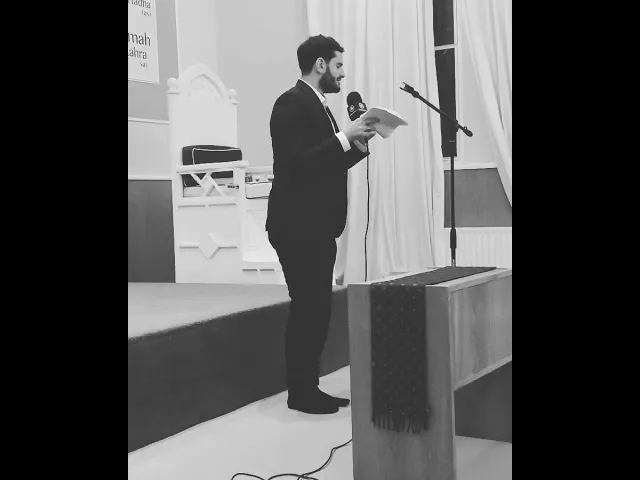
The Polarity Between Masculinity and Femininity - Sayed Mehdi Qazwini (Night 8 Muharram 2019)
0
0
19 المشاهدات·
24/03/23
في
محاضرات
The Polarity Between Masculinity and Femininity - Sayed Mehdi Qazwini (Night 8 Muharram 2019) at the Ahlul Bayt Center of Toledo
أظهر المزيد
Transcript
[0:00]to have one more time for the memory of our sister who
[0:03]we lost rahmanir rahim hamdu lillahi rabbil alameen wa sallahu wa salam
[0:30]ala ashrafilal mba even more serene Habib al-ajami Nabil cozumel Mustafa Muhammad
[0:40]vada Liberty I be no paranal Massimino al muntaha beam sallallahu assalamu
[0:47]alayka ya rasul allah sallallahu wasallam ah Ali ka-bar abdullah yah rahmatullahi
[0:58]wa my abenader till gallatin Arcana mark on CD vana forza forza
[1:09]edema audhu billahi min ash-shaitani rajim bismillah ar-rahman ar-rahim voila - taman
[1:19]oma follow allah who be he become a la ba la jolla
[1:25]no-sebum in Mecca Sabu wellness a NOC boom accessible Wasser ollahm fodhla
[1:33]analogic arabic allah shayin Alima sadaqa allahu al azim salut allah muhammad
[1:39]wa ala muhammad verse number 32 of chapter 4 in the Quran
[1:50]reminds us not to covet what one another has in other words
[2:01]do not desire something that is destined for somebody else and even
[2:08]simpler terms the Quran is explaining the human tendency to see the
[2:13]grass is greener on the other side and that's to say that
[2:21]we always think that others have it better the person on the
[2:25]other side either has it better than me they have less hardships
[2:31]than me I'm struggling my struggle is unique nobody has struggled in
[2:36]the way that I have struggled and it's all about me and
[2:43]my problems and my challenges and if only I had more time
[2:47]if only I had better looks if only I had more money
[2:53]if only if only and sometimes we live an entire life based
[2:57]off of the phrase if only so the Quran says when a
[3:05]determined Noma Fadlallah Habiba become a la Barthe larae jolliness EBU mimicked
[3:10]s Abu well in Nisa in a saebom mimicked a sub and
[3:13]the reality is that moral trials come with everything that is good
[3:22]and everything that is bad so if you're rich there are moral
[3:25]trials if you are poor there are moral trials if you're wealthy
[3:29]there are moral trials if you're not there are also moral trials
[3:35]and if you read the commentary of this verse you would come
[3:39]to know that commentators suggest that a group of women came to
[3:43]the prophet muhammad sallallahoalyhiwasallam and they asked him the question that why
[3:55]is it that men receive double the inheritance of woman or why
[4:04]is it that men are spiritually it seems like spiritually they're placed
[4:10]ahead because they're placed at the forefront for instance in the issue
[4:15]of jihad and the in the issue of battle and fighting and
[4:18]it's very interesting because it seems from this verse that even during
[4:27]those days men and women were confused about their roles in society
[4:31]as we see today men and women confused about their roles in
[4:35]society so in the case of jihad and being at the forefront
[4:42]even though that was ordained to men that was the responsibility of
[4:46]men even in those early days there were women that were fighting
[4:50]on the forefront a prominent example of that is no suburban scab
[4:58]a woman who was one of the first people who came from
[5:02]medina to pledge to the Prophet because before the Prophet left Mecca
[5:06]to go to Medina there were a number of pledges that took
[5:11]place and within those pledges the people of Medina had pledged had
[5:15]committed that if the Prophet came to him that came to them
[5:18]they would serve his mission they would help him so normally that
[5:24]was the business of men however she was one of the only
[5:27]ladies that participated with the men she wanted personally herself to pledge
[5:32]in her assistance in support of the Prophet and when the Prophet
[5:37]came she followed through with her commitment she went out into the
[5:42]battlefield in fact during the Battle of Oh hood when times became
[5:46]tough as described in the Quran and when the Prophet was almost
[5:50]abandoned completely narrations tell us that there was only a handful of
[5:56]people that stayed behind to defend the Prophet about five or six
[5:59]people she was one of those people when other men run away
[6:03]she stood there defending him even after the life of the Prophet
[6:08]she continued to participate by standing in the front lines of the
[6:13]battlefield so it seems that even in those days there was some
[6:17]confusion as to what the role of men and women are and
[6:22]so in light of that what I want to talk about is
[6:27]the question of masculinity and femininity because in today's world those questions
[6:33]exist in contemporary society and not just masculinity and femininity but you
[6:40]have you know you have the modern and the rise of the
[6:46]modern feminist movement and then there's the counter to that if you've
[6:50]heard of the meninist movement you know we always have to there's
[6:52]always one-upsmanship if you do something I have to do it better
[6:59]and where do those movements find their foundations now I want to
[7:02]talk about it from a social perspective but also focusing creating our
[7:06]focus on the Quran because if you stray away from the Quran
[7:09]you can get lost in the mumbo-jumbo of things so the number
[7:16]one question when it comes to masculinity we have this idea of
[7:21]what masculine it's years we have this idea of what femininity is
[7:27]and for most people their ideas are informed by what simply by
[7:33]their association and what they see on TV so when a man
[7:38]looks up when a boy looks up to his father he's looking
[7:41]up to his father to provide a model of masculinity to him
[7:47]when a boy or a girl looks up to the mother they
[7:50]are looking up to her to fill the role of femininity so
[7:56]the question is how do we define ourselves how do people define
[8:00]themselves because these terms are sometimes they're arbitrary and sometimes they sort
[8:06]of get confused and convoluted how do you define yourself do you
[8:13]define yourself by your job by your career by you being a
[8:22]parent if you if you wrote out the definition of myself and
[8:26]you wrote out your name what would you find there sometimes we
[8:34]tend to define ourselves by things that you know are sort of
[8:39]arbitrary and when we when we lose those things in our life
[8:42]it's as if we've lost everything in our life so if a
[8:48]person is described by their career or by their job for 40
[8:53]or 50 years of their life what happens when they're no longer
[8:57]practicing that job or practicing that career when their entire purpose is
[9:02]based upon that title when their entire meaning of life is based
[9:06]upon that title what happens when they're stripped of that title or
[9:13]when they retire they say one of the biggest killers of people
[9:17]is retirement and by retirement they you know not doing anything it's
[9:21]giving up your job and then not committing yourself to anything meaningful
[9:24]or committing yourself to anything purposeful and people who live long lives
[9:29]or people who continue even after the age of quote unquote retirement
[9:33]they continue to put their life in meaningful projects and purposeful projects
[9:39]so how do you define yourself if you ask yourself when it
[9:45]comes to success everybody wants success in this world how do you
[9:51]define success is it by the fact that you are a son
[9:56]or a daughter or a wife or a husband is that how
[10:02]you define your success the reason I bring that up is because
[10:05]we tend to sort of with that mindset we tend to reduce
[10:08]ourselves human beings so what they are in terms of the service
[10:17]that they can provide so we look at a person and we
[10:20]say that as long as this person can provide the service they
[10:24]are of value as long as they can't provide the service anymore
[10:28]they're of no value they have no value to society at all
[10:31]they have no value to their family at all the other day
[10:35]I mentioned the story of the the gentleman who you know was
[10:42]was very successful and he lived his life by the standard of
[10:44]you know living up to his father's image of success he wanted
[10:47]his father to always be happy and proud and then finally when
[10:52]he purchased that home if you remember the story and the father
[10:55]looks in the corner of the room and says there's a there's
[10:59]a watermark on the ceiling and he realized that at that moment
[11:01]that he's never gonna be able to live up to his father
[11:06]no matter what so this gentleman goes on he says that he
[11:09]would conduct interviews with some of the most successful people and he
[11:13]would ask them the first question he would ask them is what
[11:18]is your measure of success like where does your success come from
[11:21]so he says one day he was conducting an interview with a
[11:28]very successful lady I think he said it was Maria Shriver something
[11:31]like that from the Kennedy family and and you know he asked
[11:34]her what's your definition of success so he's expecting this big long
[11:37]complicated answer and she gives him a very simple answer she says
[11:43]success is being a good daughter to my parents a good mother
[11:45]to my children a good wife to my husband simple very basic
[11:52]things so he sort of had an epiphany there and he realized
[11:53]I've been asking all of these people what their definition of success
[11:57]is but I don't even know what my definition of success is
[12:02]I don't even know how I define my own self so how
[12:08]do you define yourself if you're if your sole purpose in this
[12:13]world is to be a father or a mother and nothing else
[12:20]then what happens if a person loses their child and they're no
[12:24]longer a father or a mother or if their sole purpose is
[12:27]to be a worker what happens when they don't have meaningful employment
[12:31]anymore so we tend to define people and we tend to define
[12:35]ourselves by the service that we give to society now this ties
[12:40]in with the whole idea of masculinity and femininity and even when
[12:45]we talk about issues such as equal pay and why are these
[12:47]even a reason in the first place but this type of thinking
[12:51]is dangerous I'll share a couple of examples with you in 1911
[12:56]there was a mechanical engineer by the name of Frederick Winslow Taylor
[13:00]he wrote a book called the principles of scientific management and the
[13:05]whole idea of the principles of scientific management was how do we
[13:11]find a way to increase efficiency in the workplace because in America
[13:15]the model of work was the agrarian model and then it shifted
[13:22]to the industrial model so before that time before the Industrial Revolution
[13:25]people I mentioned the other day the most common job for people
[13:30]four out of five Americans were farmers so to remove those farmers
[13:33]and then now put them into factories especially during the days of
[13:36]World War one and World War two where people needed to be
[13:40]in factories to produce he wrote a book called the principles of
[13:44]scientific management the whole idea was now you have these masses of
[13:46]people that you've gotten off the farms and you've put into the
[13:49]factory now what how do you how do you increase efficiency so
[13:57]him naturally being a mechanical engineer and if you've noticed sometimes when
[14:03]you have a certain profession or you've learned something you begin to
[14:09]see everything through that lens so Mechanical Engineers is gonna look at
[14:14]everything in terms of efficiency because as a mechanical engineer you have
[14:17]to be very efficient in your process if you're building something it
[14:21]has to be extremely efficient so you tend to see things based
[14:25]on your pet if you're a mathematician what happens when you see
[14:27]numbers or if you're an English major what happens if you see
[14:32]a word that is misspelled if someone writes there instead of there
[14:37]or instead of there what happens you lose your mind why because
[14:40]that's the paradigm that you see everything I had a relative one
[14:45]time who is building a home and every time he would walk
[14:48]into somebody else's home he would begin to measure things you know
[14:51]how is how far is this corner from that corner and you
[14:56]know this platform from that platform and this room how big is
[15:01]it because it's something that he was involved in so you begin
[15:05]to see from that point of view so Frederick Winslow Taylor developed
[15:09]an entire philosophy which was referred to as Taylorism Taylorism refers to
[15:15]the principles of scientific management how do you crew increase efficiency in
[15:20]a workplace so people were reduced in a factory they were reduced
[15:24]to a commodity - upon their value was based on how efficient
[15:32]they were if a person is efficient he stays or she if
[15:35]a person is not efficient they go now efficiency is important but
[15:40]more efficient it more important than efficiency is effectiveness to be effective
[15:45]is different than being efficient efficient is doing doing things right effectiveness
[15:53]is doing the right things so it's a little bit a notch
[15:56]above now his intentions were very well but because people were defined
[16:04]by how efficient they were they were used as pawns and commodity
[16:07]it was a very good system in creating efficiency but you know
[16:10]what the adverse effect was is that a few decades later Nazi
[16:15]Germany began to use the same philosophy when they were building their
[16:18]state if a person is not an efficient part of the state
[16:21]he's done for another example I'll give you when it comes to
[16:30]the idea of Marxism socialism communism Robert Shiller writes in his book
[16:35]self-love he talks about an example where in 1949 there was there
[16:39]was a girl who was three years old who in San Marino
[16:45]California had fallen into a well and as soon as she fell
[16:47]into that well the city began to spend exorbitant amounts of money
[16:53]to try to try to pull her out they spent a total
[16:55]of two hundred and fifty thousand dollars and in the end they
[16:58]could not save her life so Robert Shiller talks about he he
[17:05]mentions a conversation between two communists two American communists so we still
[17:08]have common they still exist by the way there's still the American
[17:13]Communist Party they're still around so he talks about a conversation between
[17:16]them he says that one of them said to the other that
[17:21]how ridiculous why would you spend two hundred and fifty thousand dollars
[17:23]trying to save a life do you know what you can do
[17:27]with that money you can build a hospital and so what what
[17:32]the author what he was trying to say was that in reality
[17:34]you can't really put a price on the life of a human
[17:40]being so even though in terms of efficiency you can think to
[17:43]yourself that $250,000 is not worth it but in reality $250,000 is
[17:53]not enough it's not enough because the value of a life of
[17:56]a person is much more than that so the conversation continues I
[18:02]said well you can replace that child if you if you bring
[18:05]together two people and they create a child nine months later that
[18:08]three-year-old child can be replaced that was the mentality that's what happens
[18:13]when you read or reduce a person to a pond to a
[18:18]commodity their value is only based off of the value that they
[18:22]can provide in this world now what is the Islamic viewpoint on
[18:28]this we have a concept in Islam which has to do with
[18:30]diet what is idea or diet D a report refers to a
[18:38]retaliatory compensation so if you were to injure somebody on accident if
[18:43]you were to injure someone on accident a significant injury you would
[18:48]have to pay that person retaliatory compensation some people they call it
[18:53]blood money so if you accidentally severed a person's finger or a
[18:58]person's hand or if you on accident you took somebody's life there
[19:04]is a diya there is a retaliatory compensation that needs to be
[19:09]paid now for a free mail what is the amount of the
[19:15]diya if you accidentally take the life of a free mail it's
[19:18]1,000 gold dinars which in today's worth is about 4 point to
[19:23]five kilograms of gold I don't know how much that's worth in
[19:28]the market probably hundreds of thousands of dollars now what's the issue
[19:33]with that some people will say okay while you're putting a price
[19:36]on the life of a human being you're not putting a price
[19:40]on the life of the human being and just to push the
[19:42]envelope a little bit further and maybe rattle your cage a little
[19:47]bit more for a man it's 1,000 dinars for a woman it's
[19:49]how much it's 500 it's half the amount Oh some people become
[19:56]very upset at this number one if the if the man the
[19:59]head of the household dies that 1000 dinar goes to whom doesn't
[20:04]go to him it's not buried in his grave it goes to
[20:06]his family if a woman is killed that 500 dinars goes to
[20:12]whom it's not buried in her grave it goes to her family
[20:16]but then you're asking okay well why why is there a difference
[20:19]between a thousand and five hundred the short answer is God said
[20:25]so but there's a long answer to it as well because that
[20:28]doesn't satisfy you know that that doesn't satisfy the answer for everyone
[20:33]the answer is that when you look at the dia the the
[20:39]the retaliatory compensation it's not effective it's not reflective of what the
[20:44]person is worth the life of the person has nothing to do
[20:46]with that how do we know that because the Quran speaks about
[20:51]the value of a human life man catalana person Bavarian ops in
[20:55]a facade and fill a loaf at Fatima patella NASA jamia woman
[21:02]ah ha ha ha Adama via NASA jamia that if you take
[21:06]arrived in reality it is as if you are taking the life
[21:10]of all of humanity and if you give life it is as
[21:14]if you are giving life to all of humanity so in reality
[21:16]there is no real worth there is no real value that you
[21:21]can place on the human being to say that well this person's
[21:23]life is worth 500 that person is worth a thousand that person
[21:29]is worth 1,500 in light of the idea that during those days
[21:33]the male the head of the household was seen as the the
[21:36]main breadwinner so if his life was taken it's sort of like
[21:40]if you think about today the same philosophy of a life insurance
[21:44]policy how long would it take for the family to recover to
[21:46]financially get back on their feet - financially recover from the loss
[21:53]that has happened from the loss of his life or the loss
[21:56]of her life and our services that we provide to our family
[22:00]they actually have value there was a study that came out a
[22:10]number of years ago it said it said that if you were
[22:13]to put value if you were to put a price tag if
[22:18]you were to provide a salary for the work that the average
[22:23]homemaker does a woman who has taking taking care of her home
[22:32]cooking cleaning staying up at night making sure the kids are you
[22:35]know being a being everything for the family if you were to
[22:41]put a price tag on that and pay someone now think about
[22:43]it it's it's easy if you were to if the mother and
[22:46]the father of the household were not to do any of those
[22:49]responsibilities and outsource it to someone else you had a full-time person
[22:53]I mean the best that you can get today is a full-time
[22:57]nanny but they're not gonna wake up in the middle of the
[22:59]night and do the same thing that the mother does when the
[23:02]mother has to take care of the child at 3:00 a.m.
[23:06]but say that you had to put a price tag on that
[23:07]how much do you think it was paid said more than a
[23:13]hundred thousand dollars more than a hundred thousand dollars for those services
[23:18]if you were to outsource them but mothers do it for free
[23:23]out of their care out of their compassion out of their love
[23:26]so the work has a price tag the next the soul does
[23:32]not have a price tag at all what happens in what what
[23:34]what Robert Shiller was saying when it when it came to the
[23:39]idea of Marxism communism socialism is that they put a price tag
[23:41]on the life of a human being not just on the person
[23:47]services so this all goes back as to how do we define
[23:48]ourselves and really the biggest issue here why people tend to ask
[23:55]these questions in the first place one reason is because we take
[23:58]God out of the equation allah subhana wa ta'ala that's why he
[24:01]says literally jolliness a bomb in Mecca Sabu when Anissa in us
[24:09]even mimicked her 7 was our Elohim and fodhla that each person
[24:12]shall receive what is due to them neither shall shall they be
[24:16]held more accountable so what God has burdened them with nor shall
[24:24]their rights be taken away so everything that God has put in
[24:27]your life God has been very intentional with that and put it
[24:32]in your life for a reason so when we talk about inequality
[24:34]when we talk about the differences between masculinity and femininity and these
[24:39]roles most of the time it's because we've taken God out of
[24:41]the equation we don't see ourselves in our relationship to God we
[24:47]see ourselves in our relationship to one another and that's when comparison
[24:50]happens not just between men and women but between men and men
[24:53]and women and women as well is because we don't realize the
[24:59]value of the life that God has given us so we're constantly
[25:01]comparing ourselves to one another and because we're constantly comparing ourselves to
[25:07]one another we are constantly not happy with our life so I
[25:11]want to share a couple of things with you number one is
[25:16]a youth psychologist that wrote the following about masculinity he said there
[25:22]are four areas when it comes to the idea of masculinity there
[25:26]are four areas that men want to intrinsically succeed these are the
[25:33]areas that men ask themselves am i succeeding number one is as
[25:40]a son all men look at themselves and think am I acceptable
[25:45]to my father am i acceptable to my father figure all men
[25:51]want to be good sons to their fathers and to their mothers
[25:54]and that's why the Quran appeals to that very entrance nature and
[26:01]it says what was final in Sanibel eyelid a he asana that
[26:09]we commanded man mankind to be benevolent towards his parents his and
[26:14]her parents and of course this verse specifically mentions the mother and
[26:19]the burden and the toil of the mother hamana to omou quran
[26:23]were allowed to occur on mohandro huwa Posada with Allatoona sha haha
[26:27]so intrinsically we want to be good sons to our fathers this
[26:36]is one area that men want to succeed another is as a
[26:39]worker so we ask ourselves the question that am i competent enough
[26:49]to provide this is a very intrinsic need that men have am
[26:52]i competent enough to provide and in some economies it's tougher than
[26:57]other economies you know when when you study the roots and the
[27:04]causes of what was known as a lobby a lobby the Arab
[27:07]Spring which started around 2010-2011 and there was a domino effect and
[27:19]the first of the event was the gentleman who set himself on
[27:21]fire in Tunisia if you remember that event it was the first
[27:26]one and the president of Tunisia left he went to another country
[27:29]why did he set himself on fire what was it that was
[27:31]burning inside of him that he had to set himself on fire
[27:35]if you read his story and he you know he died a
[27:39]couple of days later from his injury but it had to do
[27:41]with providing the economy was so terrible that he could not provide
[27:46]properly he could not get out of the bondage of debts and
[27:54]in other countries such as Egypt such as Libya such as Yemen
[27:59]you see that the biggest issue one of the biggest issues was
[28:06]unemployment the problem of unemployment and what is that cause in the
[28:09]mind of man that he is not competent enough to provide and
[28:13]that's why you have you have young men who become confused in
[28:18]their identity whenever you have terrible economies whenever people cannot get jobs
[28:23]so one thing is the economy so as a son as a
[28:29]worker as a husband men have that question as a husband can
[28:35]is he competent enough to take care of a wife to take
[28:39]care of children to raise the family and number four as a
[28:46]warrior what's a warrior warrior doesn't mean he puts on a shield
[28:48]and a sword and he goes out into the battlefield warrior means
[28:51]when you fight for a cause when you fight for a cause
[28:58]if you think about it everybody becomes a warrior in something some
[29:04]people become a warrior and they become enthusiastic and they become fanatical
[29:08]when it comes to their sports teams and their dedication to their
[29:12]sports teams don't get me wrong I'm a fan of sports myself
[29:16]i watch but that's not my cause and my fight and my
[29:21]battle cry in fact we were speaking with with some of the
[29:23]Shabaab earlier today about different sporting events and there's nothing wrong with
[29:29]that but for some people it's their battle cry it's their cause
[29:35]that they live for these are the type of people that they
[29:38]go to the sporting event and they paint their face and they
[29:42]paint their bellies and they stand in freezing cold weather and when
[29:50]their team wins they celebrate and when their team loses they're destroyed
[29:56]they cry I spoke to a gentleman one time and you know
[30:00]he's a productive man family man but he said he said on
[30:06]Sunday mornings nobody is allowed in my family to talk to me
[30:10]because he has to watch the Lions game every Sunday he's originally
[30:19]from Dearborn but he lives in Los Angeles so it's 10:00 a.m.
[30:22]for him there the game not 1 p.m.
[30:24]he said he said during that time nobody is allowed to talk
[30:27]to me at all and he you know he runs a business
[30:32]he doesn't even take care of his business three hours I lay
[30:34]in bed and that's it I only watch the Lions game that's
[30:40]it so that sometimes becomes a person's fight it becomes a person's
[30:45]cause you go to different arenas and you see a arena of
[30:48]70,000 people 80,000 people 90,000 people it becomes a person's battle cry
[30:56]because intrinsically we want to be warriors intrinsically we want to fight
[31:01]for something we want to stand up for something the problem is
[31:05]that most of us were standing up for the right thing with
[31:08]the wrong thing we're fighting for the wrong cause imam hussain ali
[31:14]sallam taught us that when it comes to confrontation when it comes
[31:17]to stand standing up and fighting you do so based on the
[31:20]correct principles on the right principles he taught us what it meant
[31:26]to truly be a warrior and go out into the battlefield it's
[31:28]not just about the battlefield the battle is within sometimes but people
[31:34]are confused so when you look at the warrior on TV for
[31:38]instance if you watch hollywood you know that they idolize personalities such
[31:46]as james bond James Bond's of the guy that has it all
[31:51]he drives an Aston Martin he wears not a not a Rolex
[32:00]he wears an Omega because you know Rolex is not cool enough
[32:04]he wears the best suits his you know his relationship status everything
[32:10]there's no strings attached and he always wins at the end he
[32:17]always beats the bad guy another model for masculinity and manliness John
[32:25]Wayne the gunslinger lone gunslinger I can do it all by myself
[32:28]and the reality is nobody can do anything by themselves that's why
[32:37]you look at this massive wave when it comes to self help
[32:39]and and there's nothing wrong reading books on personal development I actually
[32:43]encourage that all the time but the idea of self-help that in
[32:48]order to become successful I don't need anyone or that someone is
[32:51]self-made you see on Instagram people all the time and on social
[32:55]media people that are self-made nobody is self-made this is an idea
[33:01]called luciferianism Lucifer is the English word for it beliefs beliefs saw
[33:07]himself was the first person to see himself as independent that I
[33:12]don't need anyone her left anima now enraha left a woman clean
[33:15]you created me a fire I made a fire I don't need
[33:20]anyone I don't need to prostrate to someone made of clay the
[33:23]reality is is we all need someone and that is Allah subhana
[33:28]WA Ta'ala yeah you had now so I need to move for
[33:32]a la what love a world when you and I meet so
[33:35]when it comes to our fight what are we fighting for most
[33:38]people they're fighting for the wrong thing there's this term that they
[33:42]spread around called the man economy if you've heard so the man
[33:45]economy is it's a type of economy that exploits the desire of
[33:49]men to be better and recently this year they had the controversy
[33:52]with the Gillette commercial if you remember Gillette the company that makes
[33:57]the razor blades for men and their slogan 30 years ago in
[34:00]1989 during the Superbowl was do you remember the commercial what's their
[34:05]slogan the best a man can get so 30 years later they
[34:11]decided we're gonna do the best a man can be so it's
[34:14]not about getting out of the world it's about being and it
[34:17]caused a lot of controversy so it caused in the minds of
[34:22]men everywhere that they want to be better so the man economy
[34:25]is a term that's it's assigned to the economy that is dedicated
[34:30]to making men feel better about themselves making men more masculine why
[34:36]because we've strayed so far away from principles we have no idea
[34:40]what it means to be masculine anymore and we need to have
[34:43]no idea what it means to be feminine and then on the
[34:45]other side it's confused woman so women have also adapted not all
[34:51]woman but some woman have adopted a one-upsmanship that we don't need
[34:55]men anymore and what men say well we don't need a woman
[34:57]anymore and and this is what happens eventually when we take God
[34:59]out of the equation when we remove Allah subhana WA Ta'ala out
[35:04]of the equation is one-upsmanship we begin to compare one another to
[35:07]ourself allah says what ilaha min fodhla stop looking at everybody else
[35:11]stop wandering this person has it better that person has it better
[35:15]if I was only a man if I was only a woman
[35:20]if I was only on the moon I would do better wellwe
[35:21]have been further asked turn to Allah subhana WA Ta'ala so let's
[35:26]place God back in the equation and I'll end with this when
[35:28]we talk about masculinity you know when you think about imam hussain
[35:31]ali salam you think of a man who was chivalrous you think
[35:35]of a man who was brave a man who was courageous and
[35:39]when you talk about those characteristics you know this how the saying
[35:42]goes boys don't cry that you're not supposed to cry that you're
[35:51]supposed to be courageous imam hussain ali sonam while all of those
[35:55]attributes were true narrations say that when he would speak to Allah
[35:59]subhana WA Ta'ala his eyes would fill his eyes would tear would
[36:02]draw tears from his eyes as if it was a waterfall that
[36:07]his beard would be drenched in his tears I'll give you an
[36:11]example just a small excerpt from the Arafah narrated by Bashar Bashar
[36:18]even available these were two of the Companions of the Imam that
[36:22]accompanied him on the day of Arafat and they narrated this dua
[36:25]Imam Hussain ELISA Lam says and notice notice the words of tenderness
[36:31]of love of compassion waha 15e film editor flynn Swabia warez economy
[36:38]Nevada a Lebanon Maria well up after alia volleyball how Arvin waka
[36:44]felt anil omaha Tarawa ham waka latinum in tewara kill john wasallam
[36:53]tini minashi oddity one Noxon fatality ar-rahim Oh young man such beautiful
[36:58]words you watched over me in the cradle imam hussain ali salam
[37:04]is speaking to god you watched over me in the cradle as
[37:07]infant boy provided me with food wholesome milk you turned the hearts
[37:15]of the nursemaids towards me you entrusted my upbringing to compassionate mothers
[37:18]you guarded me from the calamities brought by the gin and you
[37:24]kept me secure from excess and lack o merciful or compassionate such
[37:29]a tender conversation that he has with him what allah subhanho wa
[37:34]taala so sometimes the more we grow in our masculinity and our
[37:38]courage the more we need to increase in our tenderness the more
[37:43]we need to increase in our compassion and our love and our
[37:48]mercy towards people now I want to end by turning your hearts
[37:51]to Karbala and this is the night that we remember the sacrifice
[37:55]of Allison the young man the son of an imam hassan mostafa
[38:03]salah whathe lo said I'm Molly and to make a long story
[38:05]short on that day the Day of Ashura al-qasim came to his
[38:11]uncle imam hussain ali salam seeking permission and narrations say that there
[38:17]was a letter that was written this was this letter was written
[38:21]many years before by his father it was directed to him and
[38:26]when he opened up the letter and read it it said Barnea
[38:29]Qasim adesh turtle a column or FeliCa be no salat I am
[38:36]Michael for saying o person if you find yourself in a time
[38:39]of tragedy and calamity come to the aid of your uncle for
[38:45]saying so with that he came to his uncle seeking permission to
[38:48]go out and fight into the battlefield but Imam Hussain could not
[38:52]give permission to his nephew his nephew was a remnant of his
[38:59]brother Al Hasan he said to him my dear god symphonia Qasim
[39:01]and idea to ali al hasan you are the remnants of my
[39:07]brother al hasan you were you are with us you remind us
[39:11]of my brother how could I let you go out into the
[39:14]battlefield but he was insistent on going out into the battlefield when
[39:21]imam hussain saw that he was insistent he asked him a question
[39:25]he says kafir teju duel mode how do you see daddy a
[39:29]young man I want I want to know your perspective on death
[39:31]now that you are going out into the battlefield he answers to
[39:35]him he says yeah MP no strategy from Allah min Allah sorry
[39:41]if it is in your victory if it is in your aid
[39:43]then it is sweeter than honey so imam hussain ali mesa lanterns
[39:50]two sisters aina oke as a nerve ET nearby mama t fe
[39:53]and hassan ring for me the turban of my brother al hassan
[39:58]imam hussain ali me Salam places the turban on the young man
[40:02]he places his armor on him he gives him his weapon and
[40:06]he sends him out into the battlefield al-qasim Ali Salim went out
[40:11]into the battlefield and he introduced himself to the people for those
[40:15]that did not know know him in Tumkur oniy for an unnatural
[40:18]Hasan sipped on Nabil Mustafa one more time and if you do
[40:24]not know me then I am the son of Al Hasan I
[40:28]am the grandson of rasulallah and more time and the trusted one
[40:31]and he went out into the battlefield fighting like a valiant warrior
[40:37]like a brave warrior a man who was very young in age
[40:40]but fought with the valiance of his grandfather amir al mu'minin of
[40:46]his uncle al for Saint Ali Salaam of his uncle and Abbas
[40:51]this was a young man of been awash have no ordinary young
[40:55]man he went out into the battlefield fighting until finally narration says
[41:01]that he became distracted because his strap on his sandal snapped it
[41:08]ripped so as he kneeled down and as he bent down to
[41:10]take care of it one of the enemy soldiers came up to
[41:14]him and he struck him on his head he dealt him a
[41:16]blow to his head al-qasim fell on the floor blood gushing everywhere
[41:21]imam husain alehissalaam ran out to him al-qasim called out to his
[41:26]uncle imam husain ran out to him the narration says that there
[41:31]was an enemy standing there imam hussain unsheathed his sword and he
[41:36]fought off that enemy and he began to say to his son
[41:41]oh gosh IAM he says to him yo so allah allah UNMIK
[41:43]and tadaryl fella ug book it is so hard for me Oh
[41:48]Carson that you call upon me but I cannot respond and if
[41:53]I respond I cannot come to your aid Borodino Allah Allah foam
[41:57]in cataluña Kozma home yo man the Amity judge took away a
[42:00]book he says do not worry our custom for these people that
[42:05]fought against you their enemy on the day of judgement their adversary
[42:09]shall be your grandfather in allah wa inna ilayhi larger own was
[42:14]a Alamelu Deen of Allah I am humble opinion palamoun well October
[42:19]tool in the terpenes Mela Hockman over him a llama Philomena well
[42:24]not me not when this Romina well Muslim at and
0 تعليقات
sort ترتيب حسب
- أعلى تعليقات
- أحدث تعليقات
التالي
8 المشاهدات · 25/12/01
10 المشاهدات · 13/12/26

10 المشاهدات · 14/09/23

7 المشاهدات · 21/12/07

7 المشاهدات · 22/11/28

10 المشاهدات · 24/11/14

8 المشاهدات · 25/06/22

8 المشاهدات · 25/11/02
8 المشاهدات · 13/01/07