التالي
8 المشاهدات · 25/12/01

10 المشاهدات · 13/12/26

10 المشاهدات · 14/09/23
7 المشاهدات · 21/12/07
7 المشاهدات · 22/11/28
10 المشاهدات · 24/11/14
8 المشاهدات · 25/06/22
8 المشاهدات · 25/11/02
8 المشاهدات · 13/01/07
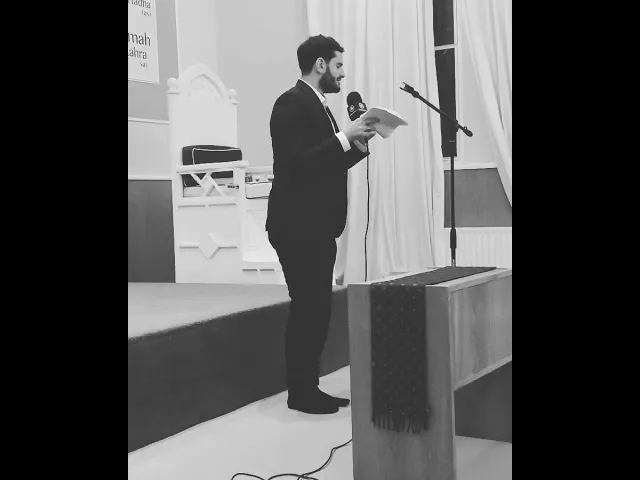
Self-Esteem and Self-Worth - Sayed Mehdi Qazwini (Night 3 Muharram 2019)
0
0
8 المشاهدات·
24/03/23
في
محاضرات
Self-Esteem and Self-Worth - Sayed Mehdi Qazwini (Night 3 Muharram 2019) at the Ahlul Bayt Center of Toledo
أظهر المزيد
Transcript
[0:00]la semilla liam min ash-shaytani r-rajim bismillahi r-rahmani r-rahim al-hamdu lillahi rabbil
[0:08]alameen wa sallahu wa salam wa ala al anbiya wa l-mursalin Habib
[0:14]al al-amin a bell Casa miel Mustafa Muhammad Allah Allah BtoB not
[0:26]bahadin alma soo min al muntaha beam sallahu wa salam alayka ya
[0:34]rasul allah sallallahu assalamu alayka ya BA Abdullah Yamato la hill wah
[0:42]wah Baba Narayana kanakam ced Fenollosa firuzan oedema audhu billahi min ash-shaitani
[1:00]rajim bismillah ar-rahman ar-rahim hosaka allahumma some macho allah allah bill fagala
[1:06]rapini lima and zelda Alea min hye-rin fakir sadaqa allahu al azim
[1:16]wa salli ala muhammad wa ala muhammad throughout the holy quran we
[1:29]are told the stories of the prophets of god and the prophet
[1:34]that is mentioned most by name individually by name more than any
[1:39]other prophet is the prophet musa alayhis salam and what's interesting about
[1:46]the stories of the prophets is that the quran tells us of
[1:52]their victories and their achievements but likewise it tells us of their
[1:58]struggles and the challenges that they faced because part of the victory
[2:05]is appreciation of the struggle so in the story of Musa for
[2:08]instance one part of his struggle is the verse that I just
[2:13]read that after he defended one of his followers he struck a
[2:17]man down and he hit him so hard that he took his
[2:22]life he had to leave and he found himself as a fugitive
[2:30]as a refugee and for days he wandered in the wilderness with
[2:36]no provisions with no food until he came to a watering hole
[2:40]and he found a number of people there among them two young
[2:44]woman who could not get to the watering hole so he made
[2:47]space for them and then the Quran says after he made space
[2:52]for them he went and sat under the shade of a tree
[2:57]and when he did so he said Rob being neelima and Zelda
[3:00]L AM in Haran fifty-year oh allah anything that you send to
[3:06]me anything good that you send my way I am Fatiha meaning
[3:10]that I am in need he had basically hit rock bottom after
[3:15]days without food without provision and that's when the blessings began to
[3:20]come his way when he found himself in a state of thought
[3:25]when he found himself in a state of need and in that
[3:28]moment psychologically and emotionally Musa was struggling likewise there are stories that
[3:36]describe our own prophet muhammad sallallahoalyhiwasallam in his own struggle so one
[3:48]story has it that during the early days of revelation the Prophet
[3:53]would receive revelation on a continual basis and then one day the
[3:56]revelation did not arrive for about three consecutive days and the Prophet
[4:01]began to think to himself where is this revelation that was once
[4:07]common and that was once frequent and so after the revelation continues
[4:12]after it resumes allah subhanho wa taala reminds the Prophet that even
[4:19]though sometimes you may feel alone that we have never left you
[4:22]Allah meeya GDK a teaming for our wah wah dah da koala
[4:27]Fahed ah Wawa hidaka uh Ellen fadna were you not in a
[4:34]state of poverty and God brought wealth to you were you not
[4:37]an orphan and we found people to shelter you were you not
[4:43]lonely and we found people to support you so God was telling
[4:47]the Prophet that despite what you're feeling despite the struggles that you're
[4:54]going through we've always had your back now some narrations push that
[5:00]even further there is a narration in sahih bukhari that says that
[5:05]and it's narrated from one of the wives of the prophet and
[5:08]she says that she describes the Prophet when he first began to
[5:15]receive the revelation that according to her description that the Prophet thought
[5:22]of himself and imagined himself as possessed he was possessed now there's
[5:29]there's two things at hand here number one is the idea of
[5:40]possession Ted Janine and conflating that meaning confusing that with mental and
[5:46]emotional illnesses and mental and emotional struggles that people face on a
[5:52]regular basis according to one writer he says that in more and
[5:56]and the term that he chooses a bit harsh he says in
[6:02]more primitive societies but what he means is in unless informed in
[6:07]less educated societies sometimes illness is induced upon people because someone else
[6:11]suggests it to them and some people there they're experts in this
[6:21]they will make you believe that you feel a certain way and
[6:24]think about it if someone if someone sees you and says you
[6:29]know you look a little bit off are you okay most people
[6:31]because because we've we feel a little bit different on a daily
[6:38]basis we'll say yeah you know what now that you mention it
[6:40]I haven't been getting of sleep or I haven't been really feeling
[6:43]well or my back has been hurting or my head has been
[6:47]hurting and the point that he was trying to make is that
[6:48]some people they're experts at this they're able to suggest to you
[6:55]that you are feeling ill so in that same way there are
[6:58]people that can suggest that you are possessed or that you are
[7:02]affected by an outside force that you have no control over in
[7:09]some societies that's one issue and another issue when it comes to
[7:14]the idea of mental and emotional struggles as it is attributed to
[7:18]the prophets in the Holy Quran is the idea that if we
[7:23]are struggling today if we're struggling in this world that means that
[7:27]somehow we are not worthy we are less worthy individuals so if
[7:34]I'm going through a bout of let's say depression or anxiety or
[7:40]some more serious mental illnesses such as bipolar or schizophrenia that in
[7:47]some way because I'm struggling from those conditions and those illnesses that
[7:54]I'm not worthy of God's love that God is angry with me
[7:57]that God is punishing me so those are two concepts at hand
[8:03]and I want to address both of them in terms of in
[8:05]terms of the first which is the idea of mental health and
[8:12]mental struggles and emotional struggles that are mentioned in the Quran the
[8:18]Quran teaches us the following the Quran describes the human persona with
[8:23]three dimensions the first dimension is known as enough Sumatra in nur
[8:29]and this is mentioned in the verse in the Quran yeah yeah
[8:33]johannesl Mitama inna l ji l arabic e ravi attend Merliah and
[8:38]what islamic psychologists have said is that this dimension this part of
[8:46]the persona this first dimension of the persona it represents our spiritual
[8:50]dimension and it represents self actualization and self-esteem so self-actualization and self-esteem
[8:58]if you're familiar with in psychology the theory of Maslow's hierarchy of
[9:04]needs so towards the top of that are the needs of self
[9:10]esteem and self-actualization this is one dimension the second dimension that the
[9:20]Quran mentions is an F Salama the the reproaching soul and that
[9:25]is responsible and that is representative of the psycho-emotional dimension that we
[9:33]have so and this corresponds to the needs of belonging and the
[9:37]third dimension is an F Salah Amara and this represents the dimension
[9:43]of our instinctive or our primal primordial dimension so basically the the
[9:51]prime or the primordial needs that we have such as safety and
[9:57]such as the need for those physiological the lowest level of the
[10:01]hierarchy of needs so when it comes to an F Salama when
[10:07]we're talking about mental health and mental illnesses it is attached and
[10:14]it corresponds directly to the second dimension which is enough Salama and
[10:17]enough Salama represents our psycho emotional needs and this is the only
[10:23]dimension of our human persona that is sworn by in the quran
[10:30]in solitude qiyamah allah subhana WA Ta'ala says bismillah nova ham locks
[10:38]immobile Fiamma voilá oxime o beneficent Allah wama and in that way
[10:43]God is swearing by enough Salama and usually I mean if you're
[10:48]familiar with the language of the Quran you would know that when
[10:53]God swears by something it means that this thing is important this
[10:56]thing is serious so in a way God is saying that your
[11:03]psycho emotional needs are important they have to be met when you
[11:09]when you correspond this with the idea of Maslow's hierarchy of needs
[11:12]you see that at the bottom you have your physiological needs the
[11:20]need for food shelter clothing breathable air this is the basic level
[11:27]when it comes to our motivations that's that's the first thing that
[11:31]we need to secure as human beings and there's a verse that
[11:34]corresponds with this in the Holy Quran Allah subhana WA Ta'ala tells
[11:40]Adam when he created him and when he placed him in in
[11:42]in in heaven of course not being genital hold but the garden
[11:47]that he placed him in he said to him in Allah and
[11:50]LA Tijera feeha wallet Allah and makalah tubman feeha while at ha
[11:59]that in it you will find no need no outside source no
[12:02]outside need for food and water you won't feel hunger because there's
[12:09]enough food for you you won't feel thirst because there's enough for
[12:14]you to drink you won't feel heat because there's enough shelter for
[12:19]you and there's enough clothing for you this need was met the
[12:22]second need that was met after that was the need for love
[12:28]and belonging and Allah subhana WA Ta'ala gave him in that his
[12:31]partner Hawaa Eve so God is telling him that your needs are
[12:38]being met so when God created the human being he did not
[12:40]just create the human being and allowed him to go fend for
[12:46]himself in the same way that every human being that is living
[12:50]now on earth there are enough resources to provide for every single
[12:56]human being but what's the challenge just today I was watching the
[13:02]report it was an eye-opener and it showed how it showed how
[13:12]the batteries in these devices are mostly made of cadmium and cadmium
[13:17]is a rare resource and there's only a few places in the
[13:20]world where it can be found and one of those places is
[13:27]the Democratic Republic of Congo in the African continent one of the
[13:34]wealthiest countries when it comes to resources but one of the poorest
[13:38]countries when it comes to population and the people that mined the
[13:41]cadmium for these batteries there's no professional mining equipment they have to
[13:46]mine with their bare hands and sometimes a father has to take
[13:51]his children out of school so that all of them can mined
[13:53]together and they were interviewing a father who said that the money
[13:56]that we get from mining this material is not even enough to
[14:03]feed my own children it's not even enough for food and what
[14:06]happens when we stand in line for the latest iPhone or the
[14:12]latest galaxy and we don't get it how upset we become when
[14:15]on the other side and they talk about first world problems which
[14:21]are real there are real first world problems but that corresponds to
[14:26]Maslow's hierarchy of needs and sometimes you need to place yourself in
[14:31]a situation or in the shoes of people who don't even have
[14:36]the most basic needs so that you appreciate the freedoms that you
[14:39]have in this country so that you appreciate all of the blessings
[14:44]that you have and Allah subhana WA Ta'ala has said in the
[14:48]Quran that he is ordained that everything is available for us so
[14:51]going back to that question of emotional struggle depression sadness anxiety all
[15:00]of these things are real and they can be treated you know
[15:05]even even if you if you study the life of our prophet
[15:11]muhammad sallallahoalyhiwasallam obviously not everything was happy-go-lucky not everything was on the
[15:23]up all the time had it been that way the profit would
[15:29]not have designated an entire year that he referred to as a
[15:36]mill hosen the year of sadness the year of sorrow and that's
[15:39]when he lost two of his most beloved people two of his
[15:46]greatest the two of his greatest defenders one was his uncle of
[15:51]a polyp who was a defender in him and a believer in
[15:56]him from day one who provided for him security who was a
[16:00]source of strength a backbone for him and number two was his
[16:06]dear and beloved and irreplaceable wife khadija bint khuwaylid a woman who
[16:13]gave everything everything that she owned everything that she possessed to defend
[16:20]the Prophet she was his spiritual and emotional backbone and the year
[16:24]that he lost them he referred to it as Amal hosen the
[16:29]year of sorrow the year of sadness so sadness and sorrow was
[16:33]part of the life of rasulallah it was part of the life
[16:37]of the prophets it was part of the life of the Imams
[16:42]of a debate Alima salaam so this is one aspect another aspect
[16:47]is the aspect of self-worth and self-esteem and perhaps one of the
[16:55]biggest struggles that we're dealing with today in this day and age
[17:03]in the in the world of in the 21st century in the
[17:06]world of connectivity in the world of abundance that we live in
[17:13]is a struggle with self image is a struggle with anxiety is
[17:17]a struggle with depression and there are many many reasons for that
[17:20]I I'm not here to go into all of those details but
[17:24]some of them are treatable for instance when you look at the
[17:32]habit of comparison when we compare ourselves to other people especially when
[17:38]we're online on social media the people that we follow it's it's
[17:44]interesting because we follow certain personalities say on well I mean Facebook
[17:49]is for old people right so nobody is on Facebook anymore Instagram
[17:53]and you follow the people that all have small different aspects that
[18:00]you want in your life there's not one person that has everything
[18:06]but a group of people so you follow the person that for
[18:09]instance is always traveling and always posting pictures of themselves in exotic
[18:14]locations and then you follow the person who is at home all
[18:22]the time making miracles in the kitchen and then you're following the
[18:27]person who is out and about on the grind making a lot
[18:32]of money in driving fast cars and these are all bits of
[18:35]pieces of a personality that we would like to construct for ourselves
[18:38]but the reality is that you don't see the other side of
[18:43]what's going on you don't see the depression you don't see the
[18:47]anxiety you don't see the worry and you know what you don't
[18:54]see the credit card statement and the debts that's the biggest thing
[18:57]that you don't see because most of these people without a credit
[18:59]card they would be barefoot they would be naked they would be
[19:03]uneducated they would not have vehicles and they would not have homes
[19:07]because everything is financed on debt I want to share with you
[19:10]a narration from amirul mumineen Hani Salaam he says the following he
[19:15]says maha-rathah perón illa bima Mucha even II on the other side
[19:23]of lavishness I'm not saying being comfortable and wealthy lavishness overspending on
[19:29]the other side of that there is always a person that is
[19:35]paying the price through poverty so the luxuries that we have such
[19:38]as the smart phones or the accessibility to the different types of
[19:42]food that we have in the gas station the grocery store the
[19:45]supermarket I read a report one time it said the amount of
[19:51]food that is produced in the world is enough to supply each
[19:55]and every living being on this earth the more than seven billion
[20:02]people with 2,700 calories per day more than enough but where we
[20:07]have an abundance on the other side of that is poverty for
[20:12]other people there's always a different perspective so comparison is one of
[20:17]those habits that causes anxiety that may lead to depression that may
[20:26]lead to other mental and emotional conditions and illnesses part of that
[20:32]also and I'll mention this is the language that we use as
[20:39]religious people and I'll just cite a couple of examples I won't
[20:43]take too long but I'll give you an example from Christianity see
[20:48]the first language that Christian philosophy was solidified in was Latin and
[20:57]the idea of self regard the first word that was chosen for
[21:05]the eye to translate the idea of self regard was humility us
[21:08]which is the root of the English word humility so when we
[21:17]talk about humility among faithful people of the world whether they're Muslim
[21:21]or non-muslim in different faith traditions we look at humility as a
[21:26]virtue and humility truly is a virtue but if you trace the
[21:29]word humility back to its root humility us literally means to downgrade
[21:33]oneself meaning to have a lower level of regard for oneself and
[21:42]so one Christian writer he says the reason why so many religious
[21:46]people they walk around with an inferiority complex is because they misunderstand
[21:51]concepts such as humility they don't know what it means to be
[21:57]humble they think that being humble and humility means that you act
[22:00]in a needy way in a slavish way and with an inferiority
[22:05]complex and there are a number of examples when the Islamic faith
[22:09]now please bear patience with me because there's an analysis to what
[22:14]I want to say if you read some of the supplications which
[22:17]were taught to us by the Imams of a debate Alima salam
[22:23]for instance I'll give you one example in the toffee bars which
[22:28]are the supplications that and the doors that are that are red
[22:32]after the five daily prayers and tactics Allah Allah so what do
[22:38]we read was a new idea to bajalia Tobit abdun Vanille Harbor
[22:43]and Fatiha ba is in miss Kenan mistaken and most a year
[22:47]I asked God to confer upon me forgiveness the forgiveness of one
[22:58]who is a slave one who is servile one who is submissive
[22:59]one who is needy one who is poor and one who is
[23:06]asking for relief it's the language of when you just look at
[23:09]the language without context it's the language of lowliness and the language
[23:13]of degradation however there's a secret to this why does it work
[23:22]I'll give you another passage from another door and this is one
[23:26]of the most powerful supplications that we have and it is durable
[23:30]hamza samadhi he says the following sayyidi aniseh hero levira beta-1 al-jihad
[23:38]Olevia olanta what an l Hualien ladira factor my lord i was
[23:48]the small one that you brought up and i was the ignorant
[23:51]one that you gave knowledge and that you educated and i was
[23:56]the lonely one al Walia I was the only one that you
[24:00]lifted that you exalted the key and I mentioned this yesterday understanding
[24:08]the following that when it comes to submission and surrender ins what
[24:13]the Prophet taught us and what the a debate on a Musallam
[24:19]Terrace is that you are submissive and you surrender to nobody except
[24:23]for allah subhana wa ta'ala and the most exalted status is when
[24:29]you submit to yourself is when you submit yourself to allah subhanho
[24:35]wa taala and you surrender everything that you have to Allah and
[24:39]there are a number of narrations that remind us that the closest
[24:43]we are in proximity to allah subhana wa ta'ala the most high
[24:49]the most great the most exalted is when our forehead is placed
[24:52]on the ground in sujood physically when we're at a very low
[24:55]level and that's the secret to the equation that if you want
[25:04]to be exalted if you want to be raised if you want
[25:07]your dreams to come true if you want your goals to come
[25:14]true then you surrender everything that you have to allah subhanho wa
[25:18]taala well in a Salah t1 no tsuki well Mejia wama mati
[25:24]lillahi rabbil aalameen everything my life my death my rituals everything is
[25:27]for our loss of hano Itano and that was the secret that
[25:38]imam hussain ali Salam Taurus in fact it's so interesting because the
[25:42]Quran refers to the most exalted human being which is the Prophet
[25:47]as apt as a slave subhanAllah Essaouira be ab de la Landman
[25:53]and Masjid al-haram Elin Masjid al-aqsa amirul mumineen one day engages in
[26:00]a long hadith that I won't mention the whole thing but he
[26:04]engages in an exchange with someone and someone mistake ins him for
[26:09]the Prophet and he says to him he describes who he is
[26:12]he says Anna abdomen IBD Muhammad Allah Allah Muhammad Ali Mohammed so
[26:24]there's no humility in being in submission and in surrendering to the
[26:31]right principles as long as they are to the right principles and
[26:39]that's exactly what imam hussain ali salon thomas he said to the
[26:43]enemy on the day of ashura he said la la cumbia d
[26:47]alpha and allele voila a third room income farrell Abid he says
[26:52]I will not give my hand to you in subservience I would
[27:00]rather give my neck than my hand I would rather live as
[27:07]a free man on my feet standing on my own two feet
[27:09]then live as a slave in this life on my knees I
[27:14]would rather die standing on my feet as a free man rather
[27:19]than live as a slave on my knees because he realized that
[27:23]he was a slave to nobody except for Allah subhana WA Ta'ala
[27:27]and there are a number of narrations which encourage this one narration
[27:33]is the following it says Abdera parinita kun Maithili My servants my
[27:39]slave God is speaking at Lani obey me Ciccone Maithili he's the
[27:50]continuation of the hadith says that in the same way that God
[27:52]says kun fa a-- kun be and it becomes you shall say
[27:58]be and it becomes and it's radically this this concept is radically
[28:02]different than what you learned on TV and through Hollywood and through
[28:06]the media you learned that you go out and get yours and
[28:11]that the world is your oyster and that the world is yours
[28:14]if you learn to be a rebel when in fact the world
[28:20]becomes your oyster and the world becomes yours once you learn to
[28:24]become submissive but submissive not to this world submissive to the creator
[28:28]of this world when you surrender to the creator of this world
[28:34]not when you surrender to the world and most people they are
[28:38]surrendering to the world rather than surrendering to the creator of the
[28:43]world this is one of our biggest challenges and then we ask
[28:49]ourselves why are we so confused why are we so unhappy why
[28:56]do we experience anxiety and sadness and sorrow and depression and upset
[29:01]on a daily basis it's because most people don't have a correct
[29:07]understanding a proper understanding of principles so in closing I'll say that
[29:12]the prophet and the Imams of a gente debate they understood this
[29:16]concept very well that anything can go their way and they were
[29:20]not in need of anyone once they submitted themselves and they surrendered
[29:25]themselves to Allah subhana WA Ta'ala there a number of stories and
[29:28]I won't go through I won't go through most I won't go
[29:33]through any of these stories I just want to leave you with
[29:39]a lesson that rasulullah sallallahu alayhi wasallam teaches us and it's a
[29:47]saying of rasulallah and sometimes the sorrowful things that happen in our
[29:51]life the sad things that happen in our life we don't have
[29:53]control over we don't have control over whether a relative who is
[29:59]sick is going to live or die we don't have control over
[30:02]that we have tested Iman yang yesterday I mentioned the the the
[30:07]concept of test neem and how a true believer because he or
[30:12]she has a clear vision of what's on the other side of
[30:15]that hurt and sorrow and pain finds themself in a state of
[30:23]submission and Tasneem because they have a clear vision and once once
[30:28]once suffering has meaning and purpose behind it it ceases to be
[30:34]suffering and Rasul Allah teaches us a very valuable lesson he says
[30:41]in his hadith in a line allotted map that our eyes may
[30:46]tear while Alba liason and our hearts may break however in the
[30:49]translation of that hadith he says we never say anything that violates
[30:55]the command of our Lord meaning that even though things are not
[30:59]going your way in your heart or even though things may happen
[31:03]that caused you to weep and be sorrowful and you and those
[31:08]are two things that you can't control sometimes what you can always
[31:15]control always have control over is your tongue the words that you
[31:19]speak do you speak in a positive way or do you speak
[31:25]in a negative way you're always in control and so there's a
[31:29]lot of greatness brothers and sisters that's waiting on the other side
[31:34]of our struggles in the same way that the Quran tells us
[31:41]that the Prophet Musa hit rock bottom and that the Prophet Muhammad
[31:46]sallallahu alehiwassallaam found himself in a state of loneliness psychologically and emotionally
[31:52]was hurting but they realized that at the end of that there
[31:58]was much joy and now I want to take your hearts to
[32:04]the journey of imam hussain ali salam because on a day like
[32:10]this which was the 2nd of Muharram after a journey that lasted
[32:14]around 23 days imam hussain arrived in the land of Karbala and
[32:19]the distance between Mecca and Karbala was roughly 1500 kilometers give or
[32:26]take and there were about 14 stops that were on the way
[32:33]and in each one of those stops his history narrates that something
[32:38]significant happened so in one of those stops the Imam met Pharaoh's
[32:44]death the poet who informed him that the people are with you
[32:51]their hearts are with you but their swords are against you and
[32:54]one of those stops he met Zahir of nail pain a man
[32:58]who had no interest in joining the caravan of imam hussain but
[33:05]had a change of hearts in one of those stops he met
[33:08]al Horeb Niazi Duryea he whom we will mention tomorrow the commander
[33:14]of the army of Amara Prasad the brave man who had a
[33:18]change of heart on the day of ashura an imam hussain ali
[33:26]salaam when he finds that his path is blocked to Kufa he
[33:32]turns to his companions he tells his companions which one of you
[33:42]knows the pathways which one of you is familiar with these roads
[33:46]so that he can deliver us to safety one of his companions
[33:51]by the name of Burma he was a he was a camel
[33:56]ear meaning that he led a fleet of camels and caravans during
[34:01]those days obviously were especially caravans in the desert were comprised of
[34:05]camels because camels can travel for long distances in that type of
[34:11]climate in that type of terrain I thought Omar says me yeah
[34:16]about the LA I'm the one I'm familiar with these roads I'm
[34:20]familiar with these paths I can take you to safety and history
[34:24]narrates a number of verses of poetry that a plural ma began
[34:32]to chance to the camels to have them rise and move in
[34:37]the direction of safety Janna patty la Torre means Edgeley when she
[34:41]been a table fedora and fairy buffet a rock Banyon Wakarusa free
[34:45]ali rasool allah a lil fairy he says to the camels he
[34:51]says do you know what kind of cargo you are taking with
[34:54]you do you know how precious this cargo is this is ali
[35:00]rasool allah this is the family of rasulallah this is the family
[35:04]of pride until finally on the second day imam hussain arrives in
[35:10]the land of Karbala and Carmela had a number of inhabitants the
[35:14]tribe of Ben who I said were the inhabitants of karbala and
[35:21]the camel stopped they did not continue imam husain knew intuitively that
[35:27]he had arrived in the place that was destined for him and
[35:31]his family he knew of the name Karbala because he had been
[35:34]informed since many years before so he began to turn to the
[35:40]people he began to ask left and right what is the name
[35:44]of this land some of them said it is known as another
[35:47]ayaat which was one of the names of Karbala does it go
[35:53]by any other name yes nainawa is one of its names does
[35:56]it go by any other name until finally they said it is
[36:03]known as carbon wa Bella the land of sorrow the land of
[36:06]misery when imam hussain ali salam heard those words he turned to
[36:13]his companions as hobby' he said my companions this is where we
[36:15]are going to settle this is where our Caravan is going to
[36:20]settle this is where we will pitch our tents this is the
[36:23]place that we will meet our final destination this is the place
[36:26]where our men shall be executed this is the place where our
[36:32]women and children shall be taken captive this is the place where
[36:34]the camps shall be set on fire in nad allahu wa ala
[36:39]here on your own whassa Alamelu deen of allah more i am
[36:42]uncle Abby and pala boon well on October 2 Lynwood second smell
[36:48]of mana rahim allah al merini nominates one Muslim inna one Muslim
[36:52]at Allah Ameen whom Allah might ha been on our banner humble
[36:55]favorites in nakamori buddha wat in the cockerel Hodja
0 تعليقات
sort ترتيب حسب
- أعلى تعليقات
- أحدث تعليقات
التالي
8 المشاهدات · 25/12/01
10 المشاهدات · 13/12/26
10 المشاهدات · 14/09/23

7 المشاهدات · 21/12/07

7 المشاهدات · 22/11/28

10 المشاهدات · 24/11/14

8 المشاهدات · 25/06/22

8 المشاهدات · 25/11/02
8 المشاهدات · 13/01/07