التالي
2 المشاهدات · 24/03/20
3 المشاهدات · 25/03/26
6 المشاهدات · 25/08/03
0 المشاهدات · 24/11/16
5 المشاهدات · 25/10/01
7 المشاهدات · 26/03/22
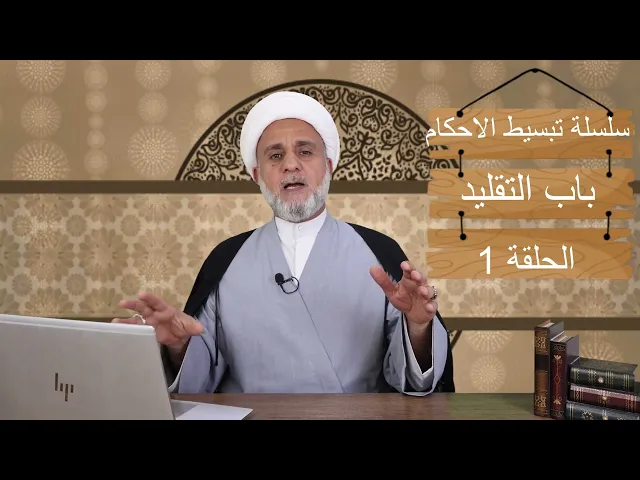
قصة التقليد Story of Taqleed
0
0
20 المشاهدات·
23/10/30
ما هو التقليد عند الشيعة الإمامية ؟ ما هو الفرق بين الفقهاء و رواة الحديث ؟
لمشاهدة الترجمة لطفا الضغط على CC في شريط المشغل
لدعم الفريق نرجو استخدام رابط الباي بال الخاص
https://www.paypal.me/abaadmedia
🔸لمتابعة إصدارات فريق أبعاد الإعلامي 🔸
🌍 تواصلوا معنا عبر :
♦️ قناتنا على youtube
https://www.youtube.com/channe....l/UCbiLcP54nczaDBzbv
🔹 قناتنا على Telegram
https://t.me/AbaadMediaTeam
📍 حساب Instgram
https://www.instagram.com/abaadmediateam/
🔸 الواتساب : إرسال كلمة ( إشتراك ) الى المعرف
009647506079737
📌 صفحتنا على facebook
https://www.facebook.com/AbaadMediaTeam1188/
موقعنا الالكتروني
http://www.abaadmt.com
أظهر المزيد
Transcript
[0:00]Islamic scholars are ordinary people and religious sources are available and Allah
[0:04]provided us with brains so, is taqleed (Emulation of Jurists) reasonable ??
[0:07]Why leave behind the narrations of the infallibles and follow those ordinary
[0:10]people ??
[0:10]Aren't there narrations that condemn taqleed ?
[0:12]The answers to these questions are in this quick review "The Story
[0:18]of Taqleed" Imam Al Baqer PBUH lived in Madinah at the time
[0:25]however, the direct contact with his followers was hard to maintain and
[0:29]this was caused by 1- The harassment of the authorities against his
[0:34]movement 2- The geographic spread of his followers in Kufa, Basra, Khorasan,
[0:40]Qom, Yemen, Egypt and other places Despite that, Imam built a generation
[0:46]of learners who moved by the commands of the Imam to support
[0:49]the need of people for religious fatwas as well as solving conflicts
[0:54]Ali bin Al Mosayab traveled 1000 km from Qom to Khorasan to
[0:59]meet Al Imam Al Rida and before his return he asked Al
[1:02]Imam My home is distant, and I can't reach you all the
[1:06]time Whom should I trust to take my religious knowledge from ?
[1:09]Imam Al Rida PBUH replied "From Zakaria bin Adam Al Qomy (from
[1:13]Qom) the reliable in the religion and worldly matters" Ali bin Mosayab
[1:17]reported And when I returned, I asked Zakaria bin Adam about my
[1:23]needs Referring to specialists is quite normal and natural by default Take
[1:29]a look around, and observe all aspects of your life There are
[1:32]three types of matters 1- Things that you do without referring to
[1:35]specialists like drinking water, education, and call the mom to stay assured
[1:40]of her health 2- Things that you avoid without referring to specialists
[1:45]like drinking poison or sleeping on railways But there are things that
[1:50]aren't that clear which urge you to refer to specialists like taking
[1:53]a prescription, fixing the car, or home design And the same applies
[1:57]to the religious rules Things that you should do without asking the
[2:01]jurists like prayer and helping others And things that you should avoid
[2:06]also without asking like drinking wine and harassment Yet there are things
[2:11]that you need to ask a specialist "Gain your safety by conveying
[2:14]the burden to the responsibility of the jurist" like selling Dinar for
[2:18]Dollars drinking malt beverages or online shopping Like any other expertise in
[2:24]life.
[2:24]Iin the time of Imams a group of religious experts were trained
[2:28]to mediate between people and their Imams Like Zorara bin Aayan Muhammad
[2:33]bin Muslim Bareed Al Ijly and Abo Baseer who were significant in
[2:37]their time in a way that Imam Al Sadiq PBUH announced :
[2:40]"Allah's trusted ones in His rulings Were it not for them the
[2:45]traces of the prophethood would have been cut off and vanished" Moreover,
[2:49]even though Imam Al Baqer was present in Madinah once said to
[2:53]his student Aban bin Taghlob "Sit in the Mosque of Madinah, and
[2:56]give fatwa to the people for I like to see in my
[3:00]followers one such as you" This group of elite students were known
[3:04]as "hadith (speech) narrators" Some people imagine, or led to do so
[3:09]that hadith narrators are somehow like a voice recorder their role is
[3:13]solely to transmit the voice of Imams and should never interpret the
[3:16]narrations or derive religious rules for example Zorara should only repeat what
[3:20]he'd heard from Imam and then people can understand whatever they like
[3:23]This assumption is entirely false Let's return to the book of Al
[3:27]Kafi (by Kulayni)- Vol.
[3:28]7 you will read many opinions quoted from hadith narrators themselves without
[3:31]mentioning anything from Imam which means that they were deriving the religious
[3:35]rules without involving common people in the process The same system that
[3:39]is still active until now In page 83, al Kulayni dedicated a
[3:43]whole chapter to Younis bin Abdel Rahman's opinions without narrating any hadith
[3:47]from his master, Imam Al Rida in page 95, al Kulayni writes
[3:51]down the notions of Fadel bin Shathan the student of Imam Al
[3:54]Jawad without protesting "Why don't you mention the original narration O, Mr.
[3:56]Fadel !?" Page 92 says that Omar bin Othayneh visited Zorara bin
[4:01]Aayan and that Omar possesses some confusing narrations So Zorara replied: I
[4:06]will inform you and NOT narrate for you !
[4:09]which means that if narrations got mixed up for you, leave them
[4:12]and just get the rules from me In summary: hadith narrators have
[4:17]TWO main roles 1- Transfer Imams' narrations, preserve them, and protect this
[4:22]tremendous heritage from loss 2- Provide religious rules needed by people It's
[4:28]true that sometimes their answers vary according to their grasp of the
[4:31]narration but Imam Al Sadiq comments on that : "We don't command
[4:35]you anything beyond your reach" So, when the source is both Quran
[4:39]and hadith and the differences occur in some subsidiary rules they are
[4:44]accepted and provide relief to the people Dawood bin Hosain asked Imam
[4:48]Al Sadiq If we encountered two different rulings provided by the narrators,
[4:52]what shall we do ?
[4:53]The captivating idea is that the Imam didn't complain about the difference
[4:59]and only provides the solution in following the most knowledgable of them
[5:04]"take from the most learned in jurisprudence, the most knowledgable about our
[5:09]narrations, and the most pious" And by the way, those who don’t
[5:13]like narrators to have opinions cannot understand this narration any other way
[5:16]because it’s unfair that Zorara can only narrate… but you can interpret
[5:21]This is how the Imams managed the situation and distributed the roles
[5:25]between their followers Thus, they built sufficient defense lines for the religion
[5:28]to withstand extreme conditions So at the time of the Lesser Occultation
[5:32]of the 12th Imam the society was preparing for a new era
[5:35]shifting from the presence of Imam to his occultation Imam Al Mahdi
[5:41]had finalized the preparation of the society by referring his followers to
[5:44]the knowledgeable in two aspects 1.
[5:46]Hadith narration 2.
[5:47]Giving fatwa Since 329 Hijri where the Greater Occultation has taken place
[5:52]until now, 1110 years have passed and the same system is still
[5:57]intact as continuation of the original procedure of narrating hadith This method
[5:59]is fundamental in both Hawza of Najaf and Qom A cleric doesn't
[6:04]become mujtahid except through hard work to achieve the ability to evaluate
[6:08]the narrations and deduce religious rules Let's view the licenses given to
[6:12]Sayyed Ali Al Sistani as an example If you review his life
[6:15]as a scholar and inspect the licenses he received from his teachers
[6:18]you can clearly distinguish the two aspects we've mentioned In the license
[6:23]from Sayyed Al Khoei Indeed I permitted him to narrate from me
[6:27]all narrations that I am eligible to narrate from the four books
[6:32]that we rely on most: Al Kafi, Al Faqeeh, Al Tahthib, and
[6:37]Istibsar He, Praise to Allah, has grasped his aim and reached the
[6:42]degree of Ijtihad, and prowess to derive rules In the license from
[6:47]Shaykh Al Hilli I authorized him to narrate from me all narrations
[6:51]that I am eligible to narrate by my chain of narration through
[6:55]my great mentors and due to the numerous discussions that we had
[6:59]I found him had reached the degree of Ijtihad and skilled to
[7:04]derive the religious rules In the license from Shaykh Al Tahrani He
[7:08]spent most of his time in learning religious knowledge in particular, researches
[7:12]in subjects of Rijal (narrators) and narrations So I permit him to
[7:16]narrate from me by my chain of narration through my mentors Moreover,
[7:19]his writings in Fiqh and Osool witness his achievements in other fields
[7:24]of knowledge, and that he reached the degree of Ijtihad Of course,
[7:29]you may as well ask : If all this rules derivation and
[7:32]taqleed was originated in the age of Imams and the narrators of
[7:36]old are the same of those of present times, then why Ahlulbayt
[7:40]prohibited taqleed in their narrations ?
[7:42]And the answer is: the banned taqleed has a totally different meaning
[7:46]which is not related to our topic However, some ill-intended people used
[7:50]this similarity to confuse the audience like the Wahhabis when taking advantage
[7:53]of the title "Mushaf Fatima" to accuse Shia that they have another
[7:57]Quran rather than the original and deny the Quran of Muslims They
[8:00]actually exploit the simplicity of people who think that the word Mushaf
[8:03]is used only for al Quran while it's used in Arabic for
[8:06]any other book A similar case here They mix the meanings of
[8:11]"taqleed" with some provocations "You are a blockhead !" "They are fooling
[8:15]you" And the simple-minded people are the victims To make it clear,
[8:20]"taqleed" can point to three meanings 1- taqleed in the principles of
[8:25]religion things like the unity of God, belief in prophethood and Imamah
[8:28]These things need certainty, which cannot be subject of taqleed One cannot
[8:32]refer in these matters to anyone even the jurists This taqleed is
[8:37]absolutely invalid because as the word "belief" suggests your heart is firm
[8:41]with certain convictions 2- taqleed of the analogists (Qiyas) At the time
[8:46]of Imam Al Sadiq some who didn't follow Ahlulbayt give fatwa to
[8:51]people And when they get into a difficult situation they think a
[8:54]bit and compare the issue to similar rules to favor an answer
[8:57]Istihsan is the act of giving fatwa based on one's taste Also
[9:01]this type of taqleed is totally denied So all narrations that totally
[9:05]condemn "taqleed" in addition to the words of scholars like Sadooq and
[9:08]Mofeed point to these two types of taqleed since it's not conceivable
[9:10]for Mufeed to condemn taqleed on one hand and compose a book
[9:13]of practical rules on the other !
[9:16]3- taqleed of the jurist which means that you put your religious
[9:20]acts under his responsibility Since you're not specialized in religion and have
[9:24]daily concerns it's impossible for you to navigate through thousands of narrations
[9:29]and here comes the role of jurists to derive the practical rules.
[9:32]In overall, you load the responsibility of your acts upon them This
[9:37]is the approved taqleed and the natural continuation of the hadith narrators
[9:41]Note that the same word (taqleed) is used in the Yemenite dialect
[9:44]to denote the third meaning of taqleed Here's another question: What is
[9:53]your stance on new knowledges that came into show after the era
[9:56]of Imams like Osool, Rijal (Narrators), and books of practical rules ?
[9:59]where did they come from ?
[10:01]Actually, it's as if somebody planted a seed that grew to a
[10:04]tree with leaves, branches, and fruits Then he comes back and asks:
[10:07]Where did all of this come from ?
[10:09]Let's investigate these knowledges one by one 1- The knowledge of Osool:
[10:13]This knowledge studies general principles of jurisprudence For example: The principle of
[10:19]Ibaha (Permission) More than a century ago, carbonated drinks appeared And a
[10:26]question arised: Is it halal to drink it ?
[10:29]Here comes the role of the jurist to apply the principle of
[10:31]Ibaha which states: Everything is halal for you unless you're ASSURED that
[10:37]it's not That means if the jurist inquired about forbiddance of something
[10:41]in Quran and Sunna but couldn't find it he gives a fatwa
[10:43]that it's halal And so on, whenever a new issue arises, the
[10:47]jurist should inquire the evidences if there's an evidence, it should be
[10:51]haram.
[10:51]Otherwise, it's halal based on this rule Of course this process is
[10:55]not as simple as we described it is just an explanation As
[10:59]for the initiator of this principle verbatim is Imam Al Sadiq PBUH
[11:04]And he's who encouraged the hadith narrators to derive and apply such
[11:07]rules when he told Hisham bin Salem: "Our task is to establish
[11:11]the principles for you and you should derive from them" Also you
[11:15]should know that the first book of Osool was written by Hisham
[11:18]bin Al Hakam a student of Imam Al Sadiq And of course,
[11:21]this branch of knowledge was to evolve much like any other...
[11:25]over ten centuries, by the efforts of the specialists similar to medicine,
[11:28]chemistry, astronomy and others.
[11:31]2- The study of rijal (narrators) It's also a rooted study because
[11:34]those who make up narrations are always around Thus people thoroughly monitored
[11:38]the narrators before accepting their transmit For example, Abo El Khattab was
[11:42]a devious person He used to make up hadith using the name
[11:45]of Imam Al Sadiq And when others validated the hadith to Imam
[11:48]Al Sadiq "Allah shall not award my dead relatives, nor bless my
[11:52]alive ones if I have ever said any of those" Another person
[11:57]asked Imam al Rida PBUH May I be at your disposal, I
[12:02]rarely could reach you to ask all my religious needs Can I
[12:07]trust Younis bin Abd el Rahman to ask him about all my
[12:11]religious needs ?
[12:12]His reply was "Yes, you can" Now let's suppose that you want
[12:17]to dispense all jurists' researches in rijal and directly refer to al
[12:21]Kafi You open the book and read the following narration A group
[12:25]of our fellows, from Ahmad bin Muhammad, from bin Faddal, from Thaalaba
[12:29]bin Maymoon from Muhammad bin Qays, from Imam al Baqer PBUH said
[12:34]Allah the Exalted likes the spreading of salam (saying peace be upon
[12:37]you) Now, if you want to know whether this narration is genuine
[12:39]or not you have two methods Either you depend on Shaykh al
[12:43]Kulayni's transmit and consider him to narrate exclusively from the approved narrators
[12:46]It's exactly taqleed and relying on Kulayni's opinion about the narrators Or
[12:50]reject to follow him or anyone and want to depend on your
[12:53]own efforts, Very good then Kindly research the following What "A group
[12:57]of our fellows" means ??
[12:59]Who is Ahmad bin Muhammad ??
[13:00]Who is bin Faddal ?
[13:01]Who is Thaalaba ?
[13:03]And who is Muhammad bin Qays ?
[13:04]If it's Muhammad bin Qays al Ansary, he is unknown but if
[13:08]it's Muhammad bin Qays al Bajaly, he is trusted Except if it's
[13:10]Muhammad bin Qays al Asady, it's not going to end here Is
[13:14]he Abo Qodama ?
[13:15]Then he is unkown Or is he Abo Nasr?
[13:19]then he is trusted.
[13:20]These words that you pass by with no attention x narrated from
[13:24]y who narrated from z from al Imam PBUH Never imagine that
[13:27]it's an easy task The jurists stayed awake many nights and spent
[13:29]maximum efforts to approve a narrator So that the narrations of Ahlulbayt
[13:33]be kept safe of tamper You can pause the video and take
[13:35]a look at these numbers 3- The Book of Practical Rules The
[13:39]jurist should accomplish three missions before delivering a religious rule A- Gather
[13:43]all narrations and evidences in front of him so that he doesn't
[13:45]loose any trail or disregard any evidence B- Next he examines all
[13:49]the proofs in "Bahth Kharej" (advanced Fiqh studies) where he concentrates on
[13:52]understanding what did Imam mean For example: "The Encyclopedia of Imam al
[13:56]Khoei" in 50 volumes "The encyclopedia of Narrators" in 24 volumes full
[14:00]of research and proof for religious rules C- Simplify the narrations and
[14:04]write down the conclusion So that the 74 volumes shrink into the
[14:08]Book of Practical Rules in two volumes; Rituals and Transactions.
[14:13]If anyone doesn't want only Practical Rules and instead wants to observe
[14:17]the proof of the rules, He can move a step back and
[14:20]study the 74 volumes!
[14:22]But if he insists to view the narrations themselves without any interpretation
[14:26]he should take yet another step back, and freely inspect the resources
[14:29]And he's most welcome, should he decide to devote his life in
[14:32]pursuing islamic knowledge Here are the statistics of Hadiths in the main
[14:34]books you decide, if you have a 9-5 job and you need
[14:39]a specific rule when could you research these narration and conclude what
[14:42]you need pause the video if you want to take a closer
[14:45]look this easy way of providing religious rules for people began along
[14:48]with the Greater Occultation of the 12th Imam and many practical books
[14:52]emerged since, "Al Hedaya", by Shaykh al Sadooq, 381 Hijri there were
[14:57]continuous suspicions at that time "Al Moqneaa", by Shaykh al Mofeed, 413
[15:01]Hijri also not without regular complainers "Sharaee al Islam", by al Mohaqeq
[15:06]al Hilli, 676 Hijri Fortunately, Facebook and electronic armies were not present
[15:10]at that time to tell people that Mohaqeq al Hilli's words were
[15:14]not Imams' But "Najat al Ibad", by Sh.
[15:17]Muhammad Hasan al Najafi, 1266 Hijri came in a calm atmosphere because
[15:21]the opposers of taqleed ran out of ammunition and people understood well
[15:25]their true value These are a few samples of hundreds of books
[15:27]on practical rules until we reached the best arrangement of practical rules
[15:30]by Sayyed Kadhim al Yazdi "Al Orwa al Wothqa", 102 years ago
[15:34]Finally, "Minhaj al Saleheen", by Sayed Mohsen al Hakeem 70 years ago
[15:38]It's the most famous nowadays and most jurists write using its pattern
[15:42]Since the Occultation up until now We will continuously witness devious individuals
[15:47]whom they claim to be al Mahdi or related to him exploiting
[15:50]people's eagerness towards his presence PBUH Sometimes claiming to be the special
[15:54]way to Imam, others faking "al Yamani" also "The Son of the
[15:57]12th Imam" And through hundreds of years The jurists held the defense
[16:00]lines against those errant people and their stray movements safeguarded people's mind
[16:05]from deception I think you can agree that this is reason enough
[16:08]behind spreading suspicion towards the jurists.
[16:10]Those who cast doubt about taqleed provokes you by giving a choice
[16:13]between taking from Imams' narrations or take the words of ordinary people
[16:15](the jurists) Certainly all of us will choose Imam's words But watch
[16:18]his methods carefully While he protests the jurists explaining Imam's narrations and
[16:21]deducing rules from them at the same time he explains the narration
[16:24]about taqleed HIS OWN WAY And simply ask you to leave the
[16:27]jurists and make taqleed to him !!
[16:30]From Imam al Hadi PBUH: "if not for the scholars, after the
[16:35]Occultation of our Qaem PBUH, who preach about him, guide towards him
[16:39]and guard his religion by the proofs of Allah and the rescuers
[16:43]of the weak of Allah's servants from the nets of the Devil
[16:47]and his gang and from the snares of nawasib (enemies of Imams),
[16:50]everyone will go out from the religion of Allah.
[16:53]But they are the ones who take hold of the hearts of
[16:57]the weak shiites as captains take control of the helm of the
[17:01]ship.
[17:02]They are the most superior in the Eye of Allah The Exalted."
[17:05]"Al Ihtijaaj" vol.
[17:06]1 p.
[17:07]9 Thanks for watching!
0 تعليقات
sort ترتيب حسب
- أعلى تعليقات
- أحدث تعليقات
التالي
2 المشاهدات · 24/03/20
3 المشاهدات · 25/03/26
6 المشاهدات · 25/08/03
0 المشاهدات · 24/11/16
5 المشاهدات · 25/10/01
7 المشاهدات · 26/03/22