
التالي
4 المشاهدات · 23/12/15
6 المشاهدات · 23/12/17
4 المشاهدات · 24/09/03
1 المشاهدات · 25/11/04
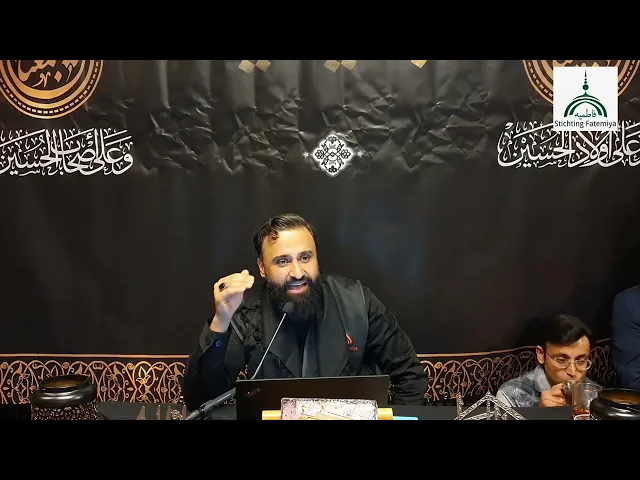
The Prophet's Journey to Taif - Sayed Ali Qazwini
0
0
0 المشاهدات·
25/03/29
في
محاضرات
The Prophet's Journey to Taif - Sayed Ali Qazwini
أظهر المزيد
Transcript
[0:10]Dear brothers and sisters, illuminate your hearts and minds in this gathering
[0:13]with another loud salawat.
[0:23]A very important yet overlooked aspect of the s of the life
[0:29]of prophet Muhammad sallallahu alaihi.
[0:31]And when we study the biography of prophet Muhammad sallallahu alaihi one
[0:37]of the main sources that we seek refuge in isb hasham ibb
[0:42]hasham a later century historian and scholar came and summarized the works
[0:47]and the life and biography of sallai.
[0:51]So he came and he dictated from the birth of towards the
[0:58]very end the life of the holy prophet peace be upon him.
[1:00]One of the most overlooked aspects perhaps we haven't even heard of
[1:08]it of the life of is his migration or rather the attempted
[1:11]migration to the city of now all of us have heard that
[1:17]13 years after revelation decided to migrate to Medina it was called
[1:24]the city of those individuals welcomed him with a red carpet we've
[1:29]all heard of it was renamed in honor of the prophet Medina,
[1:33]the city of the prophet.
[1:35]However, 3 years earlier, there was another attempted migration to a different
[1:40]city.
[1:42]Why?
[1:43]It was in the 11th year after revelation.
[1:48]This was the second year in Abu Talib, the valley of Abu
[1:56]Talib.
[1:57]This is after the mushri.
[1:57]They had engaged in an embargo and a boycott of the prophet
[2:00]sallallahu alaihi and his family and all of his companions.
[2:05]Those who were in Mecca, those who believed in Allah, they went
[2:09]through three very difficult years.
[2:13]These years in the valley, but particularly for Allah, this was a
[2:20]very difficult time period.
[2:22]Why?
[2:23]because he lost two of his most beloved figures is what is
[2:28]an orphan.
[2:29]He had no father.
[2:30]His father had passed away before he was born and before the
[2:36]tender age of six his mother had passed away.
[2:37]Who then took on his care?
[2:41]His grandfather Abdalib he later passed away.
[2:42]Who was sallallahu alaihi wasallam's rock?
[2:46]his uncle Abu Talib, the father of Imam, he was his rock.
[2:55]He was the one who shielded from his enemies.
[2:59]In Mecca, they had an honor system that someone respected in the
[3:04]community.
[3:05]If they were to offer protection, no one would dare harm that
[3:08]individual.
[3:08]Allah was under the protection of Abu Talib.
[3:12]Even though according to history Abu Talib was one of the elites
[3:15]of Quraysh the elites of Mecca even though he did not have
[3:19]a high tribal ranking nor was he wealthy but yet he commanded
[3:22]respect from the people.
[3:23]Therefore, when he saidoolah is under my protection, no one dared to
[3:27]hurt or take his life.
[3:31]But in what happened wasallam first loses his beloved wife, Lady Khadijah.
[3:40]And this was a devastating blow to she was what?
[3:45]His life partner.
[3:47]In narrations attributed to all Muslims, he would tell his wives that
[3:51]the greatest of my wives was Khadijah.
[3:53]She was his rock.
[3:56]If it weren't for the wealth of Khadijah and the sword of
[4:00]Islam would have dissipated.
[4:01]We have one narration that once was in front of the preaching
[4:08]when Abu Jah he comes and he begins insulting and all of
[4:12]a sudden they come and they start stoning the prophet.
[4:15]The prophet He heads back home.
[4:19]He's bleeding.
[4:20]Who's waiting outside for him?
[4:22]Khadijah, peace be upon her.
[4:23]She sees, he's bleeding.
[4:24]She hugs him and she embraces him.
[4:27]These kufur, these enemies of God, they chase even to his house.
[4:34]They're about to stone him.
[4:35]What happens, lady?
[4:35]She shields him from the blows.
[4:38]Then afterwards, she looks at them.
[4:40]She says, "What kind of men are you?
[4:41]You go to someone's house and you stone a lady in her
[4:45]own home.
[4:45]Afterwards, you know, they felt embarrassed.
[4:47]They left.
[4:49]So throughout the life of Allah, who was his rock?
[4:50]Lady Khadijah.
[4:52]In the valley of Abu Talib, Lady Khadijah passed away.
[4:57]And this was devastating.
[4:58]What?
[4:59]On the emotional well-being of Allah.
[5:01]Years and years after being preached, but what?
[5:06]Receiving mockery, insults, and stones in return.
[5:09]one of his only pieces and pillars of support is lost.
[5:12]Not long after who passes away?
[5:14]Abu Talib.
[5:15]Now Abu Talib this was especially devastating.
[5:19]Why?
[5:20]Because he was raised in the house of Abu Talib.
[5:22]Abu Talib was like his father such that to honor Abu Talib
[5:27]when peace be upon him was born in the Kaa came to
[5:31]Abu Talib and he said you raised me you spent on me.
[5:35]I want to repay this favor.
[5:37]Have Ali, this young child be raised in my house.
[5:41]Therefore, was actually what?
[5:43]Raised in the house of Allah.
[5:43]And was like his father and lady Khadijah was like his mother.
[5:49]This was how close the relationship was between Allah and Abu Talib.
[5:53]Now in the valley of Abu Talib, what happens?
[5:56]Abu Talib passes away.
[5:59]And with the passing of Abu Talib that protection that was on
[6:03]what is gone.
[6:05]Meaning at any moment assassins from Quresh can come and kill him.
[6:08]He's under no protection.
[6:09]He's very vulnerable.
[6:11]He's lost the two pillars of his life.
[6:16]What happens in those moments according to the seal of Ibisham his
[6:22]uncle Abu because at the end of the day yes he was
[6:23]an enemy.
[6:24]He would mock the prophet sometimes but he saw his nephew he
[6:29]felt bad for him.
[6:30]He offered him protection.
[6:29]So for a while was safe but then Abu Jah his friend
[6:34]he comes and he convinces him that what revoke your protection.
[6:38]Thus in the 11th year after revelation in the month of Shaw
[6:45]which is in a month that is succeeding us right now sallallahu
[6:49]alaihi wasallam says what I cannot stay in Mecca.
[6:53]My life is in danger.
[6:53]He says if I stay here my life is vulnerable.
[6:58]I am no longer under anyone's protection.
[7:01]Thus with divine inspiration he says I have to leave.
[7:06]Now where does head?
[7:08]He is inspired to head to a city that's 100 kilometers or
[7:14]60 miles southeast of Mecca by the city by the name of
[7:20]is in a mountainous region.
[7:23]And because it's very high, it's 6,000 ft above sea level, 1,800
[7:29]m.
[7:30]The climate and the weather is very nice.
[7:30]It's a lot cooler than what than Mecca.
[7:34]According to the pagan mythology, they had these three gods.
[7:40]the the idols, the lat, the manat, and theat.
[7:42]One of the main gods of the mush of Mecca was what?
[7:48]The lat she was housed in her shrine and her idol was
[7:54]in and the two tribes of Mecca and had very strong ties.
[8:01]The major tribe was they had this belief that Allahel it gets
[8:07]very hot in Mecca during the summer.
[8:09]It can exceed sometimes 120 degrees Fahrenheit.
[8:11]So God, he comes and he visits his daughter.
[8:14]Why?
[8:15]It's high in the mountains.
[8:16]It's cool.
[8:18]There's a lot of greenery and vegetation.
[8:20]So it's kind of like a a summer resting place.
[8:24]And in fact, now in modern day Saudi Arabia, it's a resort
[8:27]town, hotels and resorts.
[8:28]So they had this belief that God would go and visit his
[8:31]daughter in the tribes of they had strong economic ties with they
[8:40]would do business together.
[8:41]They would have shared caravans.
[8:45]There was a lot of intermarriage and if you were from Mecca
[8:48]you were very familiar with the city of thus it made sense
[8:52]for to head towards and in fact is mentioned indirectly within the
[8:59]holy Quran there's a story that's he was jealous of that and
[9:08]revelation and all this communication between God and mankind was through as
[9:14]the Quran says one of the two great cities or villages meaning
[9:18]what Mecca and he decides to head towards according to Ibisham he
[9:28]had a companion with him he didn't go alone now some sources
[9:34]say this was Z his adopted son-in-law other sources say it was
[9:39]Im Ali Ali in either case he had a companion and he
[9:43]headed towards seeking refuge for his life.
[9:45]When he arrives to several days later he decides to do what
[9:52]what he's been doing for the past several years preach Islam.
[9:55]He goes and he asks who is the tribal head here in
[10:01]this area.
[10:02]They tell him go to so- and so place you will meet
[10:03]them.
[10:04]He goes and he finds that inif there are three chiefs ruling
[10:12]the city.
[10:10]Why?
[10:10]There were three brothers, Masdir.
[10:16]Their father had been the chief.
[10:19]When he passed away, they said, you know, instead of fighting and
[10:25]killing each other over power, why don't we just equally share power?
[10:28]So these three brothers were heading the tribe in goes and he
[10:34]meets them.
[10:35]He says salam to them and he invokes them and preaches the
[10:38]message of Islam.
[10:41]How do they treat him?
[10:43]Now, at the time, Arabs had an honor code.
[10:46]When you have a guest from your city, but let alone someone
[10:51]from another city, someone who came from a far away distance, a
[10:54]refugee, right?
[10:54]Allah was basically a refugee.
[10:56]And what kind of refugee?
[10:58]He had two of the most difficult years in which whom?
[11:05]His wife, Lady Khadijah, passed away.
[11:08]And what?
[11:07]and Abu Talib he was vulnerable and so he goes in hopes
[11:13]that these people would accept his mission and he could establish a
[11:16]stronghold in how do they repay him?
[11:19]What kind of treatment do they give this honored guest?
[11:22]The first of these brothers he says you claim to be a
[11:28]messenger of Allah.
[11:28]You claim to be representing God.
[11:30]If someone like you, an orphan, someone that is has no rank
[11:35]or status in your society, you claim to represent God.
[11:39]If that's true, I'll go and rip the curtains of the Kaa.
[11:43]The second brother tells him, "Did Allah find no one better than
[11:46]you?
[11:46]An orphan?
[11:47]Of all people he could have sent, he sent someone like you."
[11:51]The third told him, "If you're being genuine, you're a prophet of
[11:58]God and you're speaking to me, I'm just a low sinner.
[12:00]It's beneath you to speak to me.
[12:01]But if you're lying and you're not a prophet and that's actually
[12:06]the case, it's beneath me to speak to you.
[12:08]Get out of here.
[12:09]This is how the heads of the tribes of greeted.
[12:16]What does he do?
[12:20]Does he give up?
[12:20]He says, "You know what?
[12:24]If these individuals, who by the way, they have strong economic ties
[12:27]to Mecca.
[12:29]One reason they didn't accept even if they may have believed was
[12:32]what if they accept the mission of the Meccans the same way
[12:37]they boycotted the Muslims in Mecca they'll boycott Biff a lot of
[12:41]trade a lot of economic ties so in order to preserve their
[12:44]own wealth their own ties they refuse so he goes to the
[12:50]marketplace and he begins preaching according to some narrations every day would
[12:55]preach and day after day people would come in the marketplace place
[12:58]it.
[12:59]They would come to hear the message of of Allah.
[13:02]Who is our one creator?
[13:05]Why should we abandon these idols?
[13:06]Allah is preaching.
[13:10]It said on the 10th day the tribal heads and all the
[13:16]elders and elites of they have a meeting and they say we
[13:19]have to get rid of this guy.
[13:22]Why?
[13:20]because lines would emerge in order for people to greet and ask
[13:26]questions from Allah.
[13:26]They were worried that if there's a mass movement of people listening
[13:33]to Allah that might put them in jeopardy, their own status and
[13:36]rank.
[13:36]So they say we have to deal with this issue.
[13:40]We have to eliminate this issue.
[13:42]They go, they gather their friends.
[13:44]They start stoning.
[13:46]This is the treatment of what?
[13:51]of a refugee.
[13:51]He's doing this for what?
[13:54]He's trying to educate them, guide them to the proper path.
[13:58]But they still refused.
[14:01]They start stoning him until history states from the top of his
[14:05]forehead to the souls of bless feet are bleeding.
[14:10]He goes outside the city.
[14:14]He's heading out, running away from these individuals, from these evil people
[14:20]who are stoning him.
[14:20]When he heads to a garden owned by two brothers and he's
[14:28]injured, he's bleeding.
[14:31]You can imagine he can't breathe properly.
[14:34]He sits down by a tree to rest for a moment.
[14:39]Who walks by these two brothers and they walk by and they
[14:45]see They are from Mecca.
[14:47]What are they doing?
[14:46]They have a garden.
[14:50]So they're retreating from the heat of the summer of Mecca for
[14:54]some rest.
[14:55]So they see and they feel bad.
[14:58]They were not Muslims by the way.
[14:59]They were and they were against but at the end of the
[15:03]day they're from Quraysh.
[15:04]They're from the same village.
[15:05]So they feel bad.
[15:09]They send whom?
[15:08]Their servant to go offer him?
[15:12]some plates plates filled with fruits and grapes as Adas is heading
[15:23]towards in this moment he's bleeding he has absolutely no recourse Mecca
[15:31]if he were to stay he would have been killed the only
[15:33]other place he went to the only other hope he had his
[15:39]family passed away his friends and companions companions in Mecca are under
[15:44]siege.
[15:43]They're starving and these people have refused him and they've what?
[15:48]They've stoned him.
[15:47]Who does he turn to?
[15:50]None other than Allahel.
[15:52]In all of Sallallam's difficult moments, he would seek refuge in Allah
[15:59]and he would never give up his mission no matter how hard
[16:03]it gets.
[16:03]And sometimes, my dear brothers and sister, life gets hard.
[16:06]We go through sometimes the highs and sometimes the lows of life.
[16:09]But during those low moments he would never forget his mission and
[16:15]he would never forget who is the one who has supported him.
[16:17]So he turns towards Allah and he recites this very beautiful dua
[16:21]that is mentioned in our hadiths.
[16:24]He says Allah oh Allah to you alone I complain of my
[16:33]weak situation.
[16:35]He's alone in a foreign city without his friends, without his family.
[16:42]Who does he complain to?
[16:46]Only Allah.
[16:45]Then he says he complains to Allah of his lack of resources
[16:56]and his weakness before people.
[17:03]Oh Allah, you are the Lord of those who have been weakened
[17:07]and you are my Lord.
[17:10]Oh Allah, who do you leave me?
[17:12]In the hands of who?
[17:14]I left Mecca fleeing the evildoing of those people in Mecca.
[17:20]And how am I treated in life?
[17:20]To who do you leave me?
[17:25]to someone distant in a far city and they mistreat me or
[17:33]you leave my affairs in the hands of an enemy who will
[17:36]have no mercy.
[17:39]Listen what says now then does say oh Allah why is it
[17:48]that you're doing this to me what have I done wrong oh
[17:51]Allah this is not fair I've given everything in my life for
[17:56]you even my family members all my wealth my relatives my entire
[17:59]life has been in dedication to you why are you treating me
[18:02]like this this is not how speaks to Allah rather he tells
[18:07]him oh Allah as long as I'm not in your displeasure, you're
[18:11]not angry with me, then I'm okay.
[18:14]This is the dua of all he's worried about is that I'm
[18:21]still in Allah's good graces.
[18:27]Look at the polite etiquette of even when he asks Allah for
[18:33]favor and what a polite manner he says however Allah if you
[18:36]were to send your ease upon me that would be easier for
[18:41]me that would be more comfortable he doesn't say oh Allah you
[18:44]have to do this for me I'm waiting why don't you answer
[18:47]my duas he says oh Allah I'm content with my situation but
[18:50]if you do send down your ease I would be grateful He
[19:04]says, "Oh Allah, I beseech you by the by the light of
[19:10]your face that you do not send down your anger upon me.
[19:17]Oh, he says, "Oh Allah, take until you are pleased.
[19:22]At the end of the day, what matters is your pleasure.
[19:27]Regardless of the situation I'm in, as long as I know I
[19:29]am in your good graces, that's enough for me." This is the
[19:34]im and the patience of Allah.
[19:36]Some of us, we go through the smallest of struggles.
[19:41]Immediately we start questioning why oh Allah why are you doing this
[19:45]to me don't I pray aren't I on top of my fasting
[19:48]aren't I a good m why are you treating like why are
[19:51]you treating me like this he knows that this dunya is a
[19:56]test of our wealth of our family members of our strength of
[20:05]our patience all he wants to know is am I still in
[20:08]God's good graces After reciting this dua, Allah lifts his head.
[20:12]Who does he see?
[20:14]He sees Adas offering him a plate of grapes.
[20:17]And grapes are one of the sweetest of fruits not commonly available
[20:21]in Mecca.
[20:23]Subhan Allah.
[20:21]He's injured.
[20:23]He's bleeding.
[20:25]And one of the sweetest and best of fruits is offered in
[20:28]front of him.
[20:28]He takes some of these grapes.
[20:31]And before he eats, he says, "Bismillah, Adas is a Christian from
[20:39]northern Iraq who happens to be a servant of these two individuals
[20:45]and he says, "This is the first time I hear someone invoke
[20:50]the name of God." Usually in the city, people before they eat,
[20:54]they mention who the This is the first time I see someone
[20:58]mentioning God.
[21:00]Who are you?
[21:01]Before he answers, he says, "What is your name?
[21:03]Where are you from?" He says, "My name is Adas." "I'm from
[21:07]Na Nineveh," which is northern Iraq.
[21:09]Allah When he hears that, he says, "You're from Nineveh?
[21:14]Isn't that the city of Eunice Ib Ma?
[21:17]Prophet Jonas?" He's shocked.
[21:18]He says, "How do you know about Jonas?
[21:21]The Arabs here in this area, they don't know about him.
[21:25]The Christians back in Iraq, they've heard of him and listened to
[21:28]his stories.
[21:29]How do you know about Jonas?" He says, "Yunice, Ununice is a
[21:32]Yunas is a prophet and he is my brother." was shocked.
[21:38]He said, "Who are you?" Allah then begins to speak and teach
[21:45]him about and the values of Islam.
[21:48]Immediately the hadith says he falls on the feet of he kisses
[21:50]his feet and he says, "I bear witness that there is no
[21:55]god but Allah and that you are his messenger.
[22:05]As soon as made that dua, it's as if Allahel sent him
[22:11]a supporter, sent him someone to say that, "Oh, even if they
[22:17]refuse your words and your teachings, there will be others who come
[22:20]after them, who will accept you, who will honor you, and who
[22:27]will understand your value.
[22:29]My dear brothers and sisters, it's very difficult.
[22:32]The position of Allah was very very difficult.
[22:37]But there are lessons to be learned.
[22:40]Even though he is a prophet of God.
[22:46]He is divinely inspired.
[22:47]But that doesn't mean that every step he takes will be fruitful.
[22:51]Even for prophets of God, sometimes the natural course of this dunya,
[22:55]the natural course of life is sometimes we encounter failure.
[22:59]Yes, Rasool Allah would preach and even though he is amongst the
[23:03]greatest of preachers, he is the greatest human being to ever walk
[23:08]this earth.
[23:07]But there were people who refused him.
[23:09]Did that stop Rasoolah from spreading his mission?
[23:13]No.
[23:14]In fact, that only further reinforced his faith.
[23:18]Thus, sometimes failure, my dear brothers and sisters, should not deter us
[23:22]from pursuing our goals.
[23:23]We have to continue to strive and strive and strive and have
[23:29]faith in God.
[23:28]What did Allahel do?
[23:31]Yes, the people of they refused.
[23:32]They mocked him and they stoned him.
[23:35]But Allahel, not long after, two years later, he replaced them with
[23:39]what?
[23:41]with a people who placed that metaphorical red carpet as he walked
[23:48]in Medina or and that was a city that he loved so
[23:54]much a city that he honored a city that he valued their
[23:56]support so much he didn't want to be buried in Mecca in
[24:01]honor and respect to the people of Medina who opened their homes
[24:06]for him.
[24:05]Thus one lesson to be learned from the incident of is that
[24:11]sometimes allahel he wants to test us.
[24:13]So we encounter these obstacles but that should not stop us my
[24:18]dear brothers and sisters.
[24:20]According to one study by Northwestern University the Kellogg School of Management
[24:26]they traced lots of researchers in the field of microbiology.
[24:29]They saw in the beginning of their careers those individuals who had
[24:34]applied to grants they placed them in two categories.
[24:37]Those who were denied grants, scholarships and those who were offered grants
[24:42]and scholarships.
[24:44]And they tracked their careers over 34 years.
[24:47]They found they were expecting to find that those individuals who were
[24:54]accepted in scholarships and grants early on they would have more impactful
[25:01]careers.
[24:59]But what they found was on average those who were rejected early
[25:05]on in their careers from grants, scholarships, they were 6.1% more likely
[25:11]to published high impact papers and have more successful careers than those
[25:17]who had acceptance early on.
[25:19]Why?
[25:19]One reason was because of the failures they encountered.
[25:24]They strove harder and harder until they established a piece of the
[25:27]field for themselves and they started publishing high impact papers.
[25:32]This dunya is like this my dear brothers and sisters.
[25:36]You fail but what happens?
[25:37]You have to get up.
[25:39]You fail again.
[25:38]Do you stay down?
[25:41]You have to get up.
[25:41]Muhammad Ali the legend the boxer once he was asked what is
[25:48]your routine for training?
[25:48]You know he's the fastest, he's the best.
[25:51]What is your routine for training?
[25:52]so that others can emulate.
[25:54]He said, "Honestly, when I do push-ups, when I do sit-ups, when
[26:00]I work out, I don't count until it starts hurting." He says,
[26:04]"When it starts hurting and I can't continue, that's when I start
[26:08]counting." My dear brothers and sisters, the weaknesses that we have, allahel,
[26:14]he places us through certain struggles so that we can develop strengths
[26:18]and replace those weaknesses.
[26:21]Sometimes the struggles we go through, they are actually a gift from
[26:28]Allah to pull out our latent talent.
[26:30]There's a beautiful quote by the author Robert 2.
[26:34]He says, "The struggles you're going through today are developing the strengths
[26:38]that you will need tomorrow." Thusallam, he was not concerned as to
[26:46]why these bal were happening, why these calamities were occurring to him.
[26:50]He was concerned, am I still in God's good graces?
[26:52]Because he knows at the end of the day, Allah is with
[26:57]him.
[26:58]He's now heading back to Mecca.
[27:01]He has no recourse other than to go back to Mecca.
[27:06]on the way descends upon us.
[27:10]He tells him, "Oh, Allah is so angered by how the people
[27:15]of have treated you that he says you give the word, Allah
[27:23]will flip over and send his punishment." Now, if I was in
[27:29]the position of put yourself in his shoes, you are there for
[27:34]what?
[27:35]for their own sake to preach to them for their own betterment.
[27:39]They leave these old filthy and bad habits of jahal days of
[27:44]ignorance and to worship the one in true Allah and they respond
[27:50]with stones.
[27:49]Any of us we would have immediately taken the offer.
[27:54]But look at the heart of how does he respond?
[27:59]He says no.
[28:01]asked him why he says because there may be one day from
[28:07]the generations that come after yes they refused me but perhaps from
[28:12]their lineage there may be a Muslim subhan allah he didn't only
[28:19]have mercy on people who were there at his time he even
[28:22]had mercy on people who were yet to come so he says
[28:28]no he says let them be may Allahh guide And not long
[28:32]after the conquest of Mecca during the era of the kaleiff joined
[28:36]and joined the fold of Islam and became a Muslim city just
[28:41]like sallallahu alaihi wasallam predicted.
[28:43]Thus my dear brothers and sisters one very important lesson to learn
[28:47]is that whatever struggles we're going through we have to remember at
[28:52]the end of the day Allah is with us.
[28:53]There is a reason why we're going through these struggles.
[28:56]Either to develop talents within us to harden us.
[28:59]They say the difference between dirt which is made of carbon and
[29:03]diamonds which is also made of carbon is the amount of pressure
[29:06]and intense heat that certain dirt goes through and that turns into
[29:10]diamonds.
[29:11]So allahel is trying to bring out the diamonds within you.
[29:16]We ask Allahh to always grant us the great the straight path.
[29:19]We ask Allah subhana wa ta'ala to always give us struggles that
[29:23]benefit us whether in this dy in terms of bettering us or
[29:29]struggles that grant us a higher rank in the for the souls
[29:46]of our beloved ones it's the final Friday of Ramadan This is
[29:49]a blessed day.
[29:51]Turn your heart towards Allah.
[29:52]Ask Allahha to forgive us of our sins.
[29:55]Ask Allahha to forgive us and our families, our parents.
[30:00]If your parents are not alive, pray for them and for the
[30:02]souls of all our let us all recite.
[30:15]Alhamdulillah.
[30:21]Assalam alaykum.
0 تعليقات
sort ترتيب حسب
- أعلى تعليقات
- أحدث تعليقات
التالي
4 المشاهدات · 23/12/15
6 المشاهدات · 23/12/17
4 المشاهدات · 24/09/03
1 المشاهدات · 25/11/04