التالي
10 المشاهدات · 24/10/06
8 المشاهدات · 12/05/27
6 المشاهدات · 21/01/03
10 المشاهدات · 22/05/25
6 المشاهدات · 24/01/31
9 المشاهدات · 24/02/01
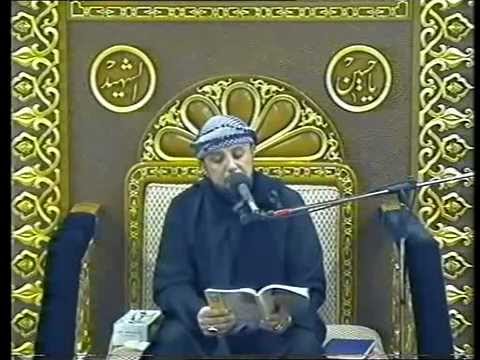
Lessons on the holy Koran- Exegesis of Suratul Ikhlas- Part 25- Hamam Nassereddine
0
0
7 المشاهدات·
24/12/10
في
محاضرات
This is part of a series of lectures given by Hamam Nassereddine that shed light on the holy Koran and explain its verses. These lectures were given at Mahad Imam Ridha in Imam Hussain Foundation.
أظهر المزيد
Transcript
[0:02]alhamd [Music] in our last lesson we finished the narration of IM
[0:56]husam the one in which he speaks about uh the meaning of
[0:59]Allah and how he and the the narration in which he dissects
[1:04]the the meaning of uh the narration led us to the topic
[1:11]of Justice because we were talking about Allah's knowledge and we explained
[1:20]how um when we say Allah subhana wa taala knows what we
[1:23]will perform what we will do before we actually do it this
[1:31]does not imply that that we are compelled to do whatever we
[1:35]do in a why because Allah tal knows what we shall perform
[1:39]what we shall do based on the Free Will that he will
[1:44]give us so there's no contradiction between believing in Free Will meaning
[1:52]believing that we humans have free will with Allah's permission and at
[1:59]the same time believing that Allah knows what people will do what
[2:04]the Believers and what the disbelievers will do before they actually do
[2:08]it there's no contradiction between the two finally we looked at a
[2:13]narration by narration that mention the dialogue between abif and IM in
[2:24]that narration Abu hanifah asked the IM uh who basically commits the
[2:34]sin who's responsible of sinning does the sin come from Allah subhana
[2:39]wa tala or does it come from the slaves of Godel so
[2:41]the IM gave him what three possibilities and we understood from the
[2:46]narration that there was not a fourth possibility and he proved that
[2:54]two were incorrect which means that the last one had to be
[2:58]the correct possibility the right possibility so the Imam proved to him
[3:02]that sins solely come from human beings solely come from the slaves
[3:10]of Allah subhana wa tala and Allah is not responsible of the
[3:14]sins committed by his slaves this is a summary of what we
[3:21]took last week today inshallah we're gonna look at a few Traditions
[3:25]speaking about we looked at the lengthy tradition of IM Hussein but
[3:30]we have also a few short traditions in which the imams commented
[3:33]on the the verse and then we'll look at the last verse
[3:39]inah uh today might be the last lesson regarding this beautiful Surah
[3:45]if it is then inallah in the upcoming lesson we will start
[3:49]with a new chapter or we'll take uh we'll take lessons on
[3:55]particular verses in alquran so let me start by sharing with you
[4:00]a few Traditions found in the book which is a secondary source
[4:09]of Hadith the author cites primary sources of Hadith mkma is a
[4:18]beautiful book very well organized the author will mention a specific topic
[4:27]and then we'll bring the quranic verses and the narrations that speak
[4:31]about that topic and in you will find Sunni Traditions as well
[4:34]so he doesn't mention Shia Traditions he does mention also some Sunni
[4:39]Traditions especially from the book known as Kel in all cases we
[4:46]find the following narrations in is narrated to have said what do
[5:05]we realize here we realize that the IM recites the verse or
[5:11]part of the verse in and then he mentions a result a
[5:17]result of what a result or an outcome or a consequence use
[5:21]any word you want um a result of what the chapter is
[5:29]mentioned and what would have taken place if Allah subhana wa ta'ala
[5:37]did originate from something or something originated from him meaning something came
[5:44]out of Allah subhanahu waala so he says meaning Allah subhah wa
[5:53]tala does not have a parent Allah did not originate from anything
[5:58]and because he did not originate from anything he has no sh
[6:08]no partner in his meaning he does not have a partner who
[6:14]shares Allah's strength subhana waala so here IM aliam is telling us
[6:21]if someone believes that God has a father or has a parent
[6:29]or originated from something then he has to believe that obviously God's
[6:35]parent or whatever he originated from should possess what the same power
[6:44]same strength if not say that if not uh more power than
[6:48]Allah subhanahu wa ta'ala but when you possess the same power as
[6:54]God or you possess more power than God then God is not
[6:57]really God right God is not really God we've mentioned before that
[7:02]if someone has a good understanding of who God is he'll understand
[7:10]that there can only be one God not more he says that
[7:27]Allah subhana wa tala does not have a child nothing comes out
[7:35]of him and had anything came out of Allah if he actually
[7:40]had a child number one he would be inherited by that child
[7:44]or by that thing which makes sense if you think about it
[7:50]well if if something is coming out of Allah subhana wa tala
[7:54]then it should have what it should have the the the traits
[7:57]of God subhanahu wa ta'ala right so it should inherit the traits
[8:04]of God and that thing would not only inherit God but on
[8:13]top of that God would be helik mean meaning he would be
[8:17]a being that that dies a being that perishes so here Imam
[8:24]is telling us that if someone believes that Allah subhana wa tala
[8:28]that God has a son or daughter or something comes out of
[8:34]God subhanahu wa ta'ala that person is basically implying that God can
[8:39]die God can perish one might say how like what's the relationship
[8:54]between the two well if something comes out of God then that
[8:59]makes God what limited correct and if he's limited subhanahu wa ta'ala
[9:07]then he cannot be the necessary being the necessary being cannot have
[9:15]any limits if he's limited he's not the necessary being and if
[9:19]he's not the necessary being then at any point he can perish
[9:22]at any point he can die so again in case the idea
[9:31]is not clear if someone believes that something comes out of God
[9:34]for example he has a child the same way we have children
[9:39]then he's technically saying Allah T is what is m is limited
[9:43]when you say he's limited then he's no no longer he's no
[9:49]longer God he's no longer the the the necessary being and if
[9:53]he's not the necessary being what does that make him makes him
[9:55]a possible being if he's a possible being it means he can
[10:00]he can perish he can die any questions on this narration no
[10:13]questions no in a second narration by says so his statement here
[10:31]is similar to IM Ali's statement but a little bit different as
[10:35]well he says Allah T does not have a child nothing came
[10:41]out of him had that been the case he would be inherited
[10:47]his child would inherit him right now think about this Allah is
[10:56]what is Immortal correct Immortal in what in the sense that he'll
[11:00]never die right perhaps the word is not the best word to
[11:06]use to describe Allah but I'm just using it to make us
[11:09]understand that Allah Never Dies and can never die he's the all
[11:16]living that does not die beautiful when someone says that God has
[11:23]a child for example all do respected the Christians when they say
[11:30]for examplea is the Son of God then technically Isa should be
[11:34]what should be immortal as well right he should be a being
[11:40]that does not die but they also believe that Isa was crucified
[11:48]and killed so how does that work how can God be killed
[11:53]yes they said that you're saying that God is limited because he
[11:59]can't create himself in a limited yeah so here that person is
[12:09]not understanding the difference between uh saying that Allah T cannot perform
[12:14]a particular thing and saying that a particular thing cannot even exist
[12:19]because of itself meaning that thing that we're thinking about that idea
[12:25]that we're thinking about is self-contradicting it cannot come into existence hence
[12:32]it will not be done by Allah subhanahu waala yes further so
[12:38]let me explain with a with a Hadith with a narration um
[12:45]once IM aliam was asked can Allah subhana wa tala place the
[12:51]whole world inside an egg without changing the size of the egg
[12:56]and without changing the size of the world now this question was
[13:03]posed to multiple imams and each Imam each Imam obviously gave a
[13:08]correct answer there's a beautiful story uh pertaining to when he asked
[13:20]IM this question so nonetheless what did IM Ali say said the
[13:25]following he said he said one cannot say that Allah T is
[13:38]weak meaning you cannot attribute weakness to God Allah T is all
[13:47]powerful he's able to do anything but whatever you asked cannot happen
[13:52]whatever you asked me about cannot take place the person was saying
[13:58]can God place the whole world inside an egg without changing the
[14:03]size of the world and without changing the size of the egg
[14:08]that in itself is what is impossible it cannot happen right IM
[14:15]said it cannot take place meaning you cannot physically place the whole
[14:22]world inside the egg without changing the size of the world and
[14:24]the size of the end you can't the idea itself is self-contradicting
[14:30]it cannot happen so the said whatever you ask me about cannot
[14:35]take place but the problem does not lie in Allah tal for
[14:40]us to say Allah cannot do it Allah tal is weak no
[14:45]no no the problem lies in the idea itself would then the
[14:53]person be correct saying that Allah is by that logic dictates cannot
[15:01]do the question is a bit tricky logic is our Del it's
[15:11]our guide which leads us to Allah subhana wa tala and helps
[15:15]us understand Allah by understanding the verses in the Quran or the
[15:19]narrations of that speak about God now this logic has been created
[15:27]by who by God so Allah created the intellect and placed what
[15:31]I like to call statements in the intellect call them principles no
[15:36]problem logical principles logical statements inside of our intellects these statements are
[15:43]what are what we call Common Sense any human being has these
[15:50]or these principles inside of his system right Allah created logic and
[15:55]placed these whatever I called statements or principles inside the intellect through
[16:04]logic Allah wants to tell you who he is all right so
[16:13]one might say that you know logic um determines what God can
[16:21]do or not do but that but the statement does not imply
[16:25]that logic chains Allah subhana or limits God no it implies that
[16:36]through logic we're able to understand Allah because he's the one who
[16:41]created it so Allah makes it an internal guide existing within the
[16:46]human being to help him understand who God is or who is
[16:52]God does that make sense so again when we say Allah subhanahu
[16:59]wa ta'ala will not perform certain actions because these actions are self-contradicting
[17:09]the deficiency does not lie in God it lies in the action
[17:13]itself it's like when someone tells me can God create a second
[17:17]God the answer is what yes or no what do you think
[17:25]no why no I give uned being okay you're on the right
[17:37]track exactly right the second being would not be God because part
[17:44]of the definition of God is to be a being that has
[17:47]no beginning that's part of being God if you're God then you
[17:55]have no beginning you always existed and you always will exist so
[17:59]the question itself is wrong can God create a second God if
[18:03]you say no then you're say you're limiting God hold on for
[18:06]a second right pull the brakes the the part of the meaning
[18:12]of God is not to have a beginning so the question is
[18:14]wrong so what you're asking will not take place not because Allah
[18:20]is weak but because whatever you're asking cannot exist it's what we
[18:27]call in philosophy an impossible being father um it's problematic to say
[18:47]he can for example create a second God but will not create
[18:50]the second God because that implies that the second God can exist
[18:54]but in reality the second God cannot exist it's impossible to have
[19:01]two gods and it's impossible to have a created God it's like
[19:06]saying I exist and not exist at the same time at the
[19:12]same time same place same same world I can exist somewhere and
[19:16]not exist somewhere else sure at the same time but to exist
[19:21]and not exist at the same place same time and same world
[19:25]that's impossible [Laughter] yeah so we have these these uh things these
[19:40]ideas that are self-contradicting um the idea itself cannot exist so the
[19:49]deficiency lies in the idea not in Allah subhanahu wa taala hence
[19:52]we've said before that we have to differentiate between what is logically
[19:58]imposs possible and what is naturally impossible there's a difference between the
[20:02]two there's a big difference when we say something is naturally impossible
[20:07]we're saying based on the laws of nature this cannot happen Okay
[20:14]when we're saying something is logically impossible we're saying based on the
[20:21]laws of logic it cannot happen Okay then what's the difference the
[20:26]difference is what's naturally impossible can be created by Allah why because
[20:32]he's the he's God he's the lawmaker he's the creator of nature
[20:36]so he can break the laws of nature whenever he wants he
[20:41]manipulates the laws of nature hence We Believe for example that with
[20:49]a simple you know gesture as he pointed to the Moon he
[20:56]split the moon if he's the rasool of Allah if he's the
[20:58]m messenger of God then yes he can do it because he's
[21:02]backed by who by Allah subhana wa tala Allah is the creator
[21:05]of the moon at any moment he can he can destroy the
[21:09]moon and then recreate it he can make it collapse he can
[21:11]split it into two into a million pieces it's up to him
[21:16]subhana wa tala we also believe that the son was brought back
[21:19]for IM aliam twice again Ali is he's backed by Allah subhana
[21:27]wa tala so the sun can return for IM Ali twice Thrice
[21:32]three million times no problem Allah tal can break the laws of
[21:36]nature whenever he wants because he's the he's the Creator he's the
[21:40]one who has full control over the laws of nature so whatever
[21:44]is naturally impossible can happen if Allah wants it to happen but
[21:48]if something is logically impossible then that means Allah tal through logic
[21:55]is telling us this cannot take place because the idea itself is
[22:05]uh self-contradicting as we said it cannot exist it's it's an impossible
[22:11]being so if we say Allah does not do it the deficiency
[22:15]does not lie in Allah it lies in the idea itself as
[22:22]we said like creating a God the idea is self-contradicting or like
[22:33]me or you existing at the same time in the same place
[22:39]in the same world and not existing existing and not existing at
[22:44]once it's impossible yes how does that work right Allah did not
[23:10]give birth to anyone nothing came out of him had that been
[23:15]the case he would be inherited and he did not come out
[23:22]of anything or anyone he has no parent had that been the
[23:25]case then he would have a partner he would have a shik
[23:29]a partner hence when you think for example of Greek uh mythology
[23:37]right you realize that uh they believed in what in multiple gods
[23:43]Zeus for example apparently he's he's God or a God and he
[23:47]has a son Hercules if I'm not mistaken or many sons but
[23:55]he's also a God or semi God right so you have sh
[23:58]it's obvious if if God is a parent then uh sorry if
[24:04]if God is is is a son of someone else then that
[24:08]someone else should also be God then there will be what multiple
[24:11]gods there will be shat partners for God subhana wa tala says
[24:26]he says Allah subhah he did not give birth to anything he
[24:34]does not have a child nothing came out of him had that
[24:39]been the case then he himself would be a child of something
[24:42]else he himself would have originated from something else and he did
[24:53]not originate from anything had he originated from something then had he
[25:00]originated from something then he would have been uh he would have
[25:04]been limited and as we said if he's limited then he's no
[25:13]longer the necessary being so he's no longer God subhana tala one
[25:19]might say why would he be limited well think about it if
[25:24]he's coming from something else before he comes out of that thing
[25:29]he doesn't exist so he has a beginning if he has a
[25:30]beginning that that's a limit you've limited Allah subhana wa tala so
[25:45]he uh he does not have a child nothing originated from him
[25:52]subhana wa taala like that nothing actually came out of Himel had
[25:56]that been the case then he would be M he would be
[26:01]the son or the child of someone else he would have originated
[26:05]from something else how do that how did that beat from the
[26:13]other like why why does it mean that if he originated from
[26:18]something he should originate you're talking about the first segment of IM
[26:30]Ali's correctly you said uh had he originated from something he would
[26:35]have originated no no how does one lead to the other how
[26:37]does one lead to the other Jade good question you can say
[26:58]that Technically when something is coming out of allaha that makes him
[27:04]what limited we said before Allah subhana wa ta'ala his his traits
[27:13]are his own self so if Allah has one deficiency has one
[27:20]has a drop of of of incompletion that makes him absolutely incomplete
[27:27]so if Allah has if Allah is limited from one one perspective
[27:34]from one angle that makes him absolutely limited it makes him basically
[27:38]limited from from all angles makes sense because his traits are what
[27:44]his own are his traits are his own Essence as a result
[27:51]what will that mean it will mean that um he did not
[27:54]always exist when we were saying that he has limits from all
[28:02]perspectives one of those perspectives would be um when did he come
[28:08]into existence he will have a beginning and he will have an
[28:11]end if he has a beginning then he has to do what
[28:17]he has to come from something else I think maybe I I
[28:23]didn't understand you or maybe I wasn't able to transer my question
[28:26]yes just the first he did not had he originated from something
[28:35]something would have originated from how does had he originated from something
[28:41]lead to something would have originated from now we said uh we
[28:49]said the opposite we said if he gave birth to something yeah
[28:52]if he if something came out of Allah then he technically would
[29:00]have to come out from something else yes yeah you're confused okay
[29:16]let's let's repeat the Hadith ahed do you have a comment yeah
[29:20]look at nature everything that is birth or has been given birth
[29:27]to is able to give birth and has been birth and that
[29:28]has not been birth can also not birth anything else nature so
[29:34]I think that example also I think yes like story the story
[29:45]exist before the story did not exist before but it doesn't mean
[29:54]what but their their question is is uh a bit different uh
[30:14]let me repeat the translation and then we'll go from there all
[30:20]right so theith says means nothing came out of Allah right he
[30:28]have a child and nothing came out of him the reason I'm
[30:33]I'm giving different translations is because as we said when we read
[30:38]the first interpretation that comes to mind is that Allah T has
[30:43]no child and has no parent that's a very basic interpretation IM
[30:48]Hussein's interpretation is much deeper he said means or indicates that Allah
[30:54]subhana wa tala does not orig from anything doesn't come out of
[31:04]anything and nothing comes out of him subhana if we say that
[31:09]we originated from Allah then the only way to accept that statement
[31:12]would be to understand it in the following way we were created
[31:19]by God Allah made us he was our origin in the sense
[31:21]that he's our creator but not in the sense that we came
[31:26]out of him we literally or physically came out of God that
[31:30]doesn't happen so the IM says Allah subhana waa did not give
[31:36]birth to anything doesn't have a child nothing came out of him
[31:42]so if he had a child if something came out of him
[31:48]and he himself would be a mud a mud means he is
[31:54]a being that that has a parent or that came out of
[31:57]something and was was born basically is that you got it now
[32:28]so the explanation I gave here we have a by the is
[32:36]speaking the masum speaks you can simply take whatever he says even
[32:42]if you don't understand even if you don't understand the logic behind
[32:49]his statement the is saying if you don't understand why you can
[32:54]still accept the word of the Im so along that you've proved
[32:59]proven that he is an IM and that he's infallible make sense
[33:02]even if you don't understand why even if if you don't understand
[33:11]the uh the reasoning behind his his his word but the explanation
[33:17]I gave uh brings us closer let's say to understanding IM Ali's
[33:22]word of course I was speaking from um in the ex existence
[33:30]perspective if we're saying that Allah subhanahu waala if we say that
[33:37]Allah has a child or something literally or physically came out of
[33:41]him that would make him limited if he's limited then he has
[33:44]to have a beginning if he has a beginning then there has
[33:48]to be someone else who brings him into existence he's he will
[33:54]be dependent on someone else J so this is one conclusion that
[33:58]you can reach if you understand that him having a child makes
[34:04]him limited subhanahu waala but there's one last point that comes to
[34:13]mind or one last question the IM didn't simply say he said
[34:22]which implies that if Allah T had a child something came out
[34:29]of Allah then Allah T himself would also be a child or
[34:32]he would come out of something then he says Allah subhah waala
[35:04]uh does not have a parent or did not come out of
[35:11]anything had that been the case then he would be limited subhah
[35:15]this one is clear the last part of the Hadith is clear
[35:30]see how much time we have left now we have a bit
[35:56]of time left let's look at one last narration before we go
[36:10]into the last verse if we have enough time for that verse
[36:20]today also found in m says does not have a child Allah
[36:40]nothing came out of him or comes out of him why because
[36:42]the child resembles his father when you have a child your child
[36:47]will resemble you not necessarily in in his physical appearance although in
[36:54]many cases the child does resemble the the parent in his or
[36:58]her physical appearance but if that's not found then you will find
[37:02]other forms of uh resemblance existing between the child and the parent
[37:09]technically the child is a product of the parent so there will
[37:13]be what an amount of resemblance between the two but Allah T
[37:18]has no likes subhah wa tala so it's as if the IM
[37:21]is telling us if you understand that Allah T has no likes
[37:26]then you will know he cannot have children again the IM uses
[37:39]the issue of Shabah meaning having a match or having a like
[37:42]he says Allah tal does not have a parent or did not
[37:48]originate from something else not come out of something else because had
[37:51]in the case he would resemble whoever preceded him so we fall
[37:58]into to what the same issue the same problem Allah subhana T
[38:01]has what has a Shabah has a like there something something or
[38:08]someone that resembles him so the IM is telling us here if
[38:16]you understand that Allah has absolutely no likes then you understand that
[38:25]he is as he said in he has no children and no
[38:31]parents then he said meaning none of his Creations were a match
[38:49]for Allah subhanahu wa taala or a match of Allah none of
[38:55]his Creations are similar to him says that Allah subhana wa ta'ala
[39:07]is very different extremely different than his Creations there's a big difference
[39:16]between the Creator and the Creations such that the traits that his
[39:35]Creations possess do not resemble his traits there's a big difference a
[39:42]huge difference between the traits of Allah and our traits here we
[39:50]remember what we said perhaps last week or a few weeks ago
[39:53]which is when we think of our traits the tra of the
[39:58]Creations some traits belong solely to us you cannot attribute these traits
[40:06]to Allah like what like having a beginning having a child having
[40:12]a parent being weak being ignorant you can't even link those to
[40:15]Godel then again there are some traits that you can link to
[40:21]the Creator and the and the the creation like Mercy Allah is
[40:23]the all merciful and I can be merciful kindness Allah is is
[40:30]the the source of kindness he is kind he is loving but
[40:37]I can also be kind I can be loving Allah is the
[40:44]most generous and I can be generous even then there's a big
[40:48]difference a huge difference between his mercy and mine his generosity and
[40:54]mine so on so forth such that you really can't compare the
[40:57]the generosity of the creation to the generosity of the Creator or
[41:04]the mercy of the creation to the mercy of the Creator you
[41:08]can't compare the two yeah yeah course yes definitely yes definitely Allah
[41:30]no no yeah no no hence we have our ninth IM ASN
[41:41]as okay I thought we'll have enough time to uh shed light
[41:48]on the fourth verse but I guess we'll leave it for the
[41:52]next lesson
0 تعليقات
sort ترتيب حسب
- أعلى تعليقات
- أحدث تعليقات
التالي
10 المشاهدات · 24/10/06
8 المشاهدات · 12/05/27
6 المشاهدات · 21/01/03
10 المشاهدات · 22/05/25
6 المشاهدات · 24/01/31
9 المشاهدات · 24/02/01