التالي
10 المشاهدات · 24/10/06
8 المشاهدات · 12/05/27
6 المشاهدات · 21/01/03
10 المشاهدات · 22/05/25
6 المشاهدات · 24/01/31
9 المشاهدات · 24/02/01
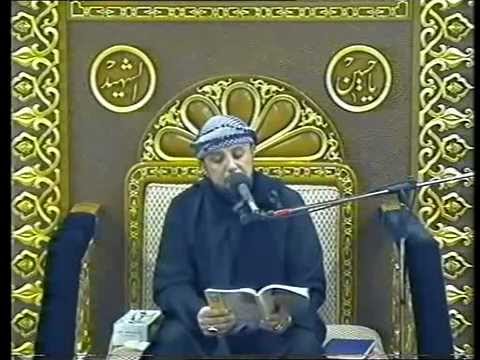
Lessons on the holy Koran- Exegesis of Suratul Ikhlas- Part 24- Hamam Nassereddine
0
0
9 المشاهدات·
24/11/08
في
محاضرات
This is part of a series of lectures given by Hamam Nassereddine that shed light on the holy Koran and explain its verses. These lectures were given at Mahad Imam Ridha in Imam Hussain Foundation.
أظهر المزيد
Transcript
[0:03][Music] m in our last lesson we were reading the final part
[0:59]of Imam Hussein's uh narration regarding and we uh stopped at the
[1:11]part in which the Imam was uh describing Allah subhah wa taala
[1:16]with new descriptions he said he is the one who knows the
[1:24]seen and the Unseen or the felt and the unfelt we touched
[1:27]upon the issue of and we gave a few examples of certain
[1:32]things that are part of the world of the Unseen for us
[1:35]and we explained that um when we're looking at any particular being
[1:41]whether we're looking at human beings or jins or Angels or other
[1:50]beings uh there is a world of sh for them and there's
[1:51]a world of for them as well there are things that these
[1:57]beings witness that they know and there are things that these beings
[2:01]do not witness and do not know for Allah there is no
[2:03]for Allah there is no such thing as meaning Allah is aware
[2:12]of all worlds of all matters and he sees everything subhana wa
[2:16]tala so when he says whether we're looking at the narration of
[2:21]Imus or we're looking at quranic verses that confirm the same trait
[2:27]for Allah subhana tala Allah is basically telling us whatever you consider
[2:33]whatever is for you I know about this I know about it
[2:39]I see it so for Allah T it's not it's not part
[2:44]of the Unseen because Allah sees everything we stopped at the uh
[2:53]the trait Al said means the great the one who's great not
[3:00]the one who's Big because Allah has no size he's not big
[3:04]or small because he does not have a size we were explaining
[3:12]what means and we said when we go to the book for
[3:20]we find several definitions of or okay so we mentioned the definition
[3:28]of a man called did he say he said and we explained
[3:36]that definition meaning he is when we say we're saying Allah subhana
[3:41]tala is the being that is what that is uh so perfect
[3:49]he does not hold the traits that solely belong to the Creations
[3:58]perspec is the way we are defining this it can only apply
[4:03]to Allah because everybody else is correct so is there a way
[4:10]to define this word word without inherently referring to Allah oh okay
[4:16]um so what does it mean from a literal perspective yeah yeah
[4:21]because when you basically just saying Allah the rest creation okay so
[4:30]okay so literally would mean um let me see how we can
[4:38]explain this from a literal perspective would mean the thing or the
[4:44]one that raises himself or exalts himself above something else yes yeah
[4:59]yeah so the literal meaning of mut would be the one or
[5:07]the thing that raises himself or exalts himself above something else you're
[5:20]welcome and then we apply to Allah we make it the absolute
[5:24]that he is above every other yeah yeah so where did I
[5:38]get this literal definition from number one M we're going into Arabic
[5:45]vocabulary at the moment comes from the word means height right height
[5:55]so we're talking about something that's high or we're talking about highness
[5:59]when you say say right now the the structure itself all right
[6:10]indicates that someone is doing something to himself make sense someone is
[6:19]doing something to himself for example is someone who is what revealing
[6:27]his he's revealing his greatness and saying that he is greater than
[6:34]someone else now is he is he right in that is he
[6:40]saying the right thing or not that's a different story uhan was
[6:44]M right he said he's better than Adam but he was wrong
[6:47]Adam was better than him but he was still meaning he claimed
[6:51]to be better than Adam by so those are two points regarding
[7:29]the the the word mut which help understand the literal meaning of
[7:33]nonetheless then he said let me send you what he said and
[7:44]we will explain it inshallah a man called said is the one
[8:07]who is so great we're talking about Allah he's so great he
[8:14]the he does not hold any of the uh traits that those
[8:23]who lied attributed to him subhanahu wa ta'ala so there are people
[8:37]who are means they're Liars they fabricated lies these people fabricated lies
[8:44]about about who about Allah subhana tal by the way the the
[8:46]word mu does not pertain to someone who only fabricates a lie
[8:53]about Allah but there are people who were M and they attributed
[8:57]lies to God subhah wa ta'ala such as the people who said
[9:03]that Allah subhana wa taala has what has children or the people
[9:06]who said that Allah subhana wa ta'ala is a human being or
[9:09]has a physical form Etc but all of these lies don't pertain
[9:15]to Allah Allah is great in fact he's the greatest in fact
[9:23]we don't understand how great he is subhah wa ta'ala whatever we
[9:30]understand of his greatness is inferior to the reality of his greatness
[9:37]so when we say alut is the one who does not hold
[9:44]the traits that were attributed to him by those who fabricated lies
[9:49]such as the people who said the angels are the daughters of
[9:56]Allah subhana wa taala or the people who said is the son
[9:59]of Allah subhah wa ta'ala or Allah has children Etc some for
[10:07]example somebody would to lie about me and say I have a
[10:11]certain trade that I don't I still don't have that trade okay
[10:14]so and and you could say that about anything right so what
[10:21]is this you know it just seems like this word could apply
[10:25]to anybody even even if it could apply to um even if
[10:28]the definition could can apply apply to to anyone uh the the
[10:34]word here based on this definition of course would be uh reminding
[10:41]us that the lies that were attributed to Allah are actual lies
[10:47]things that we shouldn't believe make sense and maybe that the lies
[10:52]are still than reality oh definitely definitely yeah definitely we're saying that
[11:00]these or lies these words the words that were fabricated and attributed
[11:04]to Allah such as Allah having a son Allah having daughters Allah
[11:08]being a human being or having a physical form Etc these lies
[11:12]don't pertain to God they're not real because Allah T is too
[11:18]great he's too perfect to hold any of these traits but there's
[11:27]a second meaning we can understand from the word ofi so the
[11:31]word of Al the definition of alwi can be understood in multiple
[11:36]ways the second way is he's saying Allah subhana is is so
[11:39]he's m in the sense that he's so great he does not
[11:43]lie he doesn't utter Any Lies subhanahu wa taala so whatever he
[11:53]says is on point whatever he says is true never does God
[11:57]uh break his promise and never does he say anything that's false
[12:02]hence Allah T makes a bold statement in the Quran saying that
[12:08]the Quran has no falsehood in it there's absolutely no falsehood in
[12:11]the book of Allah even if we go by a verse and
[12:21]it seems it seems that the Holy Verse contradicts to a certain
[12:31]extent modern science yes if we go through a verse and the
[12:35]verse seems I'm saying seems thesee focus on the word seems the
[12:39]verse seems to be contradicting modern science will go with what the
[12:46]Quran says not with what modern science says Le because human beings
[12:50]are the ones who basically taught us what modern science does scientists
[12:55]are discovering more and more secrets pertaining to this universe whether we're
[13:01]talking about Secrets pertaining to biology or chemistry or physics or other
[13:06]kinds of Sciences and theories are changing in the past there were
[13:11]certain uh scientific theories that were proven to be wrong so theories
[13:18]changed for example one example I I always remember because they taught
[13:22]us this in in chemistry is at a certain point the human
[13:27]being believed mankind believed that the smallest uh being the smallest matter
[13:35]in existence was the atom little did they know that the that
[13:38]the atom consists of what of smaller particles or smaller kinds of
[13:43]matter like electrons protons neutrons but there was that theory that the
[13:49]smallest thing in our world is the atam then they discovered oh
[13:55]we were wrong so the human beings might make a mistake today
[13:59]modern science might say something which will change tomorrow meaning tomorrow we
[14:04]might have another theory that says the old theory is wrong j
[14:07]with Allah subhana wa T he knows everything so if Allah T
[14:12]makes a statement and the statement of God seems to be contradicting
[14:16]modern modern science then we go with what Allah says because Allah
[14:20]never makes a mistake subhana wa tala yes sister okay they finally
[14:42]isolated the partic I think that that causes things to have mass
[14:45]and weight they ended up calling it The because they don't know
[14:51]how can you L it so you said electrons andon yeah y
[14:57]yeah they are composed of other sub but none of those particles
[15:03]those sub particles have weight or mass except for one particle but
[15:07]they can't figure out why that one has it and the rest
[15:11]they end up calling that particle the god the God particle yeah
[15:15]yeah they they usually or sometimes they uh link the word God
[15:22]to to certain things that are not God which is quite sad
[15:25]call it the master particle you know the king particle but but
[15:33]not God yeah your point of if science seems to contradict the
[15:41]Quran the argument that is made that the Quran is correct but
[15:47]we interpreting it wrong there's always that possibility too correct yeah yeah
[15:52]yeah Quran is always on point but sometimes what happens is we
[15:57]misinterpret the Quran so if we misin interpret it we might think
[16:00]that you know it's saying something that contradicts modern science perhaps it's
[16:05]not for example apparently there are some people who tell you uh
[16:13]Quran says that the the Earth is flat so you know when
[16:16]scientists tell you that the Earth is is not flat it's a
[16:21]a sphere in fact it has an oval shape don't believe them
[16:23]because Quran says the opposite Quran does not say that the Earth
[16:29]is flapped they misunderstood the Quran Quran does not say that that
[16:32]it's flat on the contrary there's a verse in the Quran um
[16:37]mentions which indicates that the Earth is moving and it points to
[16:47]the reality it points to the reality that the Earth is not
[16:52]flapped so yes uh the opposite is true sometimes people might misunderstand
[17:00]the Quran and for that they'll think that the Quran contradicts modern
[17:22]science withi um could have a third meaning which is is the
[17:30]one who's hi the one who's who is um um yes high
[17:41]high not in in a physical manner rather he's high in the
[17:51]sense that he is what perfect that he has no imperfections then
[17:58]he said is the following means what that Allah subhana waala is
[18:06]so great you can't describe him which is something we've mentioned multiple
[18:13]times as in any description you give to Allah whatever you understand
[18:18]of that description is inferior to his reality subhana wa tala then
[18:39]AB he read the last verse of which we will inshallah explain
[18:47]um not today but in the near future so that is the
[18:55]tradition of Imus now the tradition of the IM takes us to
[18:59]the topic of Allah's Justice why last week we said he said
[19:12]uh he said that Allah subhana T creates if Allah T creates
[19:22]a particular being and wishes for that being to continue to exist
[19:27]it will continue to exist through Allah's knowledge meaning because Allah knows
[19:34]that this being will continue to exist then whatever he knows will
[19:38]take place this word of the Imam takes us to Allah's Justice
[19:45]why because when we think of Allah's knowledge a question comes to
[19:51]mind do um does Allah subhanahu wa ta'ala know what we human
[19:55]beings uh will commit does he know the Deeds that we shall
[20:03]perform in this world before we perform those deeds the answer is
[20:07]what yes because he his knowledge is absolute it has no limits
[20:15]so here a arises which is if he knows exactly what we
[20:21]will do then that means we cannot change our Fates which means
[20:27]that we're being controlled by Allah subhana wa tala so in reality
[20:32]we have no control over what we do and we're compelled to
[20:37]do what we do hence there's compulsion in this world and as
[20:41]a result if someone sins and goes to Janam uh he truly
[20:47]doesn't deserve Janam because he was compelled to sin if someone committed
[20:52]good deeds and went to heaven he truly doesn't deserve Heaven because
[20:56]he was compelled to do the Good Deeds you understand me so
[21:02]when someone thinks of Allah's Allah's knowledge this this fallacy might pop
[21:06]up it's a fallacy it's not a it's not a correct statement
[21:12]or a correct belief but some people do say these words and
[21:16]that that those words might you know come to your mind one
[21:23]day if Allah subh knows what we will do then doesn't that
[21:25]mean we are forced to do what we do and the answer
[21:30]is no we're not forced Allah subhah wa tala knows what we
[21:37]will do before we do it but his knowledge of what we
[21:43]will do does not compel us to actually perform the actions we
[21:48]perform in this world how so the answer is very simple very
[21:52]simple Allah knows what we will do using our own free will
[22:01]that's it Allah has a plan his plan is what his plan
[22:06]is to make the human being a being that possesses free will
[22:12]a being that possesses Free Will means the being will have the
[22:16]ability to to to choose to follow the right path and will
[22:23]have the ability to choose to follow the wrong path asan says
[22:32]Allah says that he guided the human being and showed him this
[22:36]is the path of thankfulness and this is the path of unthankfulness
[22:39]now you choose Ya Allah what do you recommend me what do
[22:44]you recommend me to do Allah tells you follow the path of
[22:47]thankfulness in fact he commands us to follow that path but he
[22:50]tells us you're the one who will have to make the final
[22:54]decision so Allah has a plan his plan is to give the
[22:58]human being free will or right each one of us is given
[23:00]free will then what then we act based on that Free Will
[23:07]so if we commit a good deed we are the ones doing
[23:14]it through Allah's through Allah's Aid one might say why do you
[23:19]say through Allah's Aid because Allah gave me and you the tools
[23:26]that we needed and whatever we needed to perform the good deed
[23:29]think about it he gives you life so you may obey him
[23:34]not so you may disobey him he gives us power he gives
[23:39]us the intellect he gives us conscience what the Quran calls he
[23:48]sends you prophets IMS he creates Scholars who are Pious who remind
[23:55]you of Allah subhana wa tala he shows you countless signs in
[23:59]you and around you reminding you of Allah subhana wa ta'ala and
[24:04]he sends you divine books like theat the essential the essential andr
[24:10]finally he tells you what now after I've shown you the the
[24:16]right path and I've given you what you needed to follow the
[24:18]right path now all I want from you oh human being is
[24:21]to choose it choose the right Ya Allah I still need help
[24:26]from you all right I'll give you help I'll give you special
[24:29]type of Mercy what we call so you can obey me so
[24:34]if I obey Allah T I'm obeying him through my own free
[24:39]will but I have to thank him because had it not been
[24:45]for him I wouldn't be obeying him he's helping me he gave
[24:48]me the tools that I need and he also gave me the
[24:53]push the Divine push I need to obey whereas if I disobey
[24:55]Allah tal I'm disobeying him the my own free will as well
[25:00]but I am to be blamed not him why because the tools
[25:07]he gave me were given to me so I may obey not
[25:10]so I may disobey J and he doesn't give me any Divine
[25:15]pushes to sin he gives you divine pushes to obey him not
[25:24]to disobey yes when I decide on disobeying Allah and I actually
[25:28]into sin Allah for one reason or another for particular wisdom he
[25:35]lets go of me meaning he tells me all right you you've
[25:38]made that decision you want to sin I'll I'll allow you to
[25:43]sin not in the sense that he permits you to sin but
[25:45]he he gives you the freedom that you need to actually disobey
[25:52]him so when Allah knows what we will do before we do
[25:59]it this does not mean that we are forced to perform the
[26:03]Deeds that we perform because he knows what we will do through
[26:09]what through our own free will not through compulsion here I'll give
[26:20]a few examples to clarify these words the examples are not the
[26:24]best they're not the most precise examples when thinking about Allah but
[26:29]they will clarify what we're saying example number one I think we've
[26:35]given these examples before but there's no harm in repetition in repeating
[26:41]ourselves example number one is when you see a a small child
[26:49]taking a few steps you see your sibling or your your your
[26:55]own son walking you can tell that based on the way the
[27:00]child is walking on the 10th step he's gonna fall so you
[27:06]actually say that on the 10th step he's going to fall and
[27:13]he actually falls when he takes the 10th step here you were
[27:17]right you had based on what was happening in front of you
[27:20]that he was going to fall on the 10 stop did your
[27:24]did your knowledge cause him to fall it didn't right it didn't
[27:30]it didn't force him to fall he's the one who fell because
[27:35]of what happened perhaps he tripped perhaps he was too weak his
[27:40]legs were too weak so he fell you knew what was going
[27:42]to happen but your knowledge that not compel him to fall a
[27:47]second example is that of a movie when a person watches the
[27:53]same movie twice the second time he watches the movie or say
[27:57]the third time in case someone has bad memory J the third
[28:03]time he watches the movie does he know what the actors will
[28:05]do and what the actors will say he does his knowledge of
[28:12]what the actors will do or say does he compel the actors
[28:15]to do what they did and to say what they said doesn't
[28:25]so one might have knowledge that someone is going to perform a
[28:31]particular deed but his knowledge does not compel him to go and
[28:34]perform that with Allah he knows what perform what Ali what ja
[28:42]what Z what khad will perform with the Free Will that he
[28:45]gives them so there's no compulsion clear inshah it's clear do we
[28:55]have any questions about this sensitive topic no no questions online students
[29:11]thank you oh thank you all right hence hence when we come
[29:23]to the traditions of we find that in many Traditions mentioned that
[29:34]Allah subhah wa ta'ala is not responsible for the sins that are
[29:40]committed by mankind and they said there's no compulsion Allah T is
[29:46]not forcing you humans not forcing us humans to do what we
[29:50]do yes there are certain things that Allah T compels us to
[29:57]go through or compels us to feel um but he doesn't hold
[30:03]us account accountable for those things because he knows he's the one
[30:06]compelling you to go through that like what like hunger very a
[30:10]human being you're going to feel hungry even if I eat yes
[30:15]you eat you satisfy your hunger after a few hours you feel
[30:18]hunger again Allah doesn't uh ask you on the day of judgment
[30:23]why' you get hungry he doesn't tell you why' you get hungry
[30:28]you know what did you do no he doesn't do that because
[30:32]he's the one who created you in a way such that you
[30:37]must go through hunger sleep Allah T made us Creations that sleep
[30:41]when we sleep he doesn't hold us accountable he's not going to
[30:49]tell you you know you spent one third of your life sleeping
[30:53]technically if you if you sleep eight hours a day that's onethird
[30:57]of the day s so technically in that case possibly onethird of
[31:03]our life on Earth is spent as we are asleep does Allah
[31:09]hold us accountable for that sleep no he doesn't he created us
[31:12]subhana wa ta'ala in a way such that we have to sleep
[31:17]so if he compels us to go through something he doesn't hold
[31:23]us accountable for that specific thing and in made bold statement saying
[31:29]the sins come from the human beings not from Allah subhana wa
[31:33]tala and here I'd like to take you to an important dialogue
[31:38]between IM and Abu the IM of the this one this tradition
[31:51]is found in for in case we've forgotten was the son of
[32:20]im's Deputy so his father Ali Hussein bab was the representative of
[32:26]IM and the Man known asuk His Name by the way is
[32:32]Muhammad but saduk is a title meaning the one who's very truthful
[32:38]was living in the minor occultation of now look at his son
[32:47]here which proves to you how close he was to the imams
[32:49]meaning to the apparent imams in his book ated I'm going to
[32:56]quickly read the he says that Muhammad ahmedani told him told that
[33:09]Muhammad abdah told him that told him that told him that IM
[33:20]said so how many people are between and IM in this Senate
[33:26]one two 3 four people that's a short chain very short chain
[33:33]in some cases the chain is even smaller than that so was
[33:40]very close to the era of uh by I mean the apparent
[33:47]IMS or as we just said he was living in the minor
[33:49]occultation of so what did IM say im said that his father
[34:00]said that saidif came out from the the room or the the
[34:16]house of he had he was in the presence of Ja he
[34:24]left the IM only to encounter another IM he asked Kazam telling
[34:40]him oh boy tell me who is responsible of the sin meaning
[34:48]from who does the sin stem from the word you understand that
[34:55]IM was relatively young at that point so the IM said the
[35:02]following he gave him three possibilities and he went through an elimination
[35:08]process when you have before we continue keep this point in mind
[35:17]when you're trying to look for the truth you're seeking the truth
[35:24]and you understand that the truth lies amongst one out of seven
[35:29]veral possibilities if you go through an elimination process and you prove
[35:34]all of the possibilities wrong except for one you will know that
[35:41]the possibility that that is left is the right one make sense
[35:44]so that's what im does in this Hadith he tells him there
[35:49]are three possibilities just three so he disproves two which means he
[35:56]proves that the last possibility is the right one he he tells
[36:18]them there are three possibilities either the sin comes from Allah meaning
[36:22]Allah is responsible of our sins only Allah or it comes from
[36:29]Allah and us or it only comes from us can you think
[36:36]of a fourth possibility yes it comes from the Shan ultimately Shan
[36:46]is going to whisper to you and you're going to either obey
[36:51]or disobey the shatan even even the na if our nafs tells
[36:57]us to this old way we can answer we can accept or
[37:02]not accept so technically there is no fourth possibility the sin either
[37:14]comes from Allah or Allah and the creation or the creation on
[37:19]his own okay so he says the first possibility is it comes
[37:28]from Allah but it's not from Allah why he says he's saying
[37:44]that it does not beit God it does not beit God the
[37:50]one who isim the one who is generous he's the generous one
[37:53]it does not beit him to punish his slave for something he
[38:00]did not do here the word of the IM carries a proof
[38:05]which proves that the sin is not from God what's the proof
[38:08]If Allah tal was responsible for our sins then he wouldn't punish
[38:17]us in the herea the fact that Allah says if you sin
[38:21]you will be punished means you're responsible of the sin think about
[38:30]it if I'm being controlled by Allah I'm being compelled by Allah
[38:34]to disobey him then why in the world would he punish me
[38:37]because he needs the punishment no he doesn't need it he doesn't
[38:42]need anything because he doesn't know about the punishment how how could
[38:46]he not know about it when he's the one who informed us
[38:48]that there is a punishment if you sin and he's aware of
[38:54]all matters because he simply wants to torture us that's not Allah
[38:59]Allah is not cruel subhana wa tala he's not cruel hence IM
[39:06]said he's he's the generous one the generous one will not punish
[39:11]someone for something that he did not do makes sense so the
[39:14]fact that Allah says if you disobey me you're going to be
[39:22]punished means we are responsible for the sin it's not him subhana
[39:26]t or else punish us for a sin that we did not
[39:31]do would be a big form of what Injustice then the IM
[39:44]says the second possibility is the sin comes from Allah and from
[39:49]the slave both of them but that is not true then he
[40:01]gives the proof confirming why it cannot be from Allah and the
[40:06]slave he says that if the sin came from Allah and the
[40:11]slave that would mean that both Allah and his slave are Partners
[40:17]in the crime they're partners in crime they're Associates in crime because
[40:23]the sin is coming from both but that means but that means
[40:30]what if if this were true and Allah subhanahu wa ta'ala punishes
[40:33]the slave on the day of judgment for the sins he has
[40:36]committed it means the stronger partner is punishing the weaker partner the
[40:45]stronger associate is punishing the weaker associate and that would not be
[40:52]fair if both of them are partners in crime it means both
[40:59]deserve what punishment so if Allah T exempts himself forgive me for
[41:05]these words Allah T exempts himself from punishment and punishes his slave
[41:10]when both are what responsible of the crime that's unfair Allah of
[41:18]course cannot be punished he's he's God but we're supposing we're supposing
[41:25]that um he can be punished at the moment because we're trying
[41:32]to disprove this idea saying that the sin comes from what from
[41:36]Allah and the slave okay or else the reality is Allah T
[41:42]cannot be punished but what the Imam is saying is that if
[41:52]two individuals were partners in crime then both of them would would
[41:55]deserve the punishment not only one Allah tells us if you sin
[42:01]you're going to go to Janam so if he was responsible for
[42:08]the sin with us both of us were committing the sin then
[42:11]he would deserve punishment as well God forbid so this idea is
[42:20]also refuted yes how is it possible assuming we're talking about the
[42:26]second possibility true would it not make sense that the authority that
[42:31]is executing the punishment is exempt from the punishment or otherwise there
[42:35]has to be now an even higher authority who punishes the stronger
[42:41]party right because you the one the judge cannot punish himself right
[42:50]if if the judge is a is a human being or a
[42:56]creation he can technically he can he can punish himself s for
[43:03]Allah punishment cannot cannot overwhelm or cannot afflict him right because he's
[43:07]he's he's God subhana wa taala so yes that would mean that
[43:12]you you need a someone a being that's higher than God that's
[43:16]more perfect than God who will punish him hence the idea itself
[43:21]is is is uh filled with falsehood yeah but long story short
[43:28]what the IM wants to say here is if both of them
[43:29]were committing the sin then that would mean Allah T is also
[43:34]what he's committing a crime he's a criminal and the criminal deserves
[43:41]what punishment so if someone actually believes that Allah subhana wa ta'ala
[43:46]is committing the sin with us then he's calling Allah a criminal
[43:52]and he's saying Allah deserves punishment punishment excuse me so it's not
[44:03]a game to believe or to say that Allah is unjust then
[44:07]the IM said and we'll conclude the lesson with this word he
[44:20]said the third possibility is that the sin comes from the slave
[44:24]and indeed it comes from him only but then he says if
[44:31]Allah subhanahu wa ta'ala punishes the slave for the sin that he
[44:34]has committed then that will not contradict his Justice because he will
[44:40]be punishing him because of the sin meaning the slave would have
[44:47]done what made him deserve punishment but if he forgives him then
[44:51]that will be due to his generosity subhanahu wa taala due to
[44:59]his kamam and his Jud kamam and Jude both mean generosity in
[45:02]English but there's a difference between them kamam means someone it means
[45:09]that you give someone something after he asks for it Jud means
[45:13]you give something to someone before he asks for it okay so
[45:20]the jaad is the one who gives you something before you askim
[45:26]is the one who gives you something after you ask and Allah
[45:31]has both traits had both both traits Allah when you ask him
[45:37]for something he gives it to you and he also gives you
[45:40]many things that you don't ask for the same applies to yes
[45:52]repeat so he's saying the third possibility is the sin comes from
[46:05]the slave only not from Allah and then he confirms this reality
[46:09]he says and indeed the sin comes from him only so if
[46:15]Allah tala decides to punish the slave for his sin his punishment
[46:18]will not contradict his Justice because he's punishing the slave due to
[46:24]a crime committed by the slave but if if Allah T forgives
[46:32]the slave then that will be due to Allah's generosity here we
[46:41]don't find the IM presenting a proof in this specific part of
[46:46]the tradition confirming that the sin comes from the slave why because
[46:53]we said the IM used the elimination process he's telling basically Abu
[46:57]hanifah there are three possibilities it's either from Allah only or from
[47:03]Allah and the slave or from the slave only so he disproved
[47:07]the first two which means we're left with what with the third
[47:10]possibility and we have to accept
0 تعليقات
sort ترتيب حسب
- أعلى تعليقات
- أحدث تعليقات
التالي
10 المشاهدات · 24/10/06
8 المشاهدات · 12/05/27
6 المشاهدات · 21/01/03
10 المشاهدات · 22/05/25
6 المشاهدات · 24/01/31
9 المشاهدات · 24/02/01