التالي
13 المشاهدات · 25/03/22
12 المشاهدات · 25/03/24
10 المشاهدات · 12/05/27
10 المشاهدات · 22/05/25
6 المشاهدات · 24/01/31
9 المشاهدات · 24/02/01
2 المشاهدات · 24/02/27
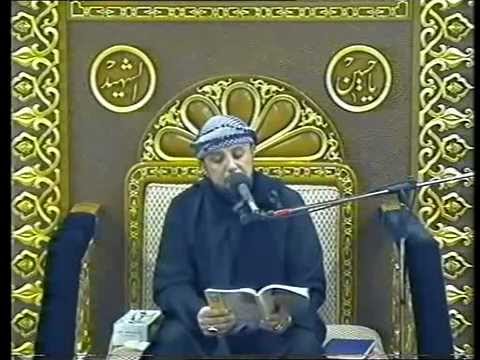
ُExplaining selected excerpts from duaa Abi Hamza AlThumali- Part 3 Hamam Nassereddine
0
0
9 المشاهدات·
26/02/23
في
محاضرات
These are English Ramadani lectures that shed light on selected passages from Duaa Abi Hamzi alThumali and the lessons that we learn from those passages.
أظهر المزيد
Transcript
[0:21]Brothers and sisters, may Allah tala accept your deeds, the deeds that
[0:32]you have performed in this holy month and the deeds, the prayers,
[0:35]the fasts and all good deeds that you shall perform in the
[0:40]holy month of Ramadan.
[0:47]In yesterday's lecture, we shed light on the word of Imamz where
[0:56]he says Allah gather me with the chosen one, the chosen prophet
[1:07]and his progeny.
[1:10]And we mentioned that when we combine this segment with the segment
[1:15]that comes before it when the Imam Alisam where the Imam Alisam
[1:19]asks Allah subhanahu wa ta'ala to pull the love of the low
[1:25]world from his heart when we combine both segments we can understand
[1:30]that being with in a spiritual sense will remove the love of
[1:40]the love of the low world from the heart of the human
[1:46]being.
[1:47]Being with being with them in a physical sense is an honor
[1:55]but it might not lead the human being to salvation.
[2:01]Why?
[2:02]Because ultimately the human being has to choose whether he wants to
[2:06]follow a or not.
[2:07]Hence you find when you look at the biographies of the members
[2:15]of that some people were very close to the infallibles yet they
[2:20]were enemies of the infallibles.
[2:22]They were close to them in a physical sense and they ended
[2:29]up revealing enmity towards the infallibles.
[2:32]Hence they were doomed in the hereafter.
[2:35]Then again some people were very close to them also on a
[2:40]physical level also in a physical sense and they were part of
[2:43]their followers.
[2:45]They were actually very close followers of like Salman Muhammad Abu Dard
[2:54]and others may Allah bless their souls.
[2:58]When we touch upon this topic, the topic of being physically close
[3:04]to the infallible, I always remember the example of Al Jawadam who
[3:09]had two wives.
[3:12]Im Jawad Ali had multiple wives.
[3:14]One was an enemy of Allah subhana wa tala who ended up
[3:20]killing the Imam himself.
[3:21]She ended up poisoning Al Muhammad Jawad.
[3:26]Then again he had SM who was the mother of Im Ali
[3:33]and was a very righteous lady.
[3:38]A lady who highly respected in fact revered Ali Imam al Jawad.
[3:42]You realize that both ladies were married to the same man, to
[3:45]the same imam.
[3:48]Both ladies were living with the same man.
[3:51]But one of them chose the path of falsehood and the other
[3:57]one chose the path of truth.
[3:59]Which reminds us that being close, physically close to the infallible is
[4:03]not the most important matter.
[4:04]It's an honor obviously to be physically close to them, but it's
[4:10]not the most important ma ma matter.
[4:13]The most important matter is what is being spiritually close to.
[4:18]So when the im says our imly or directly the imam reminds
[4:35]us indirectly or directly of what?
[4:39]of being close, spiritually close to.
[4:42]Yesterday we mentioned multiple practical steps which will bring us closer to
[4:51]the infallible such as mentioning them on a daily and nightly basis
[4:56]such as reading their biographies, their narrations, their stories and gaining more
[5:06]understanding of who these people were.
[5:08]And last but not least, gifting them every single good deed that
[5:12]we perform.
[5:13]So we make a deal with Allah subhana wa ta'ala and we
[5:16]tell Allah Allah we want you to send the rewards of all
[5:21]of our deeds to the infallible.
[5:26]By doing that we will not lose any reward.
[5:29]On the contrary, our reward will only be amplified by Allah and
[5:36]the infallibles with Allah's permission subhanala.
[5:39]When a person strives to be spiritually close to help him elevate.
[5:48]Thus you realize that the people who surrounded our imams and actually
[5:53]listen to their words were elevated by the imams and reached very
[6:01]high levels in the eyes of Allah subhanahu wa ta'ala.
[6:05]Here we can think of many examples but I'm going to give
[6:07]you one example which is a person that many of us might
[6:15]not have heard of.
[6:13]He was one of the slaves of Im Hussein the same im
[6:23]who composed dua Hamza.
[6:23]He had a slave a black slave who was very close to
[6:31]Allah subhanahu wa ta'ala.
[6:30]I believe you know that our imam would buy slaves and he
[6:40]would you know educate them.
[6:41]He would nourish them physically and spiritually and then after some time
[6:47]after an x amount of time the imam would free them by
[6:52]doing that would be basically sending ambassadors to the muslim.
[6:59]He buys the slave, keeps him with him for an x amount
[7:05]of time, teaches him the words of the knowledge of meaning parts
[7:09]of their knowledge and then he frees the slave.
[7:13]As a result, the slave becomes what?
[7:15]The slave or the person who was a slave becomes an ambassador
[7:21]for who can spread the words and teachings of the imams.
[7:25]This was one of the tactics that used in order to propagate
[7:34]and or spread the teachings of which are the teachings of Allah
[7:39]which are the teachings of Allah subhanahu wa ta'ala.
[7:43]The Imam had one particular slave who was very close to God.
[7:47]A man called Mus says, "One day we went through a drought
[7:56]and I saw the people going in different directions.
[8:01]All of a sudden I saw a black man who was standing
[8:08]on a hill.
[8:08]The man moved his lips.
[8:11]It seemed that he was saying something.
[8:12]He was actually supplicating.
[8:14]And before he finished saying whatever he was saying, Allah subhana wa
[8:23]ta'ala sent a cloud and it began raining heavily such that we
[8:28]assumed that we were about to drown.
[8:30]So here the man realized sah realized that Allah tala instantaneously answered
[8:36]the prayer of that slave.
[8:40]He did not know who he was, but he saw a black
[8:42]man standing on a hill.
[8:46]The man said something.
[8:47]He supplicated.
[8:49]Before he finished his supplication, Allah subhana wa ta'ala answered his prayer.
[8:55]A cloud was sent and it began raining heavily.
[8:58]At that point, he says, "I went to that man." He wanted
[9:01]to know who is this man?
[9:02]Who is this mysterious individual?
[9:07]So he went after him and he saw that the man left
[9:10]and went to the house of Im.
[9:14]So he understood that this was one of the slaves meaning the
[9:19]servants of Aliadam.
[9:20]He came into the house of the Imam and he told the
[9:25]Imam, "You have a slave and I want to buy him from
[9:30]you." The imam said, "Oh, why would I sell him to you?
[9:36]I'll give you the slave.
[9:36]I'll give him to you as in I'll give you my servant.
[9:41]You don't have to give me any money or monetary items." At
[9:44]that point, the imam summoned an individual who was in charge of
[9:51]his servants and he told him to bring them.
[9:51]So, the servants of the imam were brought.
[9:54]The man looked at them but he could not find that specific
[10:00]individual who made the prayer.
[10:01]So he told the Imam Alisam that individual is not present.
[10:04]He is not present amongst them.
[10:08]The Imam said I've brought you all of my servants except for
[10:14]one fan.
[10:15]The tradition says fan.
[10:18]It does not even mention his actual name.
[10:20]Im named him mentioned his name and he said he's the meaning
[10:23]he's the one who's in charge of taking care of the animals
[10:27]for example the cattle so that person was summoned by the imam
[10:31]he came when sah saw him he recognized him he said this
[10:36]is the one this is the person who made the prayer who
[10:42]made the supplication and who was answered instantaneously by Allah subhanahu wa
[10:46]ta'ala so when he came and Sah recognized him.
[10:50]The imam told that individual now from now on Sah has become
[10:59]your master.
[10:57]So you should leave with him.
[11:00]The man understood that this was the time of separation.
[11:04]The time he will separate from who?
[11:07]From so he told sah what led you to separating between me
[11:14]and my master?
[11:17]As in the man was disturbed, he was saddened.
[11:21]Why are you taking me away from my imam?
[11:25]It's an honor.
[11:25]It's a privilege to live with the Imatam.
[11:29]When you're a servant for the Imam, the Imam honors you.
[11:34]He treats you not like a servant.
[11:37]He treats you like his own son.
[11:39]That was the habit of And so the man wanted to stay
[11:46]with the im.
[11:46]He told him, "What led you to separating between me and my
[11:51]master?" He told him, "I saw what happened when you were on
[11:55]the hill." Meaning, I saw how you supplicated and Allah ta'ala instantaneously
[12:00]answered your prayer.
[12:04]So the man realized that Sah knew his secret or say part
[12:09]of his secret and so he made a prayer, a second prayer.
[12:14]This time he addressed Allah subhana wa ta'ala saying, "Ya Allah, there
[12:19]was a secret that lied between me and you and now you've
[12:23]revealed that secret.
[12:26]That being said, I want you to take me to the other
[12:30]world." Meaning, ya Allah, take my soul and let me depart to
[12:34]the hereafter.
[12:36]When he said that word, man began crying.
[12:39]The people present also began crying.
[12:45]As a result, Sah also cried and he left.
[12:47]He left.
[12:46]Perhaps he thought, you know, I've I've done enough damage.
[12:52]I've I've hurt this individual.
[12:53]So, he left.
[12:57]When he reached his house, the messenger of Imad wasam came to
[13:01]him with a message telling him if you want to attend the
[13:10]burial procession or the burial of of the slave then come to
[13:14]the house of the imat which meant that the man actually died.
[13:20]He went back to the imam's house and he found that the
[13:25]servant was lying dead in front of imat which means once again
[13:33]Allah subhana wa ta'ala answered his prayer instantaneously now this is one
[13:39]slave one servant amongst the servants of we don't even know his
[13:43]name he's not known to many people but he's known to the
[13:52]angels the He's quite known in the world of the angels.
[13:55]Yes.
[13:57]When a person follows and seeks closeness toam in a spiritual sense
[14:09]help him elevate and might lead him to the highest stations of
[14:13]heaven.
[14:14]So if we want to remove the love of the low world
[14:23]from our heart as the imam says then what would help on
[14:29]this regard is exerting effort to become closer on a spiritual level
[14:34]to the imam.
[14:38]One might say, "What else helps?
[14:43]Is there another deed that can help us pull out the love
[14:45]of the low world from our hearts?" Yes, of course.
[14:49]There are multiple deeds that help on this regard.
[14:51]And one of them is remembering the disadvantages and the negative outcomes
[15:01]or consequences of being attached to the low world.
[15:04]Because when I understand when you understand when we understand the negative
[15:10]outcomes of attaching ourselves to the low world obviously that will that
[15:16]will increase our chances of what of detaching from in better terms
[15:27]we'll become more distant from and we'll become closer to Allah subhanahu
[15:33]waala uh understanding the negative outcomes the negative consequences of attaching ourselves
[15:43]to is a very important point.
[15:48]Hence you find that our imams would remind the people of what
[15:55]of the consequences of being attached to especially the murder of the
[16:02]month of Ramadan.
[16:03]If you read, you'll find that the imatam in many instances would
[16:10]remind the people of what of the disadvantages and the negative outcomes
[16:17]or consequences of being attached to ad.
[16:19]I'll mention tonight without taking much of your time one of those
[16:26]traditions where dispraises and reveals part of the negative outcomes of being
[16:34]attached to it.
[16:37]It's a short yet very deep tradition.
[16:42]The Immat describes ad in a marvelous manner as he says Look
[16:54]at the description.
[16:56]It's a short description.
[16:57]He describes a duny with three short words.
[17:01]But each word is quite deep.
[17:05]He says a does what?
[17:08]It fools a human being.
[17:09]And it harms him and finally and finally it leaves him.
[17:16]Let's take a few minutes to dissect this narration.
[17:19]He says, "The low world will fool the human being." How will
[17:25]it fool him?
[17:28]How does it fool the human?
[17:29]And how does it try to fool me in you?
[17:34]A dunya fools the human being by revealing itself in an attractive
[17:41]manner.
[17:40]It reveals itself with its zena as it is beautified.
[17:47]Meaning it makes the human being assume that it is beautiful that
[17:54]it is beneficial whilst it hides its true face.
[17:59]It hides the disadvantages and the harm that the human being will
[18:04]attain when he attaches himself to adun.
[18:07]I'll give you a very clear example.
[18:09]Although we can think of many examples on this regard.
[18:12]Think of intoxicants, beer, wine and the likes, cannabis.
[18:21]These intoxicants are unlawful.
[18:25]Allah subhana wa ta'ala forbade the consumption of intoxicants upon us.
[18:29]However, when you look at the world of commercials, you find that
[18:37]certain commercials promote and encourage the human being to do what?
[18:43]To consume intoxicants.
[18:43]Those commercials will display the intoxicants like wine or beer in a
[18:50]beautiful manner.
[18:52]Giving you the idea, giving you and I giving us the idea
[18:55]that consuming intoxicants is good.
[18:58]Consuming intoxicants is something that the human being will enjoy.
[19:04]But the same commercial hides the harm and the disadvantages that the
[19:12]human being attains when he consumes intoxicants.
[19:14]In the commercial, you don't see any words or hear any words
[19:18]that tell you when the human being becomes intoxicated.
[19:21]At a certain point, he is not aware of what he does.
[19:27]He loses control of himself which means he might commit any kind
[19:37]of indecency such as killing his own self, killing his family members,
[19:43]killing his friends and other kinds of indecencies.
[19:49]Imat wasam says that when a person consumes intoxicants he goes through
[19:53]a state at a certain point he goes through a state where
[19:56]he might commit any kind of indecency.
[20:01]He might worship an idol.
[20:05]He might worship the devil.
[20:07]He might commit other kinds of hideous and forbidden deeds.
[20:09]So the commercial does not remind you about this.
[20:13]Why?
[20:14]Because the people of evil, the people of falsehood want to trick
[20:17]you.
[20:17]They want to fool you and I.
[20:19]They want to fool us and pull us towards what?
[20:22]Consuming intoxicants.
[20:23]So when the imam says, he's reminding us that will reveal itself
[20:29]in a fascinating manner.
[20:32]It will beautify itself for the human being, but it will hide
[20:36]its true face.
[20:39]Secondly, adun my friends, ad reveals itself to the human in a
[20:46]way the human might assume that he will live in it for
[20:50]eternity.
[20:51]Although everyone knows deep down inside every Muslim and non-Muslim, every believer
[20:59]and non-believer knows that death is a must.
[21:01]If you ask any intellectual, any human being, are you going to
[21:07]die?
[21:08]Everyone will say yes one day we will all die.
[21:09]But if you look at the actions of the human beings those
[21:14]who are distant from Allah subhanahu wa ta'ala those who can care
[21:18]less about God's commands you realize that on a practical level on
[21:25]a practical level or say in a practical sense they don't believe
[21:29]in death although they know deep down inside that everyone will die.
[21:35]Quran says Every soul shall taste death.
[21:38]But on a practical level, when you look at their deeds, it
[21:40]seems as if they don't believe in death.
[21:42]It seems as if they believe that their mother could die, their
[21:46]father could die, their neighbor could die, but they themselves will not
[21:54]pass away.
[21:53]They themselves will not die.
[21:57]So that's a second way through which fools the human being.
[21:59]He says then what does it do?
[22:02]and harms him because it attracts the human being towards unlawful deeds.
[22:08]At a certain point, the human being commits the unlawful deed.
[22:11]The unlawful deed is what my friends, let's be honest with ourselves.
[22:14]And I speak to myself before you, it's harmful.
[22:19]Had it not been harmful, Allah tala would not have forbid it.
[22:25]Allah subhanahu wa ta'ala forbids certain deeds because these deeds harm us
[22:31]in ad before the hereafter.
[22:34]So he says and then what and then it leaves the human
[22:43]being or in better terms the human being leaves it.
[22:46]and dunya is a finite world and sooner or later everyone will
[22:52]have to depart to the other world.
[22:55]So when we remember this narration which is one narration amongst many
[23:01]where the imams reveal the negative consequences of attaching ourselves to ad
[23:07]this will increase our understanding of its awfulness of its ugliness and
[23:14]as a result we'll be able or say more able to pull
[23:17]the love of the low world from our hearts.
[23:22]He says, "Tomorrow inshallah we'll continue with the fabulous dua of Imam.
[23:37]Alhamdulillah.
0 تعليقات
sort ترتيب حسب
- أعلى تعليقات
- أحدث تعليقات
التالي
13 المشاهدات · 25/03/22
12 المشاهدات · 25/03/24
10 المشاهدات · 12/05/27
10 المشاهدات · 22/05/25
6 المشاهدات · 24/01/31
9 المشاهدات · 24/02/01
2 المشاهدات · 24/02/27