التالي
0 المشاهدات · 25/10/23
11 المشاهدات · 25/12/01
10 المشاهدات · 13/12/26
10 المشاهدات · 14/09/23
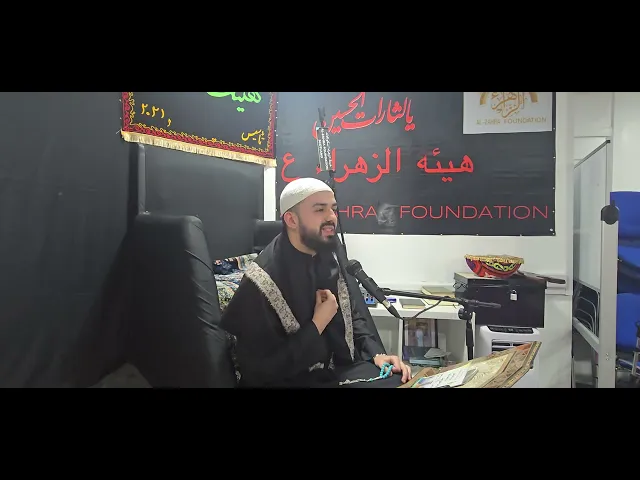
Are Muslims Welcome in America - Sayed Saleh Qazwini
0
0
8 المشاهدات·
25/10/24
في
محاضرات
أظهر المزيد
Transcript
[0:00]Oh [Music] sh [Music] Allah.
[0:21][Music] ill.
[0:29][Music] [Music] That's why [Music] [Music] You want to [Music] [Music] Hal
[1:57][Music] Fah.
[2:13]Hal [Music] Allahbarbar.
[2:33][Music] Love [Music] sayah.
[3:07]Alhamdulillah.
[3:45]Ali Muhammaduhammed Ali Muhammad Ibraimba.
[4:44]dear brothers and sisters, it is known or widely mentioned that the
[4:54]United States is the land of immigrants.
[4:55]the first who set foot on this land according to the European
[5:06]narrative or was Christopher Columbus and then later on waves of migrations
[5:12]began with the first migrants that came who were the Puritans.
[5:18]They came to this land so that they can find opportunities in
[5:25]life, religious opportunities, freedom and they were escaping religious persecution and they
[5:31]came to this new land to find more opportunities so that they
[5:38]could live their life freely after escaping the persecution that they were
[5:43]facing in Europe in the United Kingdom.
[5:45]And that began waves of migrations that began to come to this
[5:53]land, to North America, to the United States.
[5:55]And this country was made up on migrants coming.
[6:02]Of course, there were indigenous people that were living here, the Native
[6:06]Americans, but their rights were totally taken away from them.
[6:09]their land was taken away from them and the United States became
[6:15]a land where people coming from all over the world, especially Europe
[6:19]at the time in the beginning they made up the United States
[6:23]and immigrants kept pouring in until you have the constitution and then
[6:30]the United States became what it is right now.
[6:32]From amongst the immigrants that came to this country were the Muslims.
[6:38]The Muslims were also immigrants.
[6:42]Just like the Christians came as immigrants, just like some of the
[6:45]Jews came as immigrants, just like other religious groups and minorities came
[6:49]here as immigrants either fleeing religious persecution or seeking new opportunities.
[6:53]The Muslims are also a part of that group that came to
[7:00]seek and find new opportunities.
[7:01]And in fact, Muslims, there were two waves of Muslims that came
[7:06]to the United States.
[7:09]We usually talk about the second wave which is the Muslims that
[7:11]came in the last 100 years.
[7:12]The Muslims that came from the Middle East in the last 100
[7:17]years.
[7:16]However, there is a wave that was before that and it was
[7:21]and it is rarely acknowledged and that was groups of people that
[7:25]were forced to come to this land.
[7:26]Who were they?
[7:28]They were the slaves from amongst the slaves that were brought here
[7:32]in the last 200 and 300 years.
[7:35]Historians today they say about 15% of those slaves were Muslim.
[7:42]They were forced to come here and they were forced to become
[7:45]Christian and they were forced to let go of all of their
[7:47]teachings, their heritage, everything that they had.
[7:50]They had to change it alto together and they were enslaved.
[7:52]This was one wave of Muslims that first came to this country.
[8:00]And then the second wave is the last hundred years as a
[8:04]result of turmoil in the in the Middle East, as a result
[8:09]of the wars and the suffering that is going on in predominantly
[8:15]Muslim countries like for example Iraq, like Syria after after the um
[8:21]the war in in Yemen, after World War I, after World War
[8:28]to more and more Muslims began to migrate to the United States
[8:32]just as just as Christians were migrating before that from Europe.
[8:38]Then now you have waves of Muslims that are migrating and they
[8:42]came here Muslims came to this country for the very same reason
[8:46]that non-Muslims came to this country.
[8:49]They came to find opportunities in life.
[8:52]They came to find religious freedom.
[8:54]They came to grow and this is a right and a desire
[9:00]that every single person has.
[9:02]However, today, my dear brothers and sisters, we live in a time
[9:09]where from amongst the minorities that live in the United States, the
[9:15]Muslims find themselves targeted the most.
[9:19]And the Muslims find themselves projected to anti-Muslim bigotry, to hate, and
[9:29]to constant attacks.
[9:30]And this comes from all levels of society.
[9:34]You find from top all the way from the president of the
[9:37]United States publicly without any push back attacking Muslims.
[9:43]You find this taking place in Congress, members of Congress, whether Senate,
[9:49]whether um congressmen, and you also find it in the media.
[9:52]And it's become something that is very normalized.
[9:56]And you won't find a minority that is attacked in the way
[10:00]that Muslims are attacked publicly on the media, in the debates, in
[10:06]the political debates, the way Muslims are attacked.
[10:08]You won't find that.
[10:10]Any minority that is attacked the way Muslims are attacked or badmouthed,
[10:15]you find push back.
[10:15]You find some people have to resign from their positions of power.
[10:19]Some people have to uh they're held accountable.
[10:24]But unfortunately, we have reached a point where attacking Islam and attacking
[10:31]the Muslim community and accusing Muslims of having um not having loyalty
[10:36]to the United States, accusing Muslims of terrorism, accusing Muslims of being
[10:42]and work and working against the United States and having an agenda
[10:45]against the United States.
[10:47]This has become something that is very normal.
[10:49]You see it all the time.
[10:52]You hear about it all the time right now.
[10:52]For example, you see in the debate with um Mamdani who is
[10:59]about to become the mayor of the mayor of New York.
[11:04]You see that attacking Muslims just attacking him purely because he's a
[11:08]Muslim.
[11:09]Not because he said anything, not because he did anything that is
[11:12]that goes against taking away anyone's rights.
[11:16]Purely because he's a Muslim.
[11:17]That makes him subject to assault.
[11:19]that makes him subject to attack and it is perfectly okay in
[11:23]this country hate crime hate speech is something that is that society
[11:28]is generally against but when it's against Muslims it is undermined and
[11:36]it is seems to be okay and this has repercussions remember in
[11:39]the beginning of the war in the beginning of this genocide that
[11:45]took place a six-year-old child a six-year-old child in Chicago was stabbed
[11:48]to death by an old man.
[11:52]Where where does this come from?
[11:54]This comes this is is fueled by the hate and it materializes.
[11:57]It materializes when you see their attacks against Muslims.
[12:04]When you see mosques have to open their, you know, check their
[12:07]email or listen to their answering machine and you see a list
[12:10]of people calling and attacking.
[12:11]And even here we get it every once in a while.
[12:14]You you see people calling from all over.
[12:17]you don't even know where they're calling from and they're just spewing
[12:20]hatred going off for 5 minutes, 10 minutes talking about uh Islam
[12:27]and the Muslim community.
[12:29]And you see that this hate that mainstream society that politicians have
[12:34]made okay, it materializes into pain.
[12:38]It materializes into violence and it dehumanizes Muslims.
[12:41]And this is what we're seeing right now.
[12:44]Right now, the last two years, Palestine, Palestinians, Gaza was being attacked.
[12:50]Syria, Yemen, Iraq, Afghanistan, Iran, all of them were attacked.
[12:53]And if you, if a Muslim were to come and speak out
[12:58]against it, right away they come and they say you're sympathizing with
[13:01]terrorism.
[13:01]So, you don't even have a right to defend your own people.
[13:05]You don't even have the voice to defend your own people.
[13:10]So here this rhetoric has become very dangerous and we've reached a
[13:14]point where we see it it's very clearly right now for example
[13:17]how many churches are in the United States there there are church
[13:21]bells there are so many things that are going on that are
[13:27]associated with other religions you see American politicians they go to Israel
[13:32]and they're wear they're wearing the the Jewish uh hat and everything
[13:37]everything's normal.
[13:37]normal.
[13:38]But if for example someone were to do anything that is associated
[13:43]with Islam or shows some sympathy with Islam and Muslims right away
[13:47]this person is targeted.
[13:48]So now this brings us to a question and I've seen many
[13:53]Muslims in their private circles when we're gathering they ask me this
[14:01]questions.
[13:57]They ask they say are we Muslims do we have the right
[14:04]to live in this country like everyone else?
[14:06]Do we have the freedom to live in this country or should
[14:09]I go somewhere else?
[14:13]And this question comes up more often than we imagine, more often
[14:18]than we think, especially in a land and it's the irony is
[14:21]that this is a land of opportunities.
[14:23]This is a land of minorities.
[14:26]This is a land where people come to find religious freedom.
[14:28]But you find many people they're struggling with this question.
[14:31]Are we secondass citizens?
[14:34]Do we have the same rights as everyone else?
[14:38]Uh is it okay for Islam and the Muslim community to constantly
[14:42]and consistently be attacked by politicians?
[14:45]Is this something okay?
[14:46]We see many Muslims uh they ask this question and many Muslims
[14:49]especially for example college students or or young students they say I
[14:57]don't feel safe practicing my religion.
[14:59]I don't feel safe.
[14:59]A sister might say, "I don't feel safe practicing my hijab because
[15:02]of the hate that's out there.
[15:04]I don't feel safe praying in public because of the hate that
[15:08]is there." So, how do we deal with this?
[15:10]Should we get up and pack our bags and leave?
[15:12]For example, this is what some people say.
[15:16]My dear brothers and sisters, from an Islamic perspective, land and earth
[15:23]belongs to who?
[15:26]Belongs to Allah subhanana wa ta'ala.
[15:29]And you have the right to live wherever you want as long
[15:32]as you're not breaking the law, as long as you're not taking
[15:38]away anyone else's land.
[15:38]And as long as your personal religious freedoms are secured, meaning you
[15:44]could pray, you could go to the masjid, you could practice, you
[15:47]could fast during the month of Ramadan, you could do that, you
[15:51]could live anywhere you want.
[15:52]The land belongs to Allah subhanaa tala.
[15:54]There's no nowhere written down that Muslims, for example, have to be
[15:58]living in the Middle East.
[16:00]In fact, the majority of the Muslims don't even live in the
[16:02]Middle East.
[16:02]A lot of people don't know that.
[16:04]The majority of Muslims don't even speak Arabic.
[16:07]We, a lot of us, we right away we assume and here
[16:08]in America, a lot of people assume that Islam and Middle East,
[16:13]they're always together.
[16:13]No.
[16:13]The majority of the Muslims don't even live in the Middle East.
[16:16]The majority of the Muslims don't even speak Arabic.
[16:19]Why?
[16:20]Because Islam is a universal religion.
[16:23]Islam surpasses all boundaries.
[16:24]All ethnic boundaries, all cultural boundaries, all geographic boundaries.
[16:29]They're surpassed by the religion of Islam.
[16:32]So, can I, as a Muslim, live in the United States?
[16:37]Yes, I can.
[16:36]as long as my religious freedoms, as long as I'm able to
[16:42]practice my faith, as long as I'm able to pray, as long
[16:44]as I'm able to um do what I'm supposed to do as
[16:49]a practicing Muslim, not to impose my religion on other people, but
[16:52]just to be a Muslim on my own, yes, I could do
[16:56]that.
[16:57]And in fact, we see that the Muslim community, there's a lot
[17:01]of maybe there's a lot of negative things that we hear.
[17:05]Yes, there's a lot of Muslims are being targeted.
[17:06]Maybe you see that there's discrimination, rising hate against Muslims.
[17:11]But on the other hand, you find that there's a real positive
[17:15]growth of Islam and the Muslim community in this country.
[17:18]You right now there are over 3,000 mosques in the United States.
[17:25]Over 3,000 mosques in the United States.
[17:27]And there are Muslims everywhere.
[17:29]You travel, you see halal food everywhere.
[17:30]Muslims are integrated.
[17:32]you have in the top careers you have doctors, engineers, lawyers, different
[17:37]types of careers, you find the top of those careers are Muslims.
[17:42]So the main ruling my dear brothers and sisters when someone is
[17:45]asking this question should I leave?
[17:48]Should I stay somewhere?
[17:50]The main question is am I able to practice my religion?
[17:55]Am I able to pray?
[17:55]Am I able to am I able to truly implement the teachings
[18:00]of my faith?
[18:00]This is what we have to ask ourselves.
[18:02]And there's no land that is more sacred than another land.
[18:09]Look, even Mecca, Mecca, which is the holiest city, the city that
[18:14]has the Kaa in it, when Muslims were unable to practice their
[18:19]religion, what did the Quran tell them to do?
[18:22]The Quran told them to migrate.
[18:24]The Quran told them to leave.
[18:28]So what does that mean?
[18:28]That means that I am supposed to put myself somewhere where I'm
[18:32]able to practice my faith.
[18:35]There's no land that is inherently better than another land.
[18:37]Yes, of course, Mecca is a sacred land.
[18:40]Kbala, Najaf, these these cities, they're sacred cities.
[18:43]But does that mean that all Muslims have to go and live
[18:46]in these sacred cities?
[18:48]No.
[18:47]Muslims are Islam is greater than that.
[18:49]Islam is is much larger than that.
[18:54]We have to um live wherever we can live with freedom, wherever
[18:57]we can have opportunities and wherever we can practice our faith.
[19:02]And in fact, in the early days of Islam, when the command,
[19:07]the order came from Allah subhana wa ta'ala for people to migrate
[19:12]to leave Mecca, the prophet, he ended up leaving Mecca and many
[19:15]Muslims ended up leaving.
[19:16]Some of them decided to stay.
[19:20]Why?
[19:19]because of their personal attachments, because of their wealth, because of their
[19:23]businesses, because of their family, Allah subhana t brought down a verse
[19:27]about them.
[19:31]Those who they die having oppressed themselves because they chose to put
[19:36]themselves in a wrong environment.
[19:40]They chose to put themselves in an atmosphere that was unhealthy for
[19:45]their religion.
[19:51]The angels will tell them when they die, where were you?
[19:55]Why did you end up dying as a when you when you
[19:58]were a Muslim?
[20:00]They say we were oppressed in the land.
[20:02]We were forced to do the we were forced to do the
[20:08]wrong.
[20:08]And then The angels are going to tell people, "Wasn't the land
[20:20]of God vast enough for you to travel?" So here, my dear
[20:23]brothers and sisters, it all depends on the person.
[20:26]Maybe one person they come to this country and they find that
[20:29]they're losing all their faith, their religion, they're losing everything.
[20:33]What does that person have to do?
[20:36]They have to make sure they put themselves in a healthy environment.
[20:39]Sometimes I see people they've lost their children.
[20:41]They've lost their family.
[20:44]There's nothing left of Islam in them and they say say I
[20:46]have to be here.
[20:47]No, you don't have to be here.
[20:49]Is everywhere.
[20:50]You could go wherever you want.
[20:51]But it's not a general rule that everyone should leave.
[20:53]If you're able to maintain your religion, your religious values, then you
[20:57]are not required to leave.
[21:00]And there are places right now where are worse than we what
[21:04]we are experiencing right now.
[21:08]For example, the weaggguers in China, they were some reports say that
[21:12]they're forced to eat pork.
[21:13]They're forced to drink alcohol.
[21:15]They're forced to uh publicly not practice their faith.
[21:20]So here we understand that holding on to faith is something that
[21:25]is not easy and sometimes you have to migrate.
[21:30]You have to migrate for the sake of for the sake of
[21:32]religious reasons.
[21:34]sometimes for the sake of other opportunities.
[21:37]But for Muslims being in this country, even though you might face
[21:43]difficulties, you might face challenges, you might face um assault, verbal assault,
[21:47]bigotry, hatred, there's a lot of positive things that come out of
[21:54]it because h to another land, there's a lot of positive things
[21:56]that come out of it.
[21:56]And Allah says in the Quran, the one who migrates for the
[22:04]sake of Allah subhana wa tala, the one who migrates for the
[22:08]sake of religious liberties, for the sake of finding a place where
[22:12]they could practice their faith.
[22:28]So Allah says in the Quran, anywhere you go when you migrate,
[22:33]you're going to find you're going to find difficulties, but you're also
[22:38]going to find more opportunities.
[22:39]And today we are we have to strike a balance.
[22:44]There's difficulties that the Muslim community faces, but there are also a
[22:48]lot of opportunities that we have.
[22:49]There are al there is al also a lot of um opportunities
[22:52]where we could spread our faith where we could talk to people
[22:55]where other people learn about Islam where you are able to practice.
[23:01]I know many Muslims in their own Muslim countries, they are more
[23:06]persecuted.
[23:05]They don't have the freedom.
[23:07]Here you actually have the freedom.
[23:09]Here you no one's no one's bothering you based on your religious
[23:13]liberties.
[23:14]And he says the best land for a person to live in
[23:28]is the land that embraces you.
[23:28]not the one that burdens you, not the one that makes you
[23:33]feel like you are targeted and you're attacked.
[23:37]So here we Muslims, it all comes back to what we do,
[23:41]how we protect our own religious liberties and how we how we
[23:48]fight for our own cause and fight for our own justice and
[23:51]our own liberties.
[23:53]In this country, minorities came.
[23:54]They started from nothing and then you find they gained power.
[23:57]They find they gained influence.
[23:59]You find they gained strength.
[24:00]And we also need to do the same thing.
[24:13]Muhammad Aliham.
[24:27]Alhamdulillah.
[24:29]Alhamdulillah.
[24:54]Aliuhammed Muhammad.
[25:06]for Hussein.
[25:36]Hussein Muhammad Ali Muhammad Musham.
[26:00]As we are talking about some of the struggles that the Muslim
[26:09]community faces in this country, the struggles of bigotry, of being targeted,
[26:13]of the anti-Muslim rhetoric that is being thrown at the community from
[26:22]the highest levels of power from the president, Congress, media and also
[26:29]in Hollywood, you see it happening.
[26:32]ing all the time.
[26:31]But then at the same time, you also see that this is
[26:36]also a land where Muslims have found opportunities.
[26:40]This is also a land, a place where Muslims grow.
[26:42]You wouldn't have that growth that you have achieved in your own
[26:49]countries, in your own home countries back home.
[26:50]And this is a land of opportunities for everyone.
[26:53]Just like non-Muslims came here seeking opportunities, Muslims also come come here
[27:00]seeking opportunities.
[27:01]And within the Muslim community, we see that some have fully integrated,
[27:09]others not so much.
[27:09]But then we have to ask a very important question.
[27:14]As a Muslim, what is my responsibility?
[27:17]What is my duty in this country?
[27:19]When I see for example there are opportunities for me to help
[27:24]support the Muslim community grow, do I have to have a role
[27:29]in that or do I just, you know, live my life as
[27:33]if nothing is going on?
[27:33]When I see Islam is being attacked, do I have to say
[27:36]something?
[27:36]Do I have to do something?
[27:38]What is my role and what is my uh responsibility when it
[27:43]comes to this?
[27:46]In the end of the day, we understand that we all have
[27:49]responsibilities.
[27:53]Every single one of us has responsibilities.
[27:55]Just as I have responsibilities towards my family, towards my children, towards
[28:00]my career, towards my health, I also have a responsibility towards my
[28:05]religion, towards my values, defending my faith.
[28:06]Yes.
[28:07]No one is coming and saying we Muslims have to convert everyone
[28:13]and spread Sharia Allah everywhere.
[28:14]No, Shar Allah is not even being implemented in Muslim countries.
[28:16]Let alone no one is coming and saying we want to implement
[28:19]Shar Allah here.
[28:21]Muslims want to live at peace.
[28:23]Muslims want to live comfortably just as everyone else having the same
[28:28]rights having the same um same rights that everyone else has.
[28:34]So what is my duty my dear brothers and sisters?
[28:37]Number one, we have a very important religious duty to understand.
[28:46]We need to change our narrative because there's a lot of Muslims,
[28:52]they think that because I came to this country, because I came
[28:55]to a predominantly non-Muslim country, then Islam is over there and we're
[29:01]here.
[29:03]That's not the case.
[29:01]Islam is a universal religion.
[29:10]That means Islam is for everyone.
[29:16]And perhaps if we change that perspective, because many Muslims, they're very
[29:19]insulated.
[29:19]They're living in a box.
[29:23]I don't bring non-Muslims to the mosque.
[29:24]I don't go somewhere else.
[29:26]I don't interact.
[29:25]If we change the way that we practice, maybe more and more
[29:32]people will get to know about Islam.
[29:33]And this is exactly what Islam is supposed to be for.
[29:39]It's supposed to be for everyone.
[29:40]Islam is not just for the one who was born in the
[29:44]Middle East or born in Pakistan, Iran, Iraq, Afghanistan.
[29:46]No, the Islam is for everyone.
[29:49]And perhaps someone who was born in the United States, someone who
[29:54]was European descent, someone who was born in America, perhaps they could
[30:00]be a better Muslim than someone who was born in a predominantly
[30:05]Muslim country.
[30:06]Is that reality?
[30:05]Yes, that is a reality.
[30:09]So we need to get out of our cultural mindset and we
[30:13]need to understand that Islam is a religion that embraces every culture.
[30:17]While cultures maybe they draw perimeters and they do not allow other
[30:22]people to enter.
[30:24]And this is why I see reverts or converts those who join
[30:29]the religion of Islam.
[30:30]I tell them that perhaps you have an opportunity to become a
[30:34]better Muslim than someone who was born as a Muslim.
[30:39]This is a reality as well.
[30:39]The moment you join the religion of Islam, you are in the
[30:44]eyes of Allah subhanana wa ta'ala equal to everyone else.
[30:47]This is number one.
[30:47]Number two, we Muslims living in a predominantly non-Muslim society, we have
[30:56]to become positive representatives of the religion of Islam.
[30:59]When my neighbor is a non-Muslim and when my coworker is a
[31:03]non-Muslim, when people around me are non-Muslims, whatever they see from me,
[31:07]even the smallest thing, right away, it's going to impact their view
[31:14]on Islam.
[31:14]They're going to look at Islam either in a positive light or
[31:19]in a negative light.
[31:19]And we have to be very careful with that.
[31:23]The hadith of says a Muslim is not the one who prays
[31:35]and whatever you do in your house that's between you and God.
[31:38]But you want to be a good representative of Islam.
[31:44]Meaning people have to find safety from their tongue, from what they
[31:49]say.
[31:50]Be careful how we speak to people.
[31:51]Be careful when we get angry, when we get upset, how we
[31:54]react with people.
[31:57]And do not hurt people.
[31:59]This is something that is very important.
[32:02]am he tells his companions he says you can invite people you
[32:12]could show people the reality of Islam without saying a single word
[32:16]you know most people that fall in love with the religion of
[32:19]Islam and are attracted with the religion of Islam they didn't go
[32:24]and take theology lessons from a Muslim no all they did was
[32:27]they probably met one Muslim and they had a good experience where
[32:30]they talked to this person they they interacted with this person in
[32:36]a positive way and that put a good picture a positive picture
[32:38]of a Muslim in their eyes in their mind.
[32:41]Therefore they came learning about the religion of Islam.
[32:43]This is all it takes.
[32:45]So this is our responsibility my dear brothers and sisters and we
[32:49]have to be very careful.
[32:49]That means the burden on you as a Muslim is even higher
[32:54]to be well behaved to be as best as you could be
[33:01]to be honest to be decent to not hurt people because as
[33:04]soon as something bad happens right away people are going to say
[33:09]this is these are the acts of a Muslim.
[33:11]And number third, my dear brothers and sisters, one of the most
[33:16]important roles and duties that we Muslims have is that we need
[33:22]to be involved in the political process.
[33:25]We need to be involved in our community.
[33:29]I can't be insulated.
[33:29]the the first generation of Muslims, the first migrants that came, maybe
[33:34]there was a language barrier, maybe there were cultural barriers, and they
[33:39]did not feel as comfortable to go out and get involved in
[33:43]the political process.
[33:45]But we can't continue using that same lame excuse.
[33:46]We have to now we have to get involved in the political
[33:52]process.
[33:52]Some people they come and they say, "But it's haram to get
[33:55]involved in the political process." Oh, so it's not haram to pay
[33:57]taxes.
[33:58]It's not haram to support the wrong that's going on.
[34:02]But then when they tell you come and speak, say something, you
[34:04]come and you say it's haram.
[34:05]Doesn't work that way.
[34:08]So if you're paying taxes, then get involved.
[34:09]Have your voice be heard.
[34:13]And this is what we need to do as Muslims.
[34:16]Not to take political positions so that we can enforce Islamic law
[34:20]with our neighbors, with non-Muslims, with people around us.
[34:23]No, this is not what we want.
[34:27]just to guarantee our basic civil liberties, just to guarantee that we
[34:31]are a part of the process, just to guarantee that no one
[34:33]could come and just attack Islam and Muslims and then act like
[34:39]nothing has happened the way it is right now.
[34:42]And this is why we have a need for Muslims, Muslim youth.
[34:44]I know every parent, they want their child to be either a
[34:48]doctor or a lawyer.
[34:48]But it's okay if they could join journalism.
[34:50]It's okay if they could get involved in media.
[34:54]It's okay if they could have other influential roles in in in
[34:57]your community in your society because that is how you will be
[35:04]able to uplift not only your own rights but the rights of
[35:07]others around you because Allah subhana wa ta'ala has given us a
[35:10]very clear and simple formula and that is Allah does not change
[35:23]the circumstances of of a community until they change their own.
[35:26]And that means there needs to be more civic activism.
[35:31]There needs to be more involvement there.
[35:34]We need to engage with the community around us.
[35:39]And if we do that, then we will be able to guarantee
[35:40]that we have a voice for ourselves.
[35:42]And this is the only way that we will be able to
[35:48]guarantee Islam for ourselves and future generations to come in this country.
[35:54]We ask Allah subhanahu wa ta'ala to bless the Muslim community and
[35:58]give the Muslim community the strength to not only uphold the religion
[36:02]of Islam, not only hold on and maintain to the religion of
[36:08]Islam, but also to be advocates for Islam and the Muslim community
[36:13]and the rights of others and especially minorities in this country.
[36:18]We ask Allah subhanana wa ta'ala to bless you all.
[36:54]Um, so
0 تعليقات
sort ترتيب حسب
- أعلى تعليقات
- أحدث تعليقات
التالي
0 المشاهدات · 25/10/23
11 المشاهدات · 25/12/01
10 المشاهدات · 13/12/26
10 المشاهدات · 14/09/23