آخر
Have you looked at Ashura from this angle before?
A cartoonist suddenly changes how you look at a phenomenon. A graphic artist changes your outlook all at once. A painter changes your outlook all at once. A photographer changes your outlook all at once. A filmmaker or a maker of documentaries change it in another way.
Before artists have a talent in expressing something, painting, or drawing, they have a talent in how they choose to look at things. These eulogies that you enjoy give you a way of looking and say, “Look from this angle.” You cry and enjoy it. The readers of eulogies and those who read very nice poems…
Have you seen their way of looking at these scenes? What beautiful ways there are of looking at these things, which haven’t been used yet. We are so dependent upon art to change our outlook and to help us find a correct outlook. It is very important how artists look at tragedies. Beauty is created from this. Actually, what makes an artist powerful in conveying his or her own view to others is his or her outlook. Sometimes that outlook itself makes a person an artist.
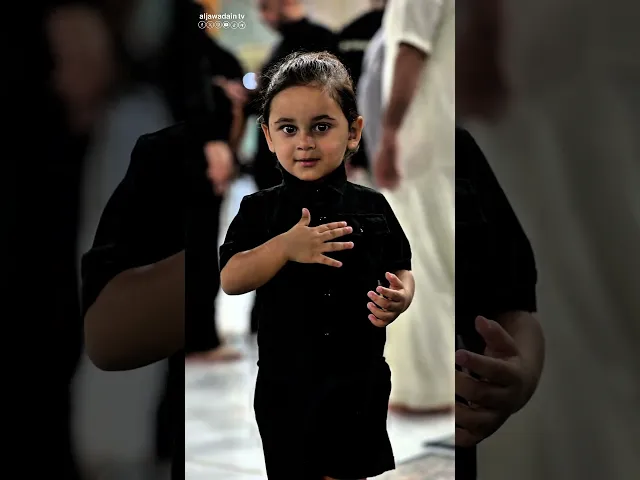
How do you look at Hazrat Sakinah (‘a)? Have you seen that some girls are like this that they are very cheerful, articulate, honest and frank, even though the people around them may be bothered by what they say. They are very inquisitive and restless. They can’t stop themselves from saying what they want. They bring cheer to any meeting. At any gathering, without doing anything bad, they make the gathering warmer.
Hazrat Sakinah (‘a) is the one, who called out when Imam Husayn (‘a) was near the Alqamah Stream, “Where is my uncle Abbas?” Hazrat Sakinah (‘a) is the one, who called out, “Come down Dad,” when he wanted to go. I think the older people were biting their lips and thinking, “Sakinah don’t say that and don’t break your father’s heart.” She said directly, “Dad, can you take us to Medina first and then go into the battlefield?”
Sakinah is the one who came to her aunt Zaynab and said, “Auntie, whose body is this that you are talking to?” Sakinah talked with her father in such a way that Husayn’s cut throat began to answer her. This girl can’t be quieted. Sakinah is a busy, cheerful, active girl.
From what time on was there no longer any news from her? She had this vibrancy all along the way. They whipped this girl so much that they made her quiet. The other women would hide this vibrant girl in the beginning so that these dishonourable men wouldn’t notice this vibrant girl. I think she changed when three-year-old Ruqayah left this world from the ruins. Sakinah, who helped with the children very much, wasn’t seen to be cheerful anymore.
How do you look at Hazrat Sakinah? She was the vibrant girl whom they made quiet and depressed. I haven’t given you any new information! But, when you put these next to each other, you say, “Yes, that’s true!”
What an opportunity these artists have! How they can play with people’s way of seeing things. This is their job, if they want to and have the ability. If they have a correct outlook, and then God gives them the talent, they can change your and my outlook.
There are still opportunities for new stories to be told about Karbala. There are still opportunities for new images to be drawn about Karbala.
See God’s kindness in tribulations
When God wants to give hardships, He does it softly.
How can a person understand God’s kindness? See God’s kindness in this point that when He wants to give hardships, He does so softly. He is careful. God gives suffering to His servants in such a beautiful way, like a mother who wants to give an injection to her child. God shakes.
“God shakes?! Up until now you talked about God being very firm.”
Yes, I used to talk about God being very firm, because those who do not want to see these things should come to their senses a little. According to a tradition, God says, “I never hesitate to do something except in one case.” But God doesn’t hesitate about whether He should do something or not! God, hesitating is meaningless for You! God says, “I hesitate in one case. That is when I want to take a believer’s life and he doesn’t like it. I say, ‘Shall I do it? But he doesn’t like it. He’s afraid. I shouldn’t? It’s to his benefit. They’ll really welcome him here. But he doesn’t like it. What should I do?!’” O my Lord! I will mention another small example of God’s kindness.
For example, they were going to send a tribulation for you to grow. They wanted to give you this tribulation to test you, for a trial, or due to a sin that you had committed. Overall, you will grow with it. Then you do a good deed. For example, you visit your family, repent or give charity. This goes into the testing system. So they decide to remove this tribulation.
But at times you do all these. After going into the testing system, they say “No” and don’t remove the tribulation. But in some cases, the system says to remove a tribulation. It is mentioned in the traditions that after removing that tribulation the Almighty God says, “My angels, if We had given that tribulation to this servant, how much would We have rewarded him?” For example, they say, “1,000 rewards! Because he was supposed to have a bad accident. So we would have given him at least 1,000 rewards.”
God says, “Now that We have removed that tribulation, what about his reward?” I’m acting this tradition out as a play. The angels say, “The balance is even now. We haven’t given him that tribulation for him to receive 1,000 rewards.” God says, “We didn’t give him the hardship, but write the reward for him.” They say, “But…!” God says, “I am God. A King is expected...” When God wants to give hardships, He first looks at your capacity. Can this person tolerate it?
Along with your capacity, He gives the needed facilities too. For example, He puts bandages next to you exactly at that time. Or you want to go to a doctor since your hand is injured. Exactly then, your friend comes to your door [so he helps you]. God says, “I don’t want My servant to be bothered.” When God wants to give hardships, He does it softly. When God wants to give hardships, He does it kindly. I ask you to see God’s kindness in hardships. Nothing is as valuable as understanding God’s kindness.
===================================
Follow us:
Facebook: https://www.facebook.com/Panahianen/
Instagram: https://www.instagram.com/PanahianEN/
Twitter: https://twitter.com/PanahianEN
Telegram: https://telegram.me/Panahianen/
==============================
It was then that Abbas (as) stood still.
Follow us:
Facebook: https://www.facebook.com/Panahianen/ ...
Instagram: https://www.instagram.com/PanahianEN/...
Twitter: https://twitter.com/PanahianEN
Telegram: https://telegram.me/Panahianen/
==============================
Aba al-Fazl (as) came to say goodbye to Husayn (as). My I be sacrificed for how you’re crying. How did Husayn (as) use to show his affection to Abbas (as)? When calling him, Husayn (as) used to say, “May I be sacrificed for you.” He loved him very much. I don’t know how Zaynab (as) used to call Abbas (as). These were their private conversations. Imam Husayn, his Imam, said, “May I be sacrificed for you.” Zaynab was his sister and sisters are more compassionate, tender-hearted and loving. She was a sister and full of affection.
For example, consider when they were on the way. It was God’s mercy that detailed memories of this caravan while travelling to Karbala have not been recorded. [It’s as if they say,] “Why do you want to know?” For example, they haven’t recorded Zaynab saying, “My Abbas, get Ali Asghar. Hug Ruqayya for a minute.” I want to say, “O Aba al-Fazl, don’t go into the battlefield. Don’t go. I plead you.”
Abbas came to say goodbye. Husayn (as) said, “Do you want to leave Husayn alone?” Alas for Abbas’s sorrows and sufferings. O Abbas, go and see what you can do for Husayn (as). You will have to become a martyr. But at least bring this waterskin back with some water so that you can relieve your sorrow a little by doing this. Abbas had so much hope and picked up that waterskin so confidently that the children felt less thirsty. They told each other, “Our uncle is going to bring water.” “Did you see how our uncle picked up the waterskin?! That’s it. Rabab, hold onto Ali Asghar. Water is coming. The way our uncle picked up the waterskin shows that we’ll have water soon.” When the enemies would beat Husayn’s children while traveling to Damascus, they would call for their uncle! How could they tell the children that their uncle would not return anymore?! He picked up the waterskin so confidently that everyone thought the same.
Abbas (as) expected the same. There is a sentence in history books that shows Aba al-Fazl was surprised himself too. When his hands were cut off, he didn’t care. But as soon as an arrow struck his waterskin, it is said that Abbas stood still. O Abbas, you didn’t expect this? It was then that he begged God to take him [due to his shame].
The Joy of Reciting the Holy Qur’an
What should we do to see God’s Kindness? One of God’s responses is, “My Kindness is free for you in the Qur’an, in the words of the Holy Qur’an. Recite the Qur’an, see My Kindness, taste it, take it, for your need for My Kindness to awaken.” A person who recites the Qur’an a lot and correctly, establishes this relationship.
I will read a tradition for you about this. It has been narrated in Misbah al-Shari’a that Imam Sadiq, (‘a) said, “A person who recites the Qur’an needs three things.” When you are reciting the Qur’an, have three things for this beautiful happening to occur for you. “A humble heart…” Come to God with a heart full of humbleness.
This means you aren’t in love yet, and haven’t understood God’s love. That’s fine. Go to God with obedience and fear. Go to Him in a polite way. The narration continues, “His body must be relaxed.” What does this mean? He doesn’t need to relieve himself. He isn’t too full. He is not too sleepy, or too hungry. I mean, your body shouldn’t trouble you. Are you comfortable now?
“He must find a place to be alone” to recite the Qur’an. Then, what should he do next? “When he starts reciting the Qur’an, while his heart is full of humbleness towards God, the cursed Satan will flee from him. He has released himself from other things, started reciting with his heart, and no factor is troubling him, to stop him from benefiting from Qur’an’s light and its blessings. Then, he sits in an empty place, and seeks seclusion from the people, while having a humble heart and a relaxed body. His heart and being will become fond of the Almighty God (when he recites the Qur’an).”
This means that when a person recites the Qur’an, he will see God’s Kindness and Grace. A person should be somewhat calm, make his heart a bit ready, remove troubling factors, and remove what comes into his mind - the unimportant things and the problems. Problems enter a person’s life to see whether he loses his concentration.
These are the world’s games. The problems are brought up one by one. Joys and tragedies come to see whether you lose your concentration, or not. Try not to lose your concentration. The philosophy of joys and tragedies is for a person not to lose his concentration. That is when you will enjoy reciting the Qur’an!
What kind of enjoyment is higher than this? I don’t know whether the joy of reciting the Qur’an is higher or the joy of becoming a martyr. Aba Abdillah al-Husayn (‘a) said it very precisely that the philosophy of his Ashura movement was dignity. “I won’t submit to anyone.” He himself and all of his beloved ones were cut into pieces. Their families were taken captive. “I won’t submit to anyone.”
But on the day of Tasu’a, he asked his enemies for one thing. To recite the Qur’an. He said, “My dear Abbas, go and tell the enemy to give us a respite for one extra night. My dear Abbas you know how much I love reciting the Qur’an. I want to recite the Qur’an for one more night.” Aba Abdillah al-Husayn (‘a) really enjoyed reciting the Qur’an. He needed this kindness from God. He wasn’t able to easily abandon this kindness from God.
Perhaps the only thing, which a person is able to delay martyrdom for, is reciting the Qur’an. Because when you love to become a martyr, what do you want to happen for you? Do you want God’s Kindness? So, come and see what God is doing with you with the Qur’an. Feel His love.
Qur’an is the words of God’s Kindness. “Recite the Qur’an, see My Kindness, taste it, take it, for your need for My Kindness to awaken.”
[From the series of speeches under the topic of, “How should we believe in God’s Kindness?” Session No. 6]
http://panahian.net/
“If a person respects himself, his desires will become worthless to him.”
==============================
Follow us:
Facebook: https://www.facebook.com/Panahianen/ ...
Instagram: https://www.instagram.com/PanahianEN/...
Twitter: https://twitter.com/PanahianEN
Telegram: https://telegram.me/Panahianen/
==============================
“If a person respects himself, his desires will become worthless to him.” [Nahj al-Balaghah, wisdom no. 449]
A person who respects himself does not sin. He says, “My dignity does not allow me to sin!” This is such a beautiful tradition. “If a person respects himself…” This is very beautiful. This is amazing. “…his desires will become worthless to him.” He won’t look at them.
You are valuable. You’re the noblest of creatures. Didn’t God say this [in the Qur’an]? You’re the Lord’s deputy on earth. “I am appointing someone as my deputy on earth.” [Qur’an 2:30] Know this. What do you want in your life? You don’t want anything? Even if one is God’s deputy on earth, one is alive due to his love and affection for something. What is it you like?
If a person has a precise self-awareness, he thinks, “I cannot spend myself for less than God and God’s Friends. It’s not worth it. Do you see this?! No, I am worth more than this. These [desires] cannot fill my existence. I am not satisfied with these. These things cannot be my ultimate love. They’re good and interesting. Yes, I understand this. I’m not foolish that I cannot understand that these are enjoyable! They’re all enjoyable. Suppose people cheer for me. Yes, I know that’s enjoyable. But that doesn’t satisfy me. When I look at myself, I see I want something else. These don’t satisfy me.”
Gradually he will understand, “Nothing but the love of God and His Friends and getting close to God can satisfy me.” He becomes busy with God Himself. By looking closely at ourselves, we realize that we do not like these other things. This has been narrated in the Qur’an in another way.
Prophet Ibrahim looked at the stars, “The stars are so glorious!” He then looked at the sun. After seeing each one of these, he said, “This is my Lord.” Then he looked at himself and said, “I do not like the setting ones.” This is self-awareness. “I don’t like the things that go down. These go down.” He found God by reading the book of his own existence.
“If a person respects himself, his desires will become worthless to him.” “No, I am worth more than this. These cannot fill my existence. When I look at myself, I see I want something else.”
No judging, no blaming, no backbiting, no suspicion!
Follow us:
Facebook: https://www.facebook.com/Panahianen/ ...
Instagram: https://www.instagram.com/PanahianEN/...
Twitter: https://twitter.com/PanahianEN
Telegram: https://telegram.me/Panahianen/
==============================
Someone says, “I want to move away from our religious neighborhood. I’ll move to a nonreligious neighborhood where no one cares about what others do. When you get up in the morning, neighbors won’t talk about whether you pray. Here, our neighbor came and said, ‘Your light isn’t on in the mornings. Don’t you pray?!’ ‘That doesn’t have anything to do with you! Maybe we pray in the dark.’ Everyone is judging each other. In our city, everyone expects others. Everyone is attacking each other based on their imaginations.”
One of the factors that causes people to become infatuated with western culture is this. When they go to western countries, they see what we are discussing in these sessions. This is called “acknowledging people’s differences.” They see this in the west. They see this in the culture of western people. Acknowledging people’s differences brings calm. They say, “I love this calmness.” Why? Actually, you should go to a place where everyone cares about you and helps you! This is being sophisticated, not what you see in western culture where people don’t care about each other due to their selfishness. But a religious person isn’t selfish. He cares due to his wanting to serve people and his being affectionate and kind! Why shouldn’t he care about others?
Our religion has said this too. Why should you search for this in the west? Why should you become infatuated with western culture, my dear? It’s said that if you see a wrong behavior, think positively about the person as much as is possible. For example, “I saw this husband and wife fighting and cursing each other.” Say, “They were practicing to see if they can curse someone! They were joking!” “No, he was really angry! He broke a glass too.” [Say,] “He was acting to see if he knows how to act. The husband and wife wanted to see if they are able to break a glass like in films. It was for fun. What’s wrong with that?!”
A tradition says, “A believer thinks good thoughts about others as much as is possible.” If it wasn’t possible to think good about him, you shouldn’t look at him as a sinner the next morning. Why? He certainly repented last night. He had time until morning. He sinned yesterday. You shouldn’t judge him today. We have some rules in our religion, which bring calmness more than what exists in the west. We are more western than western people [in these cases]! No one should pry into what others do. No one should make a bad judgement about others. No one should backbite. No one should be suspicious about others. A believer should think good thoughts about others. If a believer acts according to his beliefs, his behavior is even more sophisticated than theirs is!
Some people told Imam Khomeini, “We should fire all the judges who were working during Shah’s time.” Imam Khomeini said, “No, why do you want to fire them?” They said, “As a rule, they aren’t believers!” Imam Khomeini said, “According to which rule?” Someone wanted to say something to finish it up. A judge should be just. Just [in terms of religion] means he has to be pious and not do sins openly. So he said, “Some of these judges shave their beards and you have forbidden this.” Imam Khomeini immediately responded, “I say it’s forbidden. Maybe there is another Religious Authority who says it’s not forbidden.”
This is being sophisticated. Let me give you a higher example. A rich man went from Qazvin to Najaf Ashraf to give his Khoms tax to Imam Khomeini. He related, “I wanted to give my Khoms and he asked me, ‘Is this your yearly Khoms?’ ‘Yes.’ ‘Who were you giving it to before?’” Imam Khomeini guessed that he had been giving his Khoms tax to another Religious Authority and had recently changed. The man responded, “I used to give it to Mr. …” who wasn’t very well-known. Imam Khomeini said, “Perhaps he has plans about how to use your Khoms and wants to give it to the seminary students. Or he is doing a cultural activity and is counting on receiving your Khoms every year. If you don’t give your Khoms to him this year, it will harm his plans. Give your Khoms to that same person this year too.”
This is being sophisticated, not what you see in western culture where people don’t care about each other due to their selfishness. But a religious person isn’t selfish. He cares due to his wanting to serve people and his being affectionate and kind! Why shouldn’t he care about others?
A person says, “I’m more comfortable there because no one cares what I do.” Why? Actually, you should go to a place where everyone cares about you and helps you! This is what will captivate the west. It’s the culture of religion. The world is waiting to see this. You see a small example of this in Arbaeen.
#PnOnDiversityOfPeople
Whoever wishes to experience a good spiritual frame of mind should first help himself to feel good.
===================================
Follow us:
Facebook: https://www.facebook.com/Panahianen/...
Instagram: https://www.instagram.com/PanahianEN/...
Twitter: https://twitter.com/PanahianEN
Telegram: https://telegram.me/Panahianen/
The link for the book "How to Pray a Good Prayer," written by Ali Reza Panahian:
http://amazon.com/author/panahian
==============================
Many want to have a good spiritual feeling. What is a good spiritual feeling? It means you don’t feel bad. When you are upset, you make God upset too. Feeling good means having a good relationship with God. It’s also an introduction to having a good relationship with God. God gets upset if you’re feeling bad.
Have you seen how parents get upset when their children aren’t feeling good? You’ve certainly seen this. God gets upset one billion times more than parents from the bad feeling of His servant. God expects us to feel good more than we expect this from ourselves. If we feel bad, we’re moving away from God! Being worried is a part of feeling bad. Each moment that you’re worried, you are moving away from God. In appearances you’re not sinning, but you’re preparing the ground to commit great sins.
If you want to get close to God and feel Him, understand having a relationship with Him, and feel the taste of being close to Him, you should feel good when you go to God. You should feel good when you pray and recite the Qur’an. Then you’ll see what pure tears and good feeling God gives you [to supplicate Him]. Then if the curtains are removed [and you see the unseen], don’t be surprised.
Whoever wishes to experience a good spiritual frame of mind should first help himself to feel good. When he goes to God he should say, “God, I’m not upset about anything. I’m feeling good.” Go to God feeling good.
Session 4 / Becoming familiar with some of the sweet concepts of the Sha’baniya Supplication
In the name of God, the Beneficent, the Merciful. The feeling of wanting to supplicate God is a feeling that is caused by spiritual maturity. As a result of spiritual maturity, a person feels dependent on God, like the attachment a child has to his parents. When you separate a child from his mother, he doesn’t calm down no matter what logic you use. He can’t tolerate even a moment of being separated whatever your reasoning. One who reaches spiritual maturity gains this feeling in connection with the Lord of the universe. The difference is that a child doesn’t have a sense of guilt, humility, humbleness, beseeching, and many other feelings towards his parents that a servant has towards his master. But, this kind of feeling of needing to be close to one’s parents, is created in a person who has reached spiritual maturity. Of course, his feeling of needing to be close to the Lord of the universe is much more intense than that of a child. He sees some obstacles between God and himself. He feels sad because of these obstacles. These obstacles may be natural obstacles, like the length of one’s lifespan before meeting God. He sees these natural obstacles as being a barrier for getting close to God and meeting Him, so he cries. Or these obstacles may be from himself, and they are usually of this type.
Basically, one of the good feelings that a servant who has attained spiritual growth feels towards his master is that he always feels guilty before his master. This feeling of guilt is a true feeling and not a compliment. This will be the cause of his broken heart and sorrow, and he will be able to supplicate God. If the Almighty God wants to be gracious to a person, He puts him on the path of the relationship between a servant and his master. Naturally, there is only crying on this path. Perhaps many who are not familiar with these ideas will be surprised at these words. It’s like a person who wants to use logic to compel a child to be patient and silent for a few minutes while being apart from his mother. But the child doesn’t accept this at all. It’s as if no one understands the child, and the child doesn’t understand others.
Rumi says beautifully in a poem, “When He wants to help us, He pulls our interest towards moaning.” Next, the poem describes a heart, which moans. “Auspicious is the heart, which burns for Him (from love). Good for the eyes, which weep for Him. A person who sees the end is a blessed servant. The end of each cry is a laugh. Wherever there are flowing tears, there’ll be mercy. Wherever there is running water, there’ll be greenery.” The poem continues describing crying.
These are not descriptions, which will create that feeling in us. It’s like trying to describe a perfume or the smell of a flower. Or, it is like when we try to explain colors for a person who cannot see. There aren’t any words for describing colors. There are no words for describing the smell of a flower, or the smell of a perfume or cologne. Although people experience it, they cannot describe it. This state of wanting to supplicate God is created due to a spiritual growth. A person’s spiritual growth causes him to feel a need. This is in the same way that when people reach the age of maturity they feel a need for a companion, the same way that parents feel a need for children, and the same way that people feel a need for being in a community and are sad when they are alone. When a person grows spiritually, he wants this relationship with God too.
All these supplications can be understood in such an atmosphere. If a person is not in such an atmosphere, he cannot understand this supplication at all. It’s very good if we recite this supplication with this feeling, this pleading and praying that, “God, open this door for me.” Or, we should read this supplication with the feeling that we are very far from the feeling that the Commander of the Faithful, Ali (‘a), felt. Praising this beautiful relationship and regretting that we don’t have it can bring a person closer to Him.
Let’s talk about one of the phrases. In accordance with the rituals for supplication, the Imam (‘a) says, “What comes to me or is taken away, benefits or loss, are in Your hands and not the hands of anyone else.” One of the rituals for supplication is that a person announce his knowledge about God, especially knowledge about the oneness of the God of the universe. Seeing only God to be effective in the world, in our being and in our lives and remembering these monotheistic teachings in our praying to God and our supplications is beautiful. A tradition says, “When someone says, ‘There is no strength or power except from the High and Great God,’ the Almighty God immediately says, ‘My angels! See My servant confessed that no one has power except Me. Now, resolve any problems that he has.’”
Playing Ping-Pong with God
We are playing ping-pong with God twenty-four hours a day. When you become a member of the National Ping-Pong Team, a professional coach plays with you continuously. He knows that your weakness is in the left court when he hits the ball a certain way. Therefore, he constantly smashes into the left court until you learn. Then he says, “Now, I must strengthen him in other areas.”
We are playing ping-pong with God twenty-four hours a day. Look where he is hitting the ball for you to get it. That is your weak point, and you should work on it. You are playing with your coach.
The coach doesn’t want to stifle you either. He hits several balls for you to show your strength and feel good. Then he hits the ball into your same corner where you are weak; to make you jump. He sees you have become lazy, so He hits some balls in a new way. He is a professional coach and the real owner! This is God.
When you start to evaluate yourself, you will see He has hit most balls into the corner where you are weak. You will see God and live with Him twenty-four hours a day. This is remembering God.
However, when some people are reciting God’s names, they say, “Glory be to God; look at that car! Glory be to God; wow a new car!” What are you saying? That means “A glorious car! A glorious car!” Repeating God’s names means seeing that God is paying attention to you.
Self-evaluation helps you understand that the ball has been hit to your left corner ten times. This shows your left court is weak! What is God doing? You will realize what He will do tomorrow; and the next day. Do you know what point you will come to? God will become predictable for you.
A person is incapable of understanding his present relationship with God, and God’s expectations. What does this mean? You will gradually come to know what God expects from you tomorrow. He will probably aim at the corner of the left court. He has made me feel good for several days and worked my arm on that side. Now, He will work on this side.
I have heard that athletes have close ties with their coaches, and they become friends. If it is a good relationship, they cry when they say goodbye after a long time!
A person who sees God as a coach and his trainer with whom he is playing ping-pong will love God. He will see God’s smile towards himself.
Self-evaluation helps you to see God and know others. If you understand yourself well, you will understand others. You will understand everyone’s weak and strong points. Self-evaluation gives much insight. That is why the Household of the Prophet (‘a) say, “The person who does not evaluate himself is not from us.”
===================================
Follow us:
Facebook: https://www.facebook.com/Panahianen/
Instagram: https://www.instagram.com/PanahianEN/
Twitter: https://twitter.com/PanahianEN
Telegram: https://telegram.me/Panahianen/
===================================
Subscribe https://www.youtube.com/c/PanahianEnglish
===================================
See our pages in various languages: https://panahian.net/
===================================
He’ll let you feel Him as God and Him being a shelter!
==============================
Follow us:
Facebook: https://www.facebook.com/Panahianen/ ...
Instagram: https://www.instagram.com/PanahianEN/...
Twitter: https://twitter.com/PanahianEN
Telegram: https://telegram.me/Panahianen/
==============================
The insecurity in human beings’ lives prepares the setting for them to take refuge in God’s safe embrace. This is the path of life, servitude and moving toward Him.
God says, “Nowhere in the world is safe except for in My own embrace. You don't have security on the way coming toward Me that easily either. If you do good deeds, it’s not clear if I will accept them. And if you do a bad deed, that will have punishment. It’s even possible I will put you aside forever if you do some bad deeds.” Therefore, you see a person should always repent. The Friends of God always go to God and take refuge in Him from this insecure environment.
In which situations are we deceived? In situations where we feel we have become a little stable in our environment. And we see causes and their effects repeating in our surroundings and think these causes and effects are truly doing something independently. In which situations are we deceived? When we see we have been living for several years, and thank God, we haven’t gotten cancer. So we think we’ll never get cancer. Others will pass away, but we won’t.
“Whatever I’ve seen, it’s been like this that others have passed away, but I haven’t.” “It’s true you haven’t died yet, but you’ll pass away one day.” He says, “I ignore that part so I don’t feel insecure in life.” God says, “Look at it. When you feel insecure, take refuge in Me.”
It is said in the traditions that you shouldn’t feel safe because of your family either. “What do you mean?! They’re my family and my parents! How can I not feel safe with them?!” It is said that your children are a “Fitna.” What does “Fitna” mean? It means they’re places where you’ll be tested. So God brings insecurity here too. Your children and wealth are a “Fitna,” and you shouldn’t feel safe due to what you have. “You’re saying nothing brings security for a person.” If you feel safe with everything, and I say, “Feel safe with God too,” you’ll say, “Ok, I’ll feel safe with God too. Thank God, I have everything. All these can help together for me to feel safe [along with God].”
But God says, “I’m the only One [to depend on].” If we depend on God, we won’t feel bored, and very beautiful things will happen. Our relationship with God will take shape, and we’ll gradually fall in love with God. If you don’t feel secure due to anything else, you’ll be able to hear the words that are about God giving security. You’ll be able to hear, pay attention and be reminded.
In each moment, every time you say a little that, “O God, my security is from You,” in each moment that you say this, you’ll grow miles. You should say, “O God, I don’t feel safe without You. O God, You’re witness that my security is only from You. My security doesn’t depend on my health, youthhood, wealth, degree or position. O God, my security is only from You.” If one is able to say this to God, this is called faith. One will start tasting faith from this point on.
Nowhere in the world is secure. Nothing in the world gives security. «یُدْرِکْکُمُ الْمَوْتُ وَ لَوْ کُنْتُمْ فِی بُرُوجٍ مُشَیَّدَةٍ» “Wherever you are, death will overtake you, even if you are in fortified, high towers.” [Qur’an 4:78] From what do you want to feel secure? “O God, You’re my safety and You give me security.” [After saying this,] see what God does with you. He’ll let you feel Him as God and Him being a shelter.