
التالي
5 المشاهدات · 26/03/04
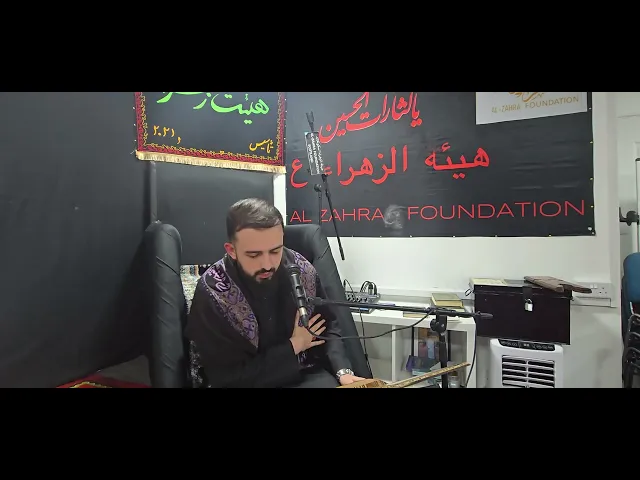
The Dua for Protection & Needs (21:86) | Quranic Duas | Night 23 | Sh. Mohammed Al-Hilli
0
0
6 المشاهدات·
25/03/24
في
محاضرات
🔔 Subscribe to this channel for more regular content Visit our website for updates and subscribe for notifications! 🔗 Website: https://alhilli.org/ 📱 Follow us on Instagram, Twitter, and Facebook for daily inspiration and updates! Instagram: https://www.instagram.com/m.alhilli/ Twitter: https://twitter.com/malhilli Facebook: https://www.facebook.com/sheikhhilli
أظهر المزيد
Transcript
[0:05]Alhamdulillah.
[0:07]Alhamdulillah.
[0:10][Music] Muhammad.
[0:50][Music] Amen.
[0:55]for foreign.
[1:47]For the purification of the souls, the enlighten of the hearts, the
[1:52]acceptance of the deeds, and for the hastening of the reappearance of
[1:57]the awaited savior for Sharif.
[1:58]Enlighten your souls and the atmosphere with the recitation of salawat upon
[2:10]respected elders, scholars, sisters and brothers.
[2:18]This dua saved the life of one of the prophets of Allah
[2:25]subhanahu wa ta'ala.
[2:25]It's a beautiful vik emphasized by the by our but especially by
[2:34]those who are concerned with spiritual progression and it's a dua that
[2:41]the almighty guarantees for protection and fulfillment of needs and the dua
[2:49]of Subhan is found in whereby Allah comes forward and brings us
[3:06]the story of this prophet who is indeed saved by him.
[3:09]This dick is one that many people would have come across the
[3:15]recommendations from the to be constantly reciting it to have memorized it
[3:22]and to indeed have practiced it throughout our lives.
[3:28]our holy six [Music] imuhammed.
[3:37]He says, Imam says, I'm surprised there are people who are saddened
[3:52]and fall into despair.
[3:52]Why do they not turn to this dua and recite subh?
[4:01]Then he says, Imam says, I know that the almighty says we
[4:16]responded to you and we took him out of hardship and likewise
[4:22]we will do the same for the believers.
[4:25]The recognition that emerges today is that you and I love anything
[4:30]that supports us, helps us or gives us a sense of happiness
[4:33]or a means of good tidings, good news.
[4:37]Good news is something that each and every one of us likes
[4:41]to hear.
[4:40]We don't like to hear, for example, somebody telling us something negative
[4:44]or something that's bad.
[4:47]We want bushra.
[4:46]We want some kind of recognition of happy occurrences.
[4:51]I remember when it comes to this there is an idea that
[4:57]not everything that we hear is always positive.
[4:58]Sometimes we hear something that is positive but we hear it as
[5:01]something else.
[5:03]We process it as something else.
[5:05]There was one of the or one of the people one day
[5:11]he was taking his wife to the hospital to deliver to give
[5:15]baby.
[5:17]Yes.
[5:16]When he was taking her, he said to her on the way
[5:21]that you are in labor.
[5:24]I cannot be with you during the delivery process.
[5:25]I will have to wait outside and I will hear the news
[5:32]once you give birth to our child.
[5:34]I will enter and I will be with you.
[5:37]She said very well.
[5:37]Inside the hospital, he waited in the waiting area where people usually
[5:42]wait.
[5:43]The nurses, midwives, they took his wife and they went inside to
[5:47]help her deliver the child.
[5:50]Whilst he was waiting in the waiting area, there was two other
[5:54]men who are also waiting who did not also want to go
[5:59]and see their wives during the delivery process.
[6:00]After a few minutes, the nurse came out, said to the first
[6:07]man who is sitting, congratulations, you have good news.
[6:09]So he stands up.
[6:12]He says, "What is the news?" She says, "Your wife has given
[6:15]birth." So the man asks, "Is it a boy or a girl?"
[6:20]The nurse says, "You have been blessed with twins.
[6:24]You have been blessed with two children." He smiles.
[6:28]He looks at the two other men and says, "This is a
[6:32]sign from Allah subhana wa ta'ala." They say to him, "Why?" He
[6:36]says, "Because I work for a hotel company known as Double Tree."
[6:40]So maybe Allah has given me two.
[6:46]So he goes to see his wife.
[6:47]After maybe one hour, two hour, the nurse comes out, looks at
[6:51]the second man and says, "Congratulations, your wife has given birth." He
[6:55]stands up.
[6:57]Is it a boy or a girl?
[6:58]She says, "It's the first time we have had in this hospital
[7:03]triplets.
[7:04]You have three children." He says to her, "That is amazing.
[7:09]It's a sign from Allah.
[7:12]She says, "Why?" He looks at the last man and he says,
[7:15]"Have you heard of this company that produces cellotape called 3M?
[7:19]I work for it." Now only this man is remaining in the
[7:24]waiting room.
[7:25]He is alone, but he is sweating a lot and he is
[7:30]shaking.
[7:31]And then he stands up and he walks right and left, back
[7:33]and forth.
[7:34]He's saying, "Ya Allah, please help me.
[7:37]Ya Allah, please help me.
[7:37]Ya Allah, this is bad.
[7:40]this is bad.
[7:39]So the nurses come out, they say to him, "Are you okay?
[7:43]Your wife hasn't given birth yet.
[7:44]Why are you in this state of turbulence?" He says, "You do
[7:47]not understand." They say, "Why?" He says, "I work for Seven Up."
[7:53]Sometimes good news is not processed as good news.
[7:58]People are wary.
[7:59]However, the recognition emerges that the Quran brings about all the news
[8:06]for the human being is for that benefit.
[8:09]is glad tidings.
[8:10]Every dua that we have is good news for you and I.
[8:16]And that's why the utilize the Quranic duas in their duas.
[8:18]What do you mean?
[8:21]Today we are fond of Ali Muhammad like we are fond of
[8:25]such as Abu Hamzali for example.
[8:30]These duas if you look inside you will see that the deliberately
[8:34]would place some of the Quranic duas inside.
[8:39]For example has this dua and you will recognize that they played
[8:47]a very important what emphasis upon they the Quranic duas.
[8:53]This dua is something that the who followed the teachings of Quran
[8:59]and but specific focus on spirituality they have emphasized that this of
[9:07]should be recited.
[9:12]For example, the teacher of he used to be known for his
[9:23]spiritual mystical approach in life.
[9:24]He used to say every single day if you want your fulfilled
[9:28]recite 400 times.
[9:33]You have another great scholar by the name of Ayatah Kashmiri.
[9:40]He comes forward and says the best deed if you want your
[9:44]fulfillment of every day after salah go into sujud and recite 400
[9:52]times for 40 days.
[9:56]For 40 days do this.
[10:00]Likewise you have whom?
[10:06]He has a great compilation of the taps of Quran and he
[10:14]is buried in Ashra.
[10:17]He died in the '9s.
[10:18]He comes forward and says one of the keys for you to
[10:25]gain protection and to have fulfillment every morning when you wake up
[10:30]recite 100 times what?
[10:30]What do you think?
[10:36]You recognize that this dua has been placed by the holy six
[10:42]im as something we should recite in this salah which is recommended
[10:47]between as the nar The hadith says in the most delicious thing
[12:08]in paradise and the most delightful taste in Jenna is what?
[12:12]Which food?
[12:13]He says three.
[12:14]three [Music] things.
[12:21]He says when an individual feels the love of Allah, when an
[12:28]individual feel feels love of others for the sake of Allah and
[12:31]when they say alhamdulillah in paradise, this would taste sweeter and more
[12:38]delicious than any other food.
[12:39]Not to discredit the enjoyment of the consumption of certain types of
[12:43]food and everything in paradise for that matter.
[12:49]That's why says vikar is like food.
[12:51]He says you will only enjoy vikar if you look forward to
[12:59]it.
[13:00]You are not forcefully doing it.
[13:02]Please understand today.
[13:03]If you do not want to eat, someone tells you please you
[13:08]must eat.
[13:07]You say, "I'm not hungry." They say, "No, you have to eat."
[13:12]They force you to consume the food.
[13:14]Will you enjoy this or not?
[13:15]Most likely you're not hungry.
[13:18]Most likely you're not desiring the food.
[13:19]Yes.
[13:20]Likewise, there are many they say, "I don't enjoy salah.
[13:25]I don't enjoy dua.
[13:25]I don't enjoy recitation of the Quran." Why?
[13:29]It's because I am not somebody who understands what I'm saying and
[13:36]I am not appreciative of the impact on my life.
[13:38]Therefore, I will say it because everyone is saying it or because
[13:41]everyone is telling me to say it.
[13:44]Whereas, if you really want to understand the beauty of these and
[13:52]these and these, you and I need to look forward to saying
[13:54]it.
[13:55]We need to enjoy just like the food, we need to have
[14:01]some kind of flavor and sweetness in its recitation.
[14:03]That's why I'd like to examine in detail on a night like
[14:10]this this beautiful dua that you and I must recite throughout our
[14:13]lives.
[14:13]And it's a key for the unlocking of many benefits in our
[14:17]lives and the lives of others.
[14:20]by looking at three things.
[14:21]Number one, Yunusam briefly, what is his story in the Quran and
[14:25]in a hadith?
[14:26]What are the inspirational elements?
[14:28]Number two, there are misconceptions about Yunos.
[14:31]Did he disobey Allah?
[14:33]Did he go against him?
[14:35]Was he that was somebody who angered Allah?
[14:38]Did Allah punish him?
[14:41]For example, as the Quran says, and number three, what are the
[14:44]three things in this dua that are beautiful that you and I
[14:47]can learn, but importantly recite in our lives and place in our
[14:53]minds on a night like this so that our can be accepted
[14:56]with the baraka of prophet Jonah in the Old Testament and the
[15:09]New Test Testament known in the Quran as prophet Eunos is the
[15:15]son of Mecca.
[15:14]Mea was a great servant of Allah.
[15:17]He lived at the time of prophet Daw and his son Alim
[15:23]Abdulat wasam.
[15:25]One day prophet Dawoud says to his son let's go and find
[15:28]Makkah because we have heard that he is a very good righteous
[15:33]servant of God.
[15:33]They go they travel.
[15:36]They go to an area known as Na.
[15:38]Nah is north of Iraq today where Mosul is.
[15:42]Where is the grave of prophet Yunusam?
[15:44]It's in Mosul.
[15:44]The grave was destroyed by D.
[15:48]The shrine was destroyed by these worst creation of Allahh when they
[15:56]had occupied Mosul.
[15:55]Ma is there.
[15:58]When they reach they find him looking for wood in the forests.
[16:02]Looking for wood and chopping trees.
[16:04]Then he carries the wood and he goes and sells it to
[16:10]somebody.
[16:08]When he sells it, he takes the money.
[16:10]They follow him.
[16:12]He goes and he buys some food.
[16:14]When he buys some food, he comes home.
[16:18]He sits there.
[16:20]He uses the flour he has bought to bake some bread and
[16:23]waits for the bread to what?
[16:28]Bake.
[16:25]Then he takes it.
[16:28]Then he sits with and says before he eats the bread and
[16:32]anything he has bought, he says, "Ya Allah, I would like to
[16:38]first of all thank you and express my shukur for allowing me
[16:41]and giving me the strength to chop the wood.
[16:44]Then to giving me the strength to carry the wood, then alhamdulillah
[16:48]for you finding me somebody to sell the wood.
[16:55]Then alhamdulillah for me to get the food which is not my
[16:59]own flower somebody sold me the food.
[17:02]Ya Allah alhamdulillah for me having the knowledge to prepare the food
[17:06]by baking the bread.
[17:11]Alhamdulillah for me having the ability to eat and alhamdulillah for the
[17:15]body that processes and digests the food.
[17:18]looks at he says to him, "Let's rise.
[17:25]Let's go." In my life, I have not seen somebody who is
[17:33]more grateful to Allah than this man.
[17:36]Everything he says, "Alhamdulillah, everything is grateful to Allah subhana tala." Today
[17:43]some of us unfortunately we have been given many many flavors many
[17:47]blessings from Allahh but every time we would like to look at
[17:50]what the negatives in our lives we don't appreciate the many blessings
[17:59]Allah says if you calculate you want to quantify the blessings of
[18:03]Allah you will never be able to quantify it you'll never be
[18:07]able to put a number to it whatever happens in our lives
[18:11]we need to Okay.
[18:12]Alhamdulillah.
[18:13]And be grateful to Allah subhana wa ta'ala.
[18:16]The more grateful we are, the more he will give us.
[18:18]This is whom this is the father of Yunusam.
[18:20]Eunos was sent to his community at the age of 30.
[18:25]He was 30 years of age.
[18:31]He preached a message of monotheism for 40 years.
[18:33]40 years he would ask them not to worship idols.
[18:38]They used to worship an idol known as Ashtar.
[18:41]Ashtar was a big idol.
[18:42]They used to worship him.
[18:45]He used to tell them that only Allah can help.
[18:46]These idols cannot help.
[18:49]They said look what you say makes sense but we have one
[18:51]problem.
[18:52]What he said all our forefathers used to worship this.
[18:56]So we cannot stop.
[18:58]We can only do what we have been taught by the generations
[19:04]that came before us.
[19:04]You think that this idea has stopped today?
[19:09]No.
[19:10]Today some of us do things in our lives that are not
[19:17]Islamically acceptable because we have learned it from culture or from generations
[19:22]that have come before us.
[19:24]For example, I get questions many a times.
[19:29]Molana, I gather with my family members, no problem.
[19:33]And I see my cousin, she's a girl, she's 15 or she's
[19:36]10 or she's 11.
[19:38]She's my cousin.
[19:40]Me and her grew up in the same house.
[19:43]We play together.
[19:41]Now I am 16, she is 10.
[19:46]We playing together.
[19:46]What's the problem?
[19:46]Hide and seek.
[19:48]We, you know, laugh with each other.
[19:51]Maana, she's cousin.
[19:54]Don't be too harsh.
[19:54]He's okay.
[19:56]So what cousin?
[19:55]Exactly the same as a non maham, another another woman from the
[20:00]street that you are playing with.
[20:01]No, no difference.
[20:01]Islam doesn't say because it's a cousin there is a discount there
[20:07]is something okay yes likewise what happens therefore is we are too
[20:11]sometimes attached yes some of what we have been taught from the
[20:14]culture is great but we have to always ask a question am
[20:19]I doing something right or not I want to give a advice
[20:22]about one thing this advice is regarding how you and I should
[20:29]perform z after salah correctly how the how the and the maraj
[20:34]want us to perform z back 3 400 years or maybe more.
[20:42]I researched this in India and in Iran when the mmin used
[20:47]to do z because the emphasis was to remember the holy eighth
[20:51]Imam peace be upon him.
[20:55]They used to mention the pa and the five then they turn
[20:58]towards mashad then they complete with the holy 12.
[21:02]This is not necessarily a wrong zara per se.
[21:05]But today, what are we saying?
[21:10]A suggestion, just a suggestion.
[21:13]Our youngsters today when they are hearing this, when they are hearing
[21:18]that I am saying the five until Hussein, then I say, then
[21:22]I turn towards imi.
[21:26]What do they understand?
[21:27]Immediately they get the idea that the eighth imam has a status
[21:31]because I'm mentioning his name and I'm not mentioning the other imams.
[21:37]So they think that the the status of the etham is high.
[21:45]So what is a better in just a suggestion?
[21:48]Yes.
[21:49]for sure are more happy than this is either you mention the
[21:55]five and then you mention the holy 12th I im because he's
[21:57]alive or even a better one is to mention Hussein Muhammad Aliham
[22:05]Ali Muhammad Ali how long did that take 10 seconds and then
[22:14]mention the holy 12th I today our eighth holy IM is absolutely
[22:20]unbelievably beautiful his shrine but he's not who is means alone nobody
[22:31]going to him yes it's a title given to him in the
[22:35]past but today alhamdulillah millions go to mash so if it is
[22:39]the idea that he is alone he's not alone the alone are
[22:43]the four ims of the alone are the two imams of yes
[22:46]that very few people Oh yes.
[22:50]So what we are encouraging and to do is to think okay
[22:52]I have been passed this on from generations.
[22:56]Okay it's not bad it's not haram but can I make it
[23:02]better?
[23:02]Can I improve it?
[23:02]Can I make sure that the children learn in the best possible
[23:07]way that I need to teach them the imams all of them
[23:10]not select only a few.
[23:15]Yes.
[23:16]And in that way we will be pleasing im Yunus after 40
[23:27]years of preaching to these particular individuals in his community.
[23:32]What happens?
[23:34]They reject.
[23:34]They refuse.
[23:35]So Yunos says to Allah, "Ya Allah, I have preached them 40
[23:41]years.
[23:39]They are not willing to listen.
[23:42]Please, what would you like me to do?" Allah reveals to him
[23:45]that I will punish them because of what they have done.
[23:50]I will punish them by a certain time.
[23:53]So you what does he do?
[23:55]He waits for that time and he quickly leaves.
[23:59]He leaves rushes out of the city.
[24:01]He takes with him an a servant of God and he leaves
[24:08]in that area of Nawah an a scholar.
[24:09]So when he goes with the he goes toward the shores of
[24:14]the sea he finds as you all know the ship he wants
[24:18]to get on it.
[24:18]when he gets on it.
[24:20]There are some rea that says there was turbulence or some say
[24:25]there was a whale whether they believe that they have to cast
[24:29]the name and bring a name out so that what so that
[24:34]either the turbulence subsides or the whale quietens three times the name
[24:38]of comes out.
[24:40]They recognize that he has to go when he is thrown into
[24:46]the sea.
[24:45]Allah through his a generative well commands the whale the big fish
[24:52]not to crush him to what just to swallow him right and
[24:58]at that moment how long does he stay inside according to 9
[25:02]hours some other say 3 days usually you need to stay there
[25:09]for a few minutes and then you die of course inside the
[25:13]belly of the whale at least 9 hours this is unique experience.
[25:20]Quran says even though he's a prophet, if he was not doing
[25:32]inside the belly of the whale, he would have remained there until
[25:36]the day of if it wasn't for his.
[25:44]And the Quran says, Now means darknesses.
[25:51]Notice Quran does not make the darkness singular.
[25:56]It is plural.
[25:56]But when it comes to light, it is singular.
[26:06]Allah.
[26:07]There are many ways to be misguided.
[26:09]There is only one path of is singular.
[26:15]Is plural.
[26:15]So the idea that imagines is he is in dulamat.
[26:18]What kind of dulamat?
[26:21]He was inside the belly of the whale.
[26:23]It was in the sea and it was dark at night.
[26:27]Three levels of darknesses.
[26:29]Yes.
[26:28]And as we will come recites this wonderful dua in sag according
[26:35]to somebody he was in s inside the valley of the whale.
[26:39]Allah says he responded to him and when he came out he
[26:46]says that the moment he came out from the belly of the
[26:51]whale he was sick but according to riat he was so sick
[26:57]that his skin was like peeling off he was weak he could
[26:59]not withstand the heat of the sun.
[27:03]Quran says This tree in the English is called the good tree.
[27:11]The tree.
[27:13]Allah wa ta'ala says we based on our mercy helped him through
[27:16]this tree.
[27:18]He would seek relief from it.
[27:19]And today it has been shown scientifically and many medical aspects are
[27:24]using it for skin conditions for all kinds of different ailments and
[27:28]diseases.
[27:30]Quran says then we sent him back to 100,000 people of his
[27:38]community.
[27:39]Now in the meantime he has left his community.
[27:42]In the meantime the community see the is about to happen.
[27:44]There are clouds gathering.
[27:44]There was an amongst them.
[27:48]He said look you has left the punishment of Allah will fall
[27:50]upon you now.
[27:52]It's the time to seek to Allah is going to punish you.
[27:54]They turned to Allah begging.
[27:57]The reaya says some women who had their children suckling them.
[28:00]They detached themselves from the circling children.
[28:01]They left the babies and they went crying, begging, begging Allah, please
[28:05]forgive us.
[28:06]We believe in you.
[28:09]We believe in we will not worship the idols.
[28:11]And Allah says Allah saved them.
[28:16]And it is a unique story in the Quran because all the
[28:19]other stories of prophets in the Quran they attained the punishment of
[28:23]God because they rejected and monotheism and the prophets whereas the community
[28:31]of prophet Yunus were the ones who accepted the teachings and Allah
[28:36]waala indeed saved them.
[28:38]question.
[28:39]How is this story depicted in the Old Testament and the New
[28:46]Testament?
[28:43]Cuz today we believe in prophets.
[28:47]Other religions also believe in these individuals, but not the same way
[28:51]as we believe.
[28:51]Why is this important?
[28:54]Because if you for example go to Netflix, you'll see there is
[29:00]a new production about the life of Nabi Musam.
[29:03]Life of Nbi Musa Alisam.
[29:08]this new production costs millions of dollars and they say I watched
[29:11]it so I don't speak from the member about something that someone
[29:14]tells me I watched it it's a series like a movie and
[29:19]it shows the story of MS they say based on Bible and
[29:21]Quran they say we as we consulted Muslim experts and we went
[29:27]to the Jews and the Christians all of them they bring so-called
[29:31]experts they give the version of Moses story and they bought this
[29:38]film But the film is rejected by us 100%.
[29:39]It goes against the Quran.
[29:43]It goes against but it's specifically against of B.
[29:45]Say to me why Mhab of B is the madhab of honoring
[29:51]prophets of Allah.
[29:53]And I mean it of B.
[29:56]Because sadly other schools in Islam have not understood the meaning to
[30:00]be a prophet of Allah.
[30:02]So therefore they have narrations which we reject.
[30:04]Bkari narrated by Abu Hur.
[30:07]One day, Prophet Musam's community come and say, "Ya Allah, we would
[30:18]like to see MS have a shower, a bath." I don't know
[30:23]why.
[30:23]Why would you want?
[30:24]But anyway, so Allah answers the dua.
[30:26]What happens?
[30:28]One day, MS is having a bath in the river.
[30:31]He places all his clothes on a rock.
[30:34]All of a sudden Allah according to this in Abkari he be
[30:39]he says to the rock run and the rock starts to run
[30:41]with the clothes of MS.
[30:44]MS comes out of the river running after the rock.
[30:45]Is they look at MS they say alhamdulillah.
[30:52]The worst thing, you know what the worst thing is?
[30:57]MS catches the rock.
[30:56]He begins to hit it and then he begins to say to
[31:03]it, "How can you run away with my clothes?
[31:05]How dare you?
[31:06]The rock has a fight with MS." The second holiest book in
[31:12]Islam.
[31:13]Anyway, so what happens is this narration likewise inki Abu narrates that
[31:17]the angel of death comes to take the life of Mus comes.
[31:19]Mus looks at him, who are you?
[31:22]He says, I am Israel, angel of death.
[31:24]I've come to take your soul away.
[31:26]Mus does what to him?
[31:27]Punches him in his eyes.
[31:28]So angel of death goes back to Allah with a black eye.
[31:33]Y angel has an eye.
[31:38]Somebody fabricating did not know how to fabricate.
[31:40]When he goes back to Allah, he says, "Ya Allah, now I
[31:44]have black eyes.
[31:43]Ma, look at what he's done to me.
[31:45]Children playing." So Allah says to him, "Go back and say to
[31:52]him, don't do this.
[31:51]It's time for you to die." School of a school of tanhul
[31:59]and we believe in the of the prophets and the imams.
[32:06]Asma means sinlessness.
[32:06]Yes.
[32:07]Protection from Allah from birth.
[32:09]We reject all these.
[32:11]That's why when you look at this movie in Netflix, what does
[32:13]it show?
[32:14]It shows Musa angry, God forbid, with Allah.
[32:17]It shows him questioning Allah.
[32:19]Harun, his brother coming to him saying, "Listen, you do what God
[32:22]tells you." He said, "No, I don't want to do what God
[32:26]tells me." Things like this.
[32:26]And even though they bring the ideas of Muslim scholars, they deliberately
[32:30]don't present their opinions if they've said about these things or they
[32:34]present what the New Testament and the Old Testament have said which
[32:37]unfortunately are full of attacks on these great individuals.
[32:39]Likewise, Yulusam Jonah in the Old Testament and the New Testament.
[32:45]What does it say about him?
[32:46]It says that he was angry with God.
[32:49]That God the Almighty told him, "Yes, why did you do this
[32:51]with your community?
[32:52]Why did you leave?" He was angry with him.
[32:54]Therefore, he ran away and went on the sh and therefore God
[32:58]wanted to punish him.
[32:57]Please focus on this so that we can be defenders of the
[33:04]prophets and the imams their of and the of the prophets are
[33:07]part of our our beliefs.
[33:11]You cannot say I will call a mana.
[33:13]You have to believe in it and defend it yourself.
[33:16]You have seen this game who wants to be a millionaire.
[33:21]Yes, there is options when you don't know the answer.
[33:26]Call a friend, ask the audience or 50/50.
[33:30]You have seen in questions of you don't have these options.
[33:34]You can't say I need to call a molana or ask the
[33:38]yes you can in the sense that to gain knowledge but you
[33:41]must have the yourself and you must be able to defend it
[33:46]yourself.
[33:47]Yes.
[33:48]Quran comes forward and says categorically that that these prophets are on
[33:56]well the idea that emerges is what is that they do not
[34:01]speak from themselves the prophet Islam does not speak from himself everything
[34:08]is but revelation yes so we believe categorically that the Quran highlights
[34:11]that all these prophets are masum and they do not make mistakes
[34:16]now there are many stories in the Quran where people look at
[34:19]it and say he's made a mistake.
[34:20]Adam Ibraim when he said I am sick but he wasn't sick
[34:27]for example.
[34:26]Yes for example you have MS you have other prophets which seemingly
[34:33]even the holy prophet of Islam in the Quran if you read
[34:35]it and you do not understand it that you may understood this
[34:42]to mean that Allah will forgive the past and the future sins.
[34:46]Yes.
[34:47]in chapter 48.
[34:47]But all these our based on the of the and one of
[34:54]the defenders of the of the whom was our only ethn.
[35:04]He would have so many discussions and he would have debates with
[35:09]scholars of other religions to defend the fact that our and other
[35:13]prophets are all the prophets are free sins.
[35:17]So if we believe this, how do we explain the ayah in
[35:24]the Quran which is chapter 21 verse number 87 is who is
[35:32]the person of the whale meaning you is now talked about in
[35:39]the Quran means what some have said it means he was angry
[35:44]with God comes from comes from anger.
[35:49]They say see this prophet was displeased with Allahh.
[35:52]Wrong.
[35:53]Very comes forward and tells us he was not angry with the
[36:00]almighty.
[36:01]How can a prophet sent by Allah who is the choicest of
[36:03]prophets or or the choices of human beings and is an individual
[36:08]who recognizes the status of Allah.
[36:10]How can a prophet like Ununus be angry with his lord?
[36:12]No, he was angry with his community means he was not angry
[36:18]with he was displeased with the fact that his community after 40
[36:25]years would not listen.
[36:25]So he left angry with them.
[36:27]Number one translation he thought we cannot control him or overpower him.
[36:38]Some have translated there is a difference between and please understand this
[36:43]is this is going now to the words in the ayah means
[36:49]strength means limit and measure in this ayah it doesn't mean that
[36:54]he did not think we can control him no he did not
[36:59]think what he did would warrant punishment or some kind of repercussion
[37:05]meaning what you want to play his salam When Allah said to
[37:10]him on this date I will send the punishment.
[37:13]It is was better for him to stay until the punishment was
[37:16]about to come or Allah tells him now you leave.
[37:21]But he left hastily.
[37:21]He left quickly.
[37:24]So he thought okay I left quickly.
[37:26]Doesn't mean that I did necessarily something wrong.
[37:30]This is not a then this is not a sin.
[37:32]This is not an act of transgression against Allah.
[37:34]It's just that he did what is known as.
[37:37]Please understand this.
[37:39]This is important in our in our beliefs.
[37:42]What is some prophets not the holy prophet or theam?
[37:43]Some prophets do what is known as leaving that which is desirable.
[37:48]Means it is not doing the most likely or the most good
[37:55]outcome and doing that which is less but it's not a sin.
[37:58]Musam when he came to separate to separate those who are fighting
[38:04]he used force to separate them and unfortunately what his enemy died.
[38:09]Yes this was not a sin this was an act to defend
[38:14]somebody but because he's too strong maybe he shouldn't have used that
[38:17]strength as much but he did not intend to kill neither was
[38:22]it something wrong necessarily it was just an element of separation that
[38:25]man fell hit his head on the ground and he died.
[38:30]Yes.
[38:31]So does not mean that the is what making errors here means
[38:36]that he did not recognize his actions are deserving of any repercussions.
[38:41]Final point here someone says excuse me he says I am vim
[38:49]I have committed sin because nobody who is a vi has not
[38:56]committed sin.
[38:57]Do you agree?
[38:57]Usually vi means what in English?
[39:00]Oppressor.
[39:01]Unjust person.
[39:02]So how is it that Yunus says I am one of the
[39:08]unjust?
[39:06]We come to the Arabic language.
[39:11]Arabic lex lexographers they say vul has many meanings.
[39:12]The first meaning of vul is when you don't put something in
[39:18]its rightful place.
[39:19]Something should be somewhere but you don't put it back.
[39:25]That is the first.
[39:24]But later on means what?
[39:28]Taking the rights of others, killing people, oppressing them in whatever way.
[39:34]Here it means he did not do what is the best way
[39:39]which is to wait which is to anticipate and to indeed receive
[39:43]the command from Allahh to leave.
[39:46]He was hasty in his decision.
[39:48]That's why interestingly the Quran actually says this regarding him.
[39:55]Allah says to the holy prophet, don't do what you did.
[40:01]Don't be hasty.
[40:02]Don't be quick.
[40:04]And so the Quran does not in any shape or form refer
[40:09]to any mistake or sin from but rather says he did something
[40:12]which was not ideal.
[40:15]Yes.
[40:16]Why?
[40:17]Because the Quran is clear in the message that all the and
[40:19]the prophets are.
[40:21]Yes.
[40:22]And therefore the recognition that emerges for you and I a very
[40:25]important lesson just quickly before we go into the dua for the
[40:28]final is what is the recognition that many times in our lives
[40:36]immediately the human being Quran says is very quick is very hasty
[40:43]the first thing that they hear they react today mashallah subhan allah
[40:48]today we are individuals who react and make comments and make an
[40:54]emotional state very quickly when we hear something.
[40:58]We need to be controlled.
[40:59]We need to limit our what?
[41:00]Limit our reaction to that which pleases Allah subhanahu wa ta'ala.
[41:04]Many times we act without pondering and reflecting here said look wait
[41:13]do not be quick in passing judgment.
[41:15]Yes.
[41:16]And that's why He famously says when there is a fitna do
[41:28]don't be by like anything other than a young she camel because
[41:34]a young she camel cannot be milked and cannot be used for
[41:41]people to ride on when there is a trial or tribulation don't
[41:44]haste and go and say I must do something I must say
[41:50]something, wait and be intelligent, seek direction and what and then be
[41:54]able to make a measured response if necessary.
[41:57]When it comes to the dua itself, it has three important elements.
[42:01]Final point, let's focus on the dua.
[42:05]Yes, these three are absolutely pivotal for our to be accepted and
[42:11]for spirituality to be gained.
[42:12]Yes.
[42:13]The first is what is the second is the third is these
[42:21]three must exist in many of our supplications including this I must
[42:27]know what is it that I'm asking Allah subhanahu wa ta'ala the
[42:29]first thing I'm asking [Music] is the holy prophet peace be upon
[42:36]him his family says there is nothing more beloved to Allah when
[42:44]A servant saysahillahillah and he says every time a servant says something
[42:50]and prolongs it by saying like this.
[42:54]The prophet says immediately all their sins fall under their feet like
[43:04]how the tree lets its leaves come down and what loses its
[43:07]leaves in the autumn the rub come down.
[43:11]Yes.
[43:13]When an individual [Music] saysahillah it's my means of protection.
[43:23]Now what is interesting aboutahill here is it's notahill it'sahillahillah I know
[43:34]this discussion is slightly higher but I'd like to raise you to
[43:37]a higher level.
[43:39]What does it mean?
[43:38]It is very specific in the Quran.
[43:41]It is very unique in the Quran.
[43:45]It shows a very close intimate conversation with Allah.
[43:48]Instead of saying he is saying he's speaking directly to and this
[43:55]have said it's one of the indications [Music] of what's it's the
[44:06]recognition of an individual expressing the fact that they returned to him
[44:13]subhanahu wa ta'ala When an individual saysahill and here it is to
[44:25]say ya Allah I am nothing.
[44:26]Ya Allah I own nothing.
[44:30]Ya Allah everything comes back to you.
[44:33]This is why those three individuals in the famous story of the
[44:38]battle of Tabuk Quran says in story of the surah TBA there
[44:41]are three who came to the holy prophet and said we will
[44:45]not come and fight.
[44:44]Prophet said fine we don't go.
[44:49]So then they felt guilty.
[44:50]They went and placed themselves in three caves and begged Allah for
[44:54]forgiveness.
[44:55]Allah says they thought they can run away from Allah but they
[45:03]have to recognize in order for them to be forgiven by Allah
[45:06]they need to go back to Allah first.
[45:09]Meaning what?
[45:11]Toba.
[45:12]Tonight is the night of m toba repentance and penitence.
[45:16]Tonight is about becky.
[45:19]Tonight is going back to Allah.
[45:21]What is the most important criteria in this is for a believer
[45:25]to recognize that is from Allah.
[45:28]Not everyone can ask for forgiveness and genuine.
[45:33]It's three steps.
[45:34]Number one, you go back to Allah.
[45:36]Number two, you ask Toba.
[45:38]Number three, Allah accepts this.
[45:40]asking to has to start with going back to in dua Abu
[45:47]Hamza.
[45:48]What do we recite?
[45:48]Recite this beautiful line.
[45:55]Ya Allah, I am running away from you to you.
[46:04]How?
[46:04]When you run away from someone, you don't run towards them.
[46:10]When you run away from an animal who's about to bite you,
[46:15]a simple example is given for babies and children.
[46:18]When the mother shouts at the baby or a child and says,
[46:22]"You've done really bad.
[46:23]You how how could you have broken this for example?" Yes.
[46:28]The child often runs to where?
[46:29]Have you seen to the mom?
[46:34]Even though the mom is shouting, the child goes back because the
[46:37]child knows despite the fact that the mother is scolding the child,
[46:41]the child finds comfort and love back at the mom.
[46:44]So it is natural to go back to the source of comfort
[46:46]and the source of someone who will make them happy.
[46:49]So even though we are displeasing Allah, Allah subhanana wa ta'ala says
[46:53]whether you like it or not, you will come back to me
[46:58]because everything is in my hands.
[46:59][Music] that is what means to start off with is what is
[47:10]this that you and I do on a regular basis very quickly
[47:17]Allah subhana tat attributes are what either of beauty or jalal exaltation
[47:23]and honor yes beauty are for example the idea of the ide
[47:34]of the will of Allah subhana wa tala the knowledge of Allah
[47:37]these are the attributes of what of his majesty and beauty there
[47:41]are attributes that is known as which means the which means those
[47:49]attributes that God does not have does not have meaning what that
[47:52]things that are attributed to God that are not part of God
[47:59]himself himself.
[47:57]Yes.
[47:58]Things which are not befitting and do not apply to the almighty.
[48:03]Things which are about deficiency.
[48:05]So when I say subhanak what is it I am saying?
[48:10]I am saying in this instance in this instance ya Allah anyone
[48:13]who says something wrong about you I distance myself from them and
[48:19]I don't want to say anything wrong about you.
[48:21]Number one.
[48:23]Number two, whatever wrong happens, it's because of me, not you.
[48:32]Imam says, "I am the one.
[48:35]I am the one.
[48:35]I am the one who made the mistake.
[48:38]I am the one.
[48:41]I am the one who is not a ashamed of you when
[48:45]I am by myself and I know you are watching." So, it's
[48:51]placing the blame on us.
[48:52]Why humiliating the self before Allah is needed.
[48:56]We most of the times have takur have too much arrogance in
[49:03]our hearts.
[49:02]Before Allah, we cannot achieve success unless we remove this from our
[49:10]hearts.
[49:07]Meaning I must beg Allah by knowing that I am nothing tonight.
[49:14]Tonight in the of in the of the eve of 23rd, if
[49:19]I want true success, if I want my year to be a
[49:20]year of happiness, if I want Allah to grant me goodness, I
[49:26]must empty my heart from any form of self-conceit and self-love by
[49:31]saying, "Ya Allah, everything that has happened that is bad is because
[49:36]of me.
[49:37]I am the one who has not performed their duties correctly." Tonight
[49:41]is not a night by saying ya Allah please why did you
[49:46]not give me last year ya Allah I thought I have done
[49:48]good but I don't see you helping me why it's not the
[49:53]way the way is by the annihilation of the self and finally
[49:57]there's which means to admit Allah loves the individual to admit why
[50:06]don't say to him ya Allah you know my sins please forgive
[50:11]When you and I mention 70 times after I need to be
[50:19]thinking of the sins in my mind.
[50:21]This is not just the utterance of the tongues.
[50:23]I need to have this active rather than the repetitive.
[50:30]Yes, the is of the utmost importance.
[50:34]Question.
[50:35]What happens when I go through these three steps?
[50:38]Quran says after he saved you he will also save us.
[50:45]The guarantee is thereby in the Quran Allah says you supplicate to
[50:52]me using this and I will answer you and I will give
[50:55]you and I will fulfill your wishes.
[50:56]That's why on a night like this there are quickly five points
[51:04]to remember about how to approach it in the right manner.
[51:07]Very briefly, the first thing that we must be thinking about is
[51:12]what is the greatest deed in the month of Ramadan?
[51:14]What is the best thing that you could do in this holy
[51:18]month?
[51:19]This was given to us by the holy prophet.
[51:21]When says to him, what are the best deeds in the holy
[51:26]month of Ramadan?
[51:26]He says, do you agree?
[51:30]means the higher level of tawa which means that when it comes
[51:33]to knowing Allah is watching me I am more careful not to
[51:38]sin.
[51:39]It's not only tawa to know God's presence but to also be
[51:41]careful not to lead towards a sin not to put myself in
[51:48]those situations where God forbid I might sin.
[51:51]Yes.
[51:52]If is the best deed in the holy month of Ramadan, then
[51:57]for sure it is one of the best deeds on the night
[51:59]of if I make a commitment to Allah that ya Allah, I
[52:04]want help.
[52:05]I want that strength that when I am out there, when I'm
[52:08]on my phone, when I'm with friends, when I am in a
[52:13]moment of temptation, I need I need that higher level of tawa
[52:18]to say no to desires, not to risk it, not to put
[52:20]my soul into a potential danger.
[52:23]Number one.
[52:28]Number two, tonight belongs primarily to the master of our time, im
[52:40]Meaning what?
[52:42]Meaning that the Quran says is the present tense.
[52:51]Meaning every night of the and who is a creation of Allah
[52:54]special creation of Allah who is with them and supports them and
[53:01]guides them and gives them instruction from Allahha.
[53:03]This is a special creation of Allah is a higher status than
[53:08]the angels according to.
[53:08]They descend on a night like this to whom?
[53:12]To the holy awaited savior to represent of Allah on this earth
[53:17]and they present the of human beings to him.
[53:21]Tonight I must not allow the night to go except that I
[53:28]make a conversation or a commitment with the imam of my time.
[53:30]How much do I know about him?
[53:36]How much do I serve him?
[53:36]How much do I prepare for his reappearance?
[53:40]How much do I do on his behalf?
[53:43]How beautiful it is like a night like tonight you do and
[53:48]you say this is from me to Imah I tell you if
[53:55]today you came to somebody and said to them at the time
[53:58]ofar yes when you're having this date or when you're having the
[54:03]samosa someone comes to you and you say to them may Allah
[54:09]accept you what do they say to youallah They say to you
[54:16]also, yes.
[54:17]Imagine on a night like this that you say, "May Allah accept
[54:22]your deeds." What do you think Imam Zaman would say to you
[54:25]if I iman once says, "May Allah accept your deeds." All your
[54:30]deeds have been accepted.
[54:32]One time, one time, one time, Immi says, "Ya Allah, this person
[54:39]has just prayed and asked that I have my accepted.
[54:42]I am praying for him.
[54:43]Do you think the dua of is small in the eyes of
[54:45]Allah?
[54:46]Imagine that ability to have that connection with Im.
[54:51]Number three, tonight is a night of [Music] Quran.
[54:57]Yes.
[54:58]Notice how powerful the Quran is.
[55:00]Girael brings the Quran.
[55:03]He is the best angel.
[55:05]The holy prophet receives the Quran.
[55:07]He is the best prophet.
[55:08]The night of is the night of the Quran.
[55:12]the best night.
[55:15]Yes, the Quran is truly phenomenal and tonight is the night to
[55:18]establish a special relationship with the Quran.
[55:21]If we are afraid to pick up the Quran, if we are
[55:23]not a Quran, tonight is the night to say, "Ya Allah, I
[55:28]want this year to make a special connection." How it's your journey?
[55:31]Maybe you want to recite more during the days, normal days.
[55:36]Maybe you want to go and understand taps.
[55:39]Maybe you want to memorize.
[55:39]Maybe you may want to become more familiar.
[55:42]But if you make a decision tonight, it will more likely to
[55:49]work than if you make a decision tomorrow.
[55:50]It's a special night greater than 83 years.
[55:54]Yes.
[55:55]And therefore, it's a special night in that particular regard.
[55:59]Number four, when it comes to what do we find?
[56:02]This is an important lea when it comes to seeking forgiveness.
[56:08]Tonight is a night of Torah as we mentioned is a night
[56:15]of emptying our deeds that are what causing us all kinds of
[56:19]problems in life.
[56:20]And final point is the night of love is the night of
[56:22]love of Allah subhana tala and is the night to submit ourselves
[56:28]to him and to feel his presence in our hearts.
[56:30]What does that mean?
[56:32]It's not denied only to perform and say kalas I have done
[56:35]my spend some time alone in private private when you go back
[56:42]home maybe just sit and speak to Allah try it tonight empty
[56:45]your hearts yes speak to him about all the favors that he
[56:50]has given you speak to him about all the that he's bestowed
[56:52]upon you speak to him about what you would like to do
[56:56]how you want him to help you but start off with all
[57:01]the praise the taught us the adab of dua is start with
[57:03]praise not that Allah needs it but it's good for us when
[57:09]we remember the blessings of the almighty upon us yes it changes
[57:12]our lives may Allah wa'ala accept all our on a night like
[57:19]this and on the month of Ramadan may Allah wa'ala writes us
[57:22]amongst those who are meaning blessed and forgiven on a night like
[57:27]this may he subhanahu wa ta'ala allow us to witness many years
[57:31]inshallah of Ramadan and the actions of don't forget those who were
[57:37]with us last year in they're not with us this year and
[57:42]we may have people who are with us this year and are
[57:44]not with us next year so we don't know maybe all of
[57:48]us maybe some of us maybe one or two of us this
[57:50]could be our last so how would we utilize it bless you
[57:56]all with the barak of [Music]
0 تعليقات
sort ترتيب حسب
- أعلى تعليقات
- أحدث تعليقات
التالي
5 المشاهدات · 26/03/04