التالي
10 المشاهدات · 25/08/06
10 المشاهدات · 25/10/24
6 المشاهدات · 23/10/14
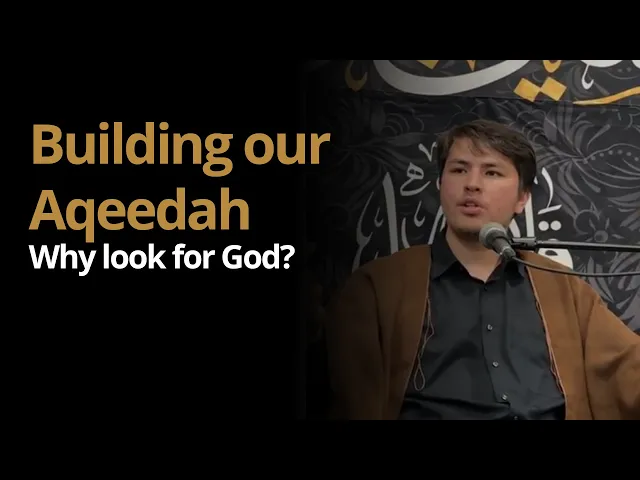
Building our Aqeedah 4 - The Outward Way to Find God
0
0
8 المشاهدات·
25/12/28
في
آخر
Building our Aqeedah 4 - The Outward Way to Find God
أظهر المزيد
Transcript
[0:05]Alhamdulillah.
[0:37]Alhamdulillah.
[0:45]Alhamdulillah.
[1:07]Allah My dear brothers, sisters and respected scholars.
[1:49]I of course begin by offering my condolences to all of you
[1:56]and to the IM of our time in regards to the passing
[2:05]of the date of the passing of our 10th im of course
[2:10]the 12 lights or of the 14 lights of the and one
[2:15]that we should always try to remember and look more into his
[2:22]life and research further to gain to gain an understanding of our
[2:26]imams.
[2:27]Many times we understand the lives of Im Ali or Hassan or
[2:31]Hussein.
[2:32]But when we're asked further of the other imm but after him
[2:44]we find that many times there are less research within our communities.
[2:50]So I want to of course today go through our uh weekly
[2:55]sessions of building our based on the book from that inshallah we
[3:04]first build our beliefs before we turn over to uh remembering our
[3:09]im on the anniversary of his passing.
[3:13]Of course this month is also the month of Raj.
[3:16]So I want to congratulate you all on this month and the
[3:21]importance of this month.
[3:21]Inshallah we will look into it a bit further without your recitation
[3:24]of >> so how far did we get in our understandings of
[3:36]the 50 lesson the 50 principles of we said that first we
[3:44]need to understand if there is an existence of a god why
[3:46]there is a need for a god and then we moved on
[3:50]to our next point which was how can we prove his existence
[3:54]and we said there was two ways that we can prove his
[3:55]existence both an inner way and an outward way.
[3:58]Now we need to make sure that we can understand these two
[4:03]ways.
[4:02]The inward way was through a simple word.
[4:05]When we try to understand Allah through ourselves, it is through our
[4:11]fra of Allah subhana wa ta'ala that he's given.
[4:17]This is the divine ination, the divine inclination towards a higher being.
[4:24]So we said that there are many societies who believe in it
[4:27]and it's never disappeared and there's always been a need for a
[4:32]higher understanding to something that is not within this realm.
[4:34]Now we want to go ahead and move to the next uh
[4:39]discussion and the next discussion is the outward way.
[4:43]How can we understand Allah subhanahu wa ta'ala through outward?
[4:47]So he begins by under by by helping us clarify some ambiguities.
[4:54]What does he say?
[4:55]He says number one in order to come into being and to
[4:59]remain into being there are certain conditions for all existence.
[5:03]All things that exist within this world have certain conditions.
[5:08]Right?
[5:08]We said a plant needs sunlight.
[5:10]He needs water.
[5:10]He needs proper soil for him to come together to be able
[5:17]to exist.
[5:16]So when we understand this there are of course certain chemicals that
[5:22]it it needs that need to be in the atmosphere for it
[5:24]to be able to exist and in the same manner we are
[5:27]ourselves it's sun we need sustenance to exist right we need oxygen
[5:31]to exist we need so many different conditions for us to remain
[5:37]in existence not just to be here but to stay here so
[5:40]we need to understand that there are certain conditions a Second point
[5:46]uh which is given is every creature has a special effect which
[5:49]is exclusive to it.
[5:52]So water and fire have their own peculiarities.
[5:54]One cannot be the other.
[5:58]They are within themselves.
[5:58]So they are certain uh elements of nature that exist within themselves.
[6:03]A third point he says that is that all of the members
[6:07]the organs of living creatures work and are co coordinated together.
[6:11]So all work together consciously or unconsciously.
[6:14]all of our organs within our bodies, how the system works, our
[6:20]respiratory system, right?
[6:20]And our other systems as well, our digestive system.
[6:23]The way that they work is in harmony and in that manner
[6:26]there is a perfection that exists there.
[6:29]And fourth he says is that when we look outside of the
[6:33]organs of our body, we see in nature and this is the
[6:35]important point within nature there exists an understanding of a design.
[6:40]When we look at for example a field of flowers, how is
[6:44]it that those flowers are able to grow when that field is
[6:48]is supposed to grow?
[6:49]We see that there are certain insects like bees and flowers that
[6:52]work in harmony to bring that environment into play.
[6:57]So when we look into the outward world and we look towards
[7:01]our environment, it helps us understand that there has to be a
[7:05]design.
[7:06]Can there be a design without a designer is the question.
[7:11]And here according to Sharazi he brings out the point that it
[7:15]is not possible it is not possible for for something to be
[7:20]in order to be created out of disorder.
[7:23]He says there has to be a relation between a intellect and
[7:27]a perfect design.
[7:28]He says it's not possible for a blind or an illiterate person.
[7:31]He could never type a good essay or write a social or
[7:36]a critical article just like a child of two years cannot paint
[7:40]a beautiful painting.
[7:41]So in these manners we can say that this perfection that we
[7:47]view in the outside world.
[7:47]It has to come from a creator and we we've brought that
[7:53]verse at the beginning in verse 53.
[7:56]Allah subhana t says soon we shall so show show our signs
[8:06]in the horizons and in their own souls.
[8:07]Allahh talks about those two points that we will show our signs
[8:13]within their souls and within the horizons within the world so that
[8:23]it becomes clear to them that he is he is real.
[8:29]Is it not sufficient that their lord is a witness of all
[8:35]things?
[8:35]So we can understand that the second point of understanding towards how
[8:40]we can come to prove the existence of God is through our
[8:44]world.
[8:45]And in the following discussions there are certain examples certain ways that
[8:51]we can see uh divine perfection that exists within our world.
[8:55]And one of the ways that is explained within this book is
[9:00]the brain and the body.
[9:01]When we see for example certain parts of the brain such as
[9:06]the cerebrum which is the center of our willpower, our consciousness and
[9:09]our memory.
[9:10]It is one of the most sensitive areas of our brain and
[9:13]it is everything that controls our fear, our our emotions.
[9:18]It is one part of it.
[9:20]So if we take it out of an animal and we leave
[9:23]the other organs exactly as they are, the human or any other
[9:26]creation would not be able to do anything.
[9:29]They've tested it with a pigeon, for example, they took out the
[9:32]cerebrum from that brain of this pigeon and they allowed it to
[9:37]live.
[9:38]It did live.
[9:37]It was able to breathe and and exist.
[9:40]But when it was given seeds, for example, it wasn't able to
[9:44]take those seeds.
[9:44]It wasn't able to eat those seeds.
[9:45]So in that way, just a simple smart small part of the
[9:50]brain, once it was removed, it was impossible for that pigeon to
[9:54]exist.
[9:54]and other aspects such as memory.
[9:57]It's very difficult for us to for example imagine ourselves without that
[10:02]ability to memorize right we don't think about these bounties from Allah
[10:08]subhana wa tala or the these gifts from Allah the fact that
[10:10]we can simply remember the things that we do whether it is
[10:15]back in history or recently certain things that you did this morning
[10:18]or yesterday so these are certain aspects of the wonderful sense of
[10:23]memory that Allah subhana wa ta'ala has given us so it is
[10:26]a that we can understand Allah subhana wa ta'ala and in their
[10:35]souls as well will they perceive it not so Allah subhana wa
[10:40]ta says on the earth are signs of those who have assured
[10:42]faith that's also in your own selves will you not see so
[10:48]we have many people who for example don't understand that but that
[10:51]is another way that we can understand it now another beautiful example
[10:55]given in this book is a certain animal that they talk about
[10:59]the animal is a bat.
[11:02]We understand that many other birds when they're for example flying they
[11:06]use their vision and it's quite simple.
[11:09]So they use their eyes and they're able to see how they
[11:11]can go around and how they can fly around.
[11:14]But we can see a bat is within darkness and they're able
[11:19]to fly.
[11:21]So scientists they've been astounded by this.
[11:22]How is it possible that this bat can fly around and it
[11:29]won't knock into anything in the darkness?
[11:31]He says in a very long sermon about creation, he mentions the
[11:36]bat.
[11:37]It says he says it is never prevented from the way because
[11:40]of the darkness of the night.
[11:41]Great and glorious is God without a previous model brought everything into
[11:45]being.
[11:47]We can see that this bat has brought uh it has a
[11:52]sense of echolocation and it's able to thrive within the darkness right
[11:55]so we can see that this is an example and what's really
[12:00]interesting about this phenomenon is that us as insan we have many
[12:08]problems within our own societies and many times we follow nature and
[12:12]the perfection of nature to resolve those problems and this is called
[12:17]in science biomimicry So when for example uh certain engineers in Japan
[12:22]they wanted to rebuild their highspeed rail what did they look towards
[12:26]to help them understand those aerodynamics.
[12:30]They looked at the beak of a kingisher.
[12:33]So this is a bird that when it enters the water there's
[12:36]no drag.
[12:38]They look at the beak and how it's shaped and they take
[12:40]that design the perfect design from Allah and they implement it to
[12:46]solve their own problems.
[12:47]So we can see that even us ourselves we have found a
[12:51]sense of biomimicry that we copied nature to solve our problems.
[12:56]And there are other cases for example such as this bat.
[13:00]We see that modern sonar systems look towards that echol location of
[13:04]the back to be able to understand how for example modern drones
[13:11]will be able to uh find their location and to move and
[13:14]in that manner it's able to copy from the creation of Allah
[13:19]subhanahu wa ta'ala and in that same way we're able to understand
[13:21]and get that little bit of understanding and it brings us towards
[13:25]Allah subhana wa ta'ala and a beautiful uh the designer or perfect
[13:32]designer to that creation.
[13:39]And there are other examples inshallah [clears throat] if you have a
[13:44]chance to read them like he explains an atom and how an
[13:46]atom how the electrons they move around the atom the nucleus and
[13:52]in that same manner perfection is is created and in a way
[13:55]that in 1945 they were able to take that and split it
[13:59]in in that manner to create what is a nuclear bomb and
[14:02]how that doesn't happen naturally within nature this is all explained so
[14:06]we don't have too much time to go into that but inshallah
[14:07]we want to end off there in our understanding of the outside
[14:12]world.
[14:11]So how does that help us?
[14:15]We can understand the creation of Allah subhana wa ta'ala.
[14:18]We can understand his existence through his creation.
[14:22]So I want to move on now to the month of Rajab.
[14:25]As we all know that it is narrated from the holy prophet.
[14:31]The month of Rajab is the greatest month of Allah.
[14:33]Not one of the greatest, the greatest month of Allah.
[14:38]No month can come close to matching its sanctity and grace.
[14:41]Fighting of those disbelievers is prohibited in this month.
[14:46]Ind indeed raj pay attention to this important one.
[14:48]Rajab is the month of Allah while shan is my month and
[14:55]Ramadan is the month of my um of my people.
[14:58]So Raj is the month of Allah that he says that anyone
[15:03]who fasts with only one day within the month of Raj he
[15:06]receives the pleasure of Allah subhanahu wa ta'ala and the wrath of
[15:09]Allah is moved away from him and the doors of hell is
[15:15]closed to him.
[15:15]I think it's a quite a good deal.
[15:19]Don't you all agree as well?
[15:20]If you fast for simply one day, the holy prophet said the
[15:23]wraths of Allah subhana wa ta'ala's doors are closed.
[15:27]So this is a great month.
[15:30]Many of us we wait for the month of Ramadan to begin
[15:32]our supplications and begin our connections to Allah or to fast.
[15:37]But we can see in this narration that the holy prophet has
[15:39]said that Rajab is the month of Allah.
[15:41]So remember how we're close to the end of the year.
[15:45]So it's quite befitting to bring this example.
[15:48]You know how many people they make uh for example a resolution
[15:51]on New Year's and they'll say that I'll do so and so
[15:54]on the month of and the beginning of the new year.
[15:57]We can understand that many people who wish to do that they
[16:02]start they create the groundwork for that new year right they create
[16:05]the groundwork for beginning their resolutions at the before that new year
[16:09]begins.
[16:09]So I want all of us to understand that Raj and Shaan
[16:14]and Ramadan are all three blessed months within themselves.
[16:16]So you can't just start being spiritual at one simple point when
[16:21]Ramadan appears, right?
[16:22]They can't just go all the way up like that.
[16:23]It has to slowly slowly increase.
[16:27]And inshallah we want to use that month of Raja for ourselves
[16:30]as a springboard to bring us towards the month of Shaan and
[16:33]Ramadan so that we can create a framework for getting closer to
[16:39]Allah subhana wa ta'ala in the following blessed months.
[16:42]And it said from that he has recounted from the holy prophet
[16:46]he says the month of is the month of repentance for my
[16:53]community.
[16:54]So increase the seeking of repentance.
[16:55]Allah subhana wa tala is he is he is the forgiving.
[17:00]This month is called the month of where there is an abundant
[17:05]an outpouring flow.
[17:08]It is because the blessings of Allah his forgiveness is abundant within
[17:13]this month.
[17:14]So remember right sometimes when we want to begin getting closer to
[17:18]Allah the first step is to ask for forgiveness and this is
[17:21]that month for it.
[17:25]recounts from the holy prophet that in the month of forgiveness we
[17:32]need to use these fasts use these days as a way for
[17:35]us to connect and inshallah in that way that we're able to
[17:39]get closer to Allah subhana wa ta'ala therefore we have to dedicate
[17:42]in our prayers and we should make sure that it said that
[17:49]we recount this specific phrase so inshallah let's say it together.
[17:58]So let's keep that reminder that I seek forgiveness from Allah subhana
[18:04]wa ta'ala and I ask and I ask forgiveness from him.
[18:09]So inshallah we make sure that we can use the month of
[18:13]Raj and of course it would be remiss of me to not
[18:16]discuss on the shahada on this day of imam with your recitation
[18:23]of >> many people say that what we have brought from the
[18:36]two most important things that are left behind from Hadi are two
[18:42]important zar that these from imi are ones that we recite often
[18:53]ourselves on a yearly basis and these two zar that we need
[18:55]to pay attention to are one of them is the z of
[19:00]on the day of we recite the z this comes from Imam
[19:05]recounts this Zara and he is one of the defenders of the
[19:14]that when we recite the Zara we can understand his rights on
[19:19]this day.
[19:21]One of those excerpts that we take from the zad is this.
[19:25]I bear witness that those who deny the imam it is as
[19:31]if they disbelieved in the holy prophet's message.
[19:35]This is an excerpt from that we recite every day on the
[19:43]day of.
[19:42]So we need to make sure that we can look at these
[19:45]when we recite these to understand these meanings.
[19:49]This is really important.
[19:52]The Imam himself is saying that if they did not understand your
[19:55]rights and they did not respect your rights on they disbelieved in
[20:00]Allah's message that there were people who fought against Imam forget disbelieving
[20:09]they fought against him this shows that shows in this way that
[20:15]inad that these people have disbelieved and they have brought kufur towards
[20:20]the messenger or message of the holy prophets.
[20:24]And the second z is which is an very important z that
[20:29]is recited.
[20:29]Many of you have probably recited when you've got to harams or
[20:31]when you've got to z and in one of these another excerpt
[20:40]that we'll take is where it says says that we should say
[20:48]towards the peace be upon you oh doors of faith of im
[20:56]that if we want to when you want to enter into somewhere
[21:01]a house you have to go through the so if you want
[21:07]to have im the im is showing us through this of the
[21:09]of the through this that's on the j that we enter these
[21:17]doors of and it's only through the that we can enter those
[21:23]and enter that iman so inshallah if you also want to enter
[21:26]into those doors recite Muhammad Ali Muhammad Ali.
[21:38]He was martyed during the time of Mu by the K of
[21:47]Muasi of the Abbassids.
[21:48]And it said that the imam was brought poisoned pomegranates and he
[21:53]was forced to eat it in front of him and he was
[21:57]very painful.
[21:59]It wasn't that he was able to pass away right at that
[22:01]moment after eating those pomegranates.
[22:03]The narrations say that after he ate those pomegranates, his entire body
[22:08]swelled and it's as if his complexion changed to be completely pale.
[22:14]And when he ate those pomegranates, he suffered and he was in
[22:19]pain.
[22:20]And he showed that within his face for three days that he
[22:23]was in complete pain from eating those pomegranates.
[22:26]And on the final night, he said, it's narrated.
[22:30]He told one of his companions, "It is as if all of
[22:36]my interiors are being cut by a sword right now." How sad
[22:40]is it that imams had to go through such trials and such
[22:43]difficulties.
[22:45]So he says that it is as if my insides are being
[22:49]cut up by swords.
[22:52]He calls Hassan towards him when he's on his deathbed on on
[22:56]that final day and he says Hassan grant my salams to the
[23:00]awaited savior that will appear after you.
[23:03]So he knew that of >> grant my salams to him.
[23:19]This awaited savior that is going to be one of your sons.
[23:21]And in that way the Imam he gave what he had his
[23:27]final rings and his swords the little that he had during that
[23:30]time.
[23:31]And when he gave it to Hassan at he laid and he
[23:36]flattened his arms and his legs as if he was now about
[23:40]to leave.
[23:39]And his soul in that moment had left his body.
[23:45]And he tearfully washes the janaza of his father.
[23:48]And when this janaza is brought out of the home im they
[23:56]see that he's without his and he's wearing his robes that he
[24:00]has from home and when they the followers of they see they
[24:06]see that he's wearing those robes they're being torn apart.
[24:10]It is as if when he was in grief he tore apart
[24:12]those robes and when they came up to him some of the
[24:16]companions they asked from him the narration say that uh oh why
[24:23]is it that you are showing yourself in society in this manner
[24:28]with your robes your inside robes that you have that you've torn
[24:34]apart the people said that this is not befitting he says to
[24:38]as a response to to those people.
[24:39]He says, "Woe upon you." MS wept in the same manner for
[24:45]he wept in that same way.
[24:48]So many of us during the month of Muharam, we might see
[24:51]that other people are in grief and that they might show certain
[24:56]ways that they're showing grief for the Messiah of Abdah Hussein.
[24:59]And [clears throat] we might belittle or denounce their certain ways of
[25:05]grieving.
[25:05]But we can see here from the Imam.
[25:08]He says that woe upon you that MS himself had been in
[25:11]grief in the same manner.
[25:15]And it does not be us to belittle those ways that other
[25:17]people have their grief.
[25:21]Inshallah we pray to Allah subhanahu wa ta'ala that we are blessed
[25:28]inshallah to visit his haram and to receive his on the day
[25:32]of judgment.
[25:33]Forehammed.
[25:44]Muhammad.
0 تعليقات
sort ترتيب حسب
- أعلى تعليقات
- أحدث تعليقات
التالي
10 المشاهدات · 25/08/06
10 المشاهدات · 25/10/24
6 المشاهدات · 23/10/14