التالي
10 المشاهدات · 25/08/06
10 المشاهدات · 25/10/24
10 المشاهدات · 23/04/04
11 المشاهدات · 25/07/03
9 المشاهدات · 20/02/02
11 المشاهدات · 25/07/04
7 المشاهدات · 26/02/25
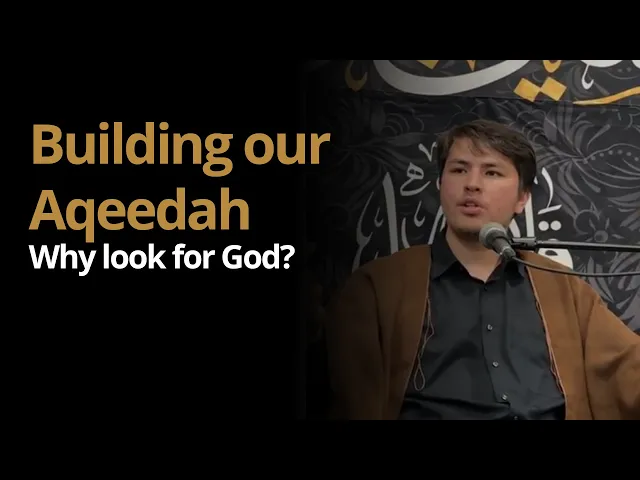
Building our Aqeedah 2 - The Benefits of Knowing God
0
0
5 المشاهدات·
25/10/11
في
آخر
In “Building our Aqeedah 2 – The Benefits of Knowing God,” we explore that belief in God deepens our pursuit of knowledge, gives strength and hope in hardship, instills moral responsibility, and brings inner peace by assuring that life’s trials have divine purpose. True tranquility comes when faith is pure and untainted by wrongdoing, forming the foundation for the next discussion on proving God’s existence.
أظهر المزيد
Transcript
[0:00]Show Muhammad Salahhammed.
[0:38]Alhamdulillah.
[0:57]Lord.
[1:10]Alhamdulillah.
[1:18]Alhamdulillah.
[1:33]I'm wow.
[1:58]Dear brothers and sisters, alaykum.
[2:03]Previously we discussed our in our beginnings of our discussions in understanding
[2:11]our our and we talked about the importance of our how we
[2:18]need to strengthen though that which we believe because now living today
[2:25]it's important that we have to build our because we clash with
[2:29]many other different beliefs.
[2:30]No matter where you go, as we said, there are people who
[2:33]don't necessarily align with what you think.
[2:36]They may not believe in God.
[2:40]They not may not be Muslim.
[2:41]They may be from other religions.
[2:42]And they might have a different worldview as we call it, a
[2:47]different type of way that they view the world.
[2:49]So we said that we have to come back to the first
[2:54]point and start building it step by step to make sure that
[2:57]we're able to properly defend our beliefs or re-evaluate it if we
[3:05]need to.
[3:03]So as a result we discussed why we need to search for
[3:08]God in our last class.
[3:12]In our last lesson, the lecture was why we need to find
[3:14]God.
[3:14]And we said that it is as a as a self as
[3:19]a form of thankfulness.
[3:19]If we are somewhere, we want to be thankful.
[3:24]We said that it's important that Insan always looks towards his own
[3:29]self-interest.
[3:30]If there are a certain person that's telling you to follow my
[3:33]path, it's important that we evaluate it because they're trying to tell
[3:36]you this is the path for eternal eternal bliss.
[3:39]So we have to evaluate it and make sure that it's correct
[3:45]because if not and we following an incorrect path, it could cause
[3:48]us problems in the future.
[3:49]So uh Insan as a result of his own self-interest needs to
[3:55]look towards what is the correct path and of course we are
[4:00]innately in search of finding someone who is a higher power and
[4:08]we'll go ahead and begin that discussion today.
[4:09]But it's important that we take another step right before that.
[4:16]Before we try to find and understand God and prove his existence,
[4:19]we have to realize what that belief entails.
[4:23]What does it mean if I know or believe in a God
[4:27]or if I have a religion?
[4:28]What benefits does it bring to me?
[4:29]Nowadays, we see many people, they'll tell you, "What benefit does religion
[4:34]have towards myself?
[4:37]I don't necessarily need it." Some may have this point of view.
[4:41]So today we're going to try to understand what this belief in
[4:44]God or understanding that there is a God that exists helps us
[4:49]in our own lives.
[4:50]So inshallah if you're here to help me out in understanding this
[4:53]concept reciteham >> and the first in in the benefits of understanding
[5:06]the signs of God and understanding God is that it helps us
[5:12]to progress in science.
[5:13]It helps us want to know God ourselves.
[5:15]Now God in his own essence, Allah in his own essence, it's
[5:20]impossible for us to understand his essence.
[5:23]But what does Allah say?
[5:27]He asks us to search from search him through his signs.
[5:30]When you for example are given a book, you're given a book
[5:35]by someone and they tell you that this is uh by a
[5:38]professor who is in a PhD and he's every single line that
[5:43]he's cho he wrote in this specific book.
[5:45]This has a lot of meanings to it.
[5:47]Let's say someone gives you this book and he tells you that
[5:49]this is by someone who spent 80 years discuss learning about this
[5:56]topic and he made this magnum opus to write this book.
[5:59]You say okay wow this person spent his whole life to write
[6:04]this book.
[6:03]Let me read it.
[6:06]And you carefully dissect every single sentence in that book.
[6:09]It's only logical because we heard about this book being so great
[6:16]we want to look into it.
[6:18]And let's say as opposed to that someone else says that a
[6:20]person wrote this book carelessly he did not care and he just
[6:27]simply decided to write a book.
[6:28]We say we're going to pass through the book or we're going
[6:31]to flip the pages and we're not necessarily going to pay attention
[6:34]to it.
[6:35]Right?
[6:34]we're going to say okay this person who wrote this book they
[6:39]didn't really care.
[6:39]So when we look at the existence of nature but when we
[6:45]look around us we see that there has to be a creator
[6:50]and this creator fine-tuned every single aspect to the perfect minute detail.
[6:55]When we look at our neurons we look at the atoms within
[6:58]the world.
[6:59]We want to learn more about it because it helps us know
[7:04]God.
[7:03]When we know that Allah built this and he's fine-tuned this, it
[7:08]brings us a sense of joy in understanding nature to want to
[7:13]excel in science because we know that God created such but we
[7:18]want to know how this works.
[7:20]We want to understand the mechanisms.
[7:22]So as a result when we want when we have something so
[7:26]beautiful we need to assess it.
[7:29]We need to look at the specific details.
[7:32]So knowing God helps us in our pursuit of science.
[7:36]Knowing God helps us to gain more knowledge about his creation.
[7:41]Secondly, there is an understanding that those who know God, they endure
[7:46]hardships.
[7:47]They have hope within their lives.
[7:50]Let's say there are two types of people.
[7:52]Someone who for example believes in a religion, believes in a god
[7:58]and a hereafter and someone who doesn't.
[8:01]We see that many times many people they go through their lives
[8:03]and they have many difficulties.
[8:05]No matter those difficulties they find themselves strong because they know that
[8:10]there is someone who is watching over me I know that even
[8:16]though I'm going through hardships that no matter what I have someone
[8:19]who has planned from beginning to end he's made my plan for
[8:22]me so I don't lose hope.
[8:27]No matter what there is, I know that because there is a
[8:29]God who is watching over and I make every single dua and
[8:33]I build my connection to him.
[8:34]I feel a sense of hope.
[8:35]And on the other side, we see someone who doesn't believe in
[8:40]it.
[8:41]It's very simple for him to say that feel hopeless that it's
[8:44]only me in this situation.
[8:45]I have no one.
[8:47]And in a sense, they feel lost.
[8:49]And we see that many people unfortunately they attempt to commit suicide.
[8:54]As a result, we see that there is a sense of hope
[8:59]that that's created.
[8:59]There's a sense of enduring hardships that's created.
[9:02]One of the most famous sayings that is brought up, what we
[9:07]can say against religion is that we know that Karl Marx who
[9:11]brought the Marxist school, he says that religion is the opium of
[9:14]the masses.
[9:16]Let's try to understand what that means in this context.
[9:18]There's many contexts we can understand it but in this specific context
[9:22]Karl Marx himself says that people use religion as a way to
[9:28]cope for their pain.
[9:29]That's his way of understanding that because they are systematically in uh
[9:36]they are maybe marginalized.
[9:40]They are uh to a point where they're in a lot of
[9:42]hardships.
[9:43]They use religion as a a way of an opium as a
[9:48]drug to take them away from their problems.
[9:51]Well, I would say to that or we would say that in
[9:56]the religion of Islam, we say that yes, Mr.
[9:59]Moses, this is what religion entails.
[10:02]When there are hardships, we use religion because we believe in a
[10:07]sense of connection to God.
[10:07]We say that because I believe in God, because I'm connected to
[10:13]God, that there's a sense of hope in my life.
[10:15]As opposed to one who doesn't believe in God and they have
[10:19]difficulties and trials, then they are in a state where they don't
[10:22]have anywhere to go.
[10:24]They don't have any way to deal with their hardships because they
[10:27]don't have a connection.
[10:27]Now, this doesn't mean that we should continue to be in pain
[10:33]or in hardships.
[10:32]Allah tells us to for for to fight in our hardships, make
[10:37]our duas, but to continue in our hardships, not to stay in
[10:40]there.
[10:41]But it's important that we understand that religious gives us a sense
[10:44]of refuge.
[10:45]No matter what, when I know that there is a God and
[10:50]I come to believe it through philosophy, I can justify his existence
[10:53]and understand his existence.
[10:54]I connect to him.
[10:56]I speak to him.
[10:56]And when I'm in a moment of pain, I talk to him
[11:00]and I can feel that relief.
[11:01]And if you have as well recite a salawat.
[11:11]>> The third point that we need to understand as to the
[11:15]benefits in knowing God and knowing him and understanding him is that
[11:19]it gives us a sense of responsibility.
[11:22]When you believe that there is a God that's watching over you,
[11:27]you know that there is also a level of expectations.
[11:29]There is a level of accountability on your end.
[11:34]Let's say there is no God.
[11:37]If someone doesn't believe in it, what is stopping him from doing
[11:41]anything?
[11:42]A doctor, for example, that sees that his patient doesn't have enough
[11:45]money to for his treatment, he will say, "What is it to
[11:49]me?
[11:50]If this person dies, it doesn't hurt me.
[11:54]We're all in a material world.
[11:56]So if this person dies, he didn't have the money for it.
[12:01]There is no benefit to me.
[12:02]I don't see any benefit myself.
[12:03]And many of those who who are materialist, they've come to try
[12:07]to defend this in different manners.
[12:10]But we can understand that when one believes in God, there's a
[12:15]sense of responsibility to him.
[12:15]Someone who is a doctor and he believes in God and he
[12:21]has that belief towards it.
[12:22]He himself feels a sense of responsibility.
[12:25]that if this patient cannot provide me the money, I know that
[12:31]there is someone who is accountable for me, who is making everything
[12:34]that I do accountable.
[12:38]So if I don't help this person, what will I respond to
[12:41]him on the day of judgment?
[12:42]So it builds a sense of morals for us.
[12:45]It builds a sense of accountabilities for us because at the core
[12:51]we understand that there is a responsibility for me as whatever I
[12:53]am a doctor a businessman a salesperson someone who is helping others
[12:58]or in humanitarian aid we feel a sense of connection because we
[13:06]know that there's an accountability here so it's important that you know
[13:10]even now today we understand those who don't even believe in God
[13:14]even they build those sense of good and evil from religious scripture.
[13:19]If we think about it, the society that we've built our laws
[13:23]around, the cores of the society go back to religion to tell
[13:27]them what is good or what is evil.
[13:29]So there's a sense that they find a responsibility, a sense of
[13:34]good and evil and to follow that good as a result of
[13:39]belief in a god.
[13:39]And we'll go on to our last point.
[13:41]We'll end off here.
[13:44]There is also a sense of peacefulness.
[13:46]When you know that God exists, you feel a sense of peacefulness.
[13:54]That there is in your mind and in your heart a sense
[13:57]that no matter what I have, I have anxieties, I have difficulties.
[14:03]that because there is a God who's watching over me even in
[14:08]any moment of difficulty.
[14:08]He's aware that he doesn't make my burdens way too difficult for
[14:13]me.
[14:17]Allah does not burden a soul more than it can bear.
[14:21]You cannot say that why God have you put me in such
[14:25]a difficult position because you know Allah knows that you have the
[14:28]ability to withstand it.
[14:33]You have that human nature that will fight against it.
[14:36]And because there's that belief in God, there is a sense of
[14:43]peacefulness within oneself.
[14:46]With the with the belief in God, does the heart find peace?
[14:51]And we had a verse that I began at the beginning.
[14:57]those who have faith and they do not taint their faith with
[15:03]their wrongdoings.
[15:06]He says, "For those people, they have faith and they have not
[15:12]tainted their faith in any way.
[15:12]They have not done any wrongdoing.
[15:14]They haven't hurt others." Right?
[15:16]Let's look at that.
[15:19]The Quran does not say just because he has faith.
[15:20]It says those who have faith, those who have Great.
[15:26]But Allah says, "But they haven't tainted that faith with wrongdoings." If
[15:32]they've done, what's the point of that that iman?
[15:36]Allah says those who have faith and those who don't wrong others
[15:41]as a result they have that strong faith then they find safety
[15:50]and they are and they are the ones who are rightly guided.
[15:54]So we can understand that we need to have that iman and
[16:01]we need to have that sense of responsibility for ourselves and only
[16:05]then do we find within ourselves a level of peace that no
[16:09]matter what happens and there's a very famous uh example that uh
[16:15]I heard before and I always love to repeat it.
[16:17]It's like you for your example you're only one person.
[16:21]You don't know which way you're going.
[16:23]You know, in some moments you feel like something's unbearable, but when
[16:27]you understand that there's a God who's watching over you and he
[16:31]knows that there are better times that are coming, that this is
[16:35]just like a weather of a storm that once it passes, you'll
[16:39]find better moments, then you feel a sense of calmness, a sense
[16:44]of peacefulness because you know that God will never make you in
[16:48]a situation that you couldn't bear.
[16:49]So these are ways that we find a benefit within religion.
[16:52]We find a benefit within belief in a god.
[16:56]And as a result, if we take this along with the necessity
[17:00]or the need for existence of a god, we can start to
[17:03]build towards what is towards proving his existence.
[17:08]And inshallah, stay with me in the following weeks as we expand
[17:12]on this topic and understand that in regards to God's existence, there
[17:18]are two ways that we can understand him.
[17:19]Both an inner way and an outer way.
[17:23]And through these two manners we can find the existence of God.
[17:26]And and only then do we feel a true sense of belief
[17:30]in him.
[17:29]So inshallah if you're going to be with me I would really
[17:34]appreciate it.
[17:32]And with that
0 تعليقات
sort ترتيب حسب
- أعلى تعليقات
- أحدث تعليقات
التالي
10 المشاهدات · 25/08/06
10 المشاهدات · 25/10/24
10 المشاهدات · 23/04/04
11 المشاهدات · 25/07/03
9 المشاهدات · 20/02/02
11 المشاهدات · 25/07/04
7 المشاهدات · 26/02/25